 Lesson 7: Foundations of Prophecy
7.3 Like Burning Coals of Fire
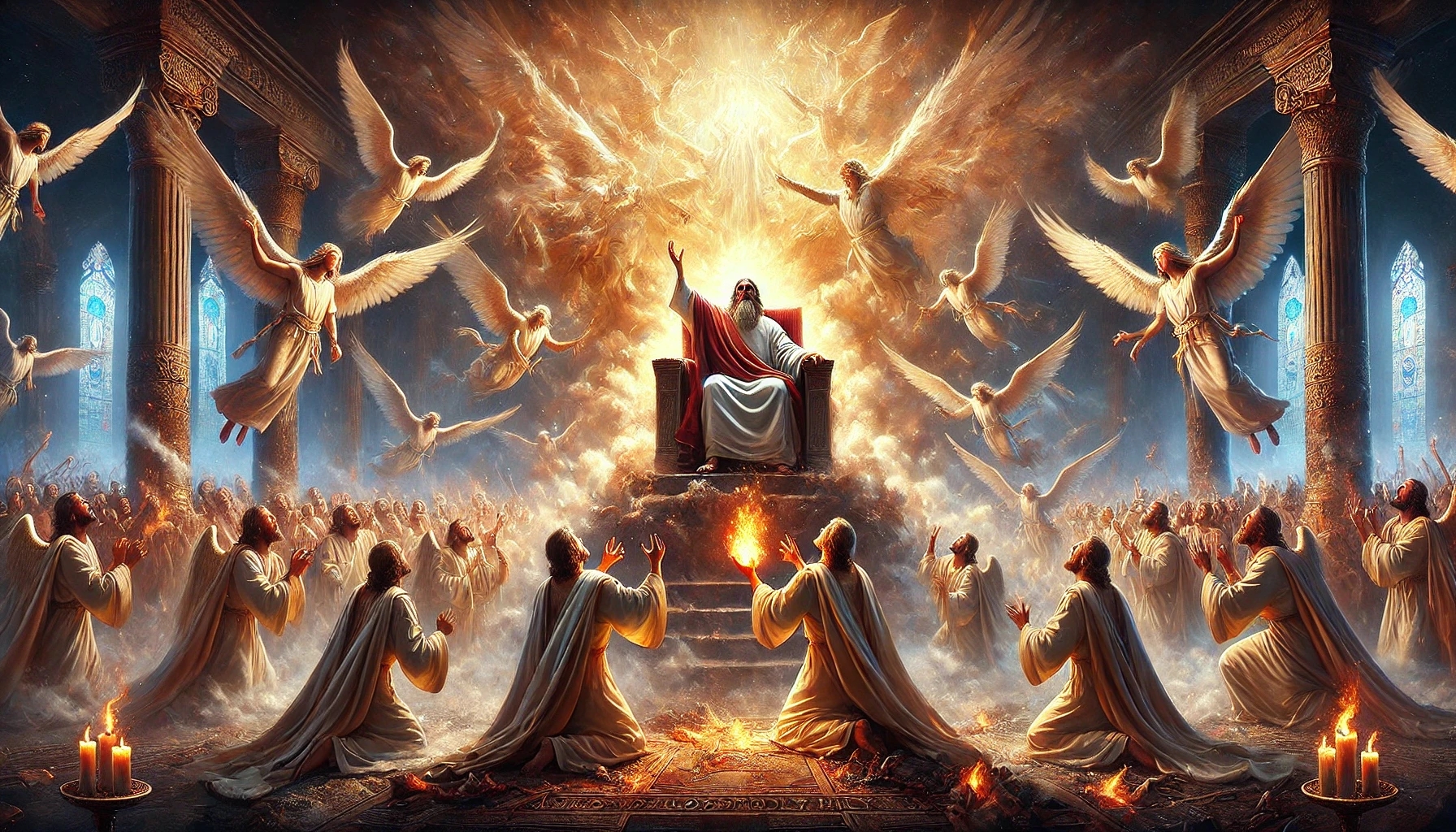
Fire, Wings, and Glory—A Vision of God’s Throne
…………………………………………………………………
 Introduction
Cherubim—those mysterious, awe-inspiring beings—always appear when God’s throne is revealed. Whether as golden figures on the Ark (Exodus 25:18), woven into the veil of the Holy of Holies (Exodus 26:1), or as living, terrifying creatures in Ezekiel’s vision (Ezekiel 1:4–14), their presence speaks of majesty, holiness, and divine nearness. Psalm 18:11 describes God as riding on the cherubim and “flying”—a poetic image of His absolute authority over time, space, and creation.
These beings are no mere decoration; they are intimately linked to God’s throne. They remind us of a crucial truth: when people encounter God, everything changes. That is precisely what happens in the throne visions of Ezekiel, Isaiah, and John.
………………………………………………………………….
 Bible Study: Three Visions—One Message
Ezekiel 1:4–14: Fire, Motion, and Four Faces
Ezekiel describes a stirring, almost unworldly scene: a storm from the north surrounded by fire and brilliant light, bearing four living creatures. Each had four faces—man, lion, ox, and eagle—and moved without turning, carried by the Spirit. Between them glowed something like burning coals, with lightning flashing. This image proclaims God’s power even in exile: though His people are in Babylon, He is not absent. His throne stands above all.
Isaiah 6:1–6: The King on His Throne
Isaiah sees the Lord seated on a lofty throne, high and exalted. Seraphim—angelic beings—surround Him, crying, “Holy, holy, holy is the Lord of hosts!” The temple shakes, and smoke fills the room. Isaiah immediately perceives his own impurity: “Woe is me, for I am lost!” A seraph touches his lips with a glowing coal from the altar—a sign of divine purification.
Revelation 4:1–11: The Throne in Heaven
John sees heaven opened and a throne encircled by a rainbow, flashes of lightning, and seven lamps (the Spirit). Around the throne are four living creatures covered with eyes—lion, ox, man, and eagle, echoing Ezekiel’s vision. They never cease to cry, “Holy, holy, holy, Lord God Almighty.” They worship day and night, while twenty-four elders cast down their crowns in reverent praise.
Questions & Answers
 1.What similarities unite Ezekiel 1, Isaiah 6, and Revelation 4?
-
-
God’s throne is central—high, majestic, surrounded by heavenly beings.
-
Living creatures with multiple faces appear in Ezekiel and Revelation.
-
In all three, worship and awe resound: “Holy, holy, holy” rings out.
-
Fire (burning coals) marks God’s presence and cleansing in both Ezekiel and Isaiah.
-
Each vision proclaims: God is exalted, incomparable, and full of glory.
-
2.How do you stand before God’s holiness? What does that reveal about your need for the gospel?
Like Isaiah, we see our own impurity. No one can stand before Holy God without cleansing. The burning coal symbolizes the gospel: God’s grace that takes away our guilt. We urgently need forgiveness, redemption, and renewal—only in Christ.
………………………………………………………………….
 Spiritual Principles
-
God’s holiness is absolute—beyond every human concept.
-
True encounters with God confront us with sin, not to destroy us but to cleanse us.
-
God reigns even in exile, distress, and storms—His throne remains unshaken.
-
Worship is the natural response to divine majesty—on earth as in heaven.
………………………………………………………………….
 Application for Daily Life
-
Deepen your quiet time: Each day, approach God’s throne. Meditate on Ezekiel 1, Isaiah 6, or Revelation 4.
-
Live in worship: Learn not only to ask God for help but to worship Him for who He is, not just for what He does.
-
Pursue holiness: Holiness isn’t religious perfectionism but growing into God’s character—love, truth, and purity.
-
Share the gospel: People need the “burning coals”—the life-changing message of Jesus Christ.
………………………………………………………………….
 Conclusion
Three visions, one God. Prophecy reveals a God who is not distant but enthroned above all, yet intimately near. The cherubim remind us that His glory is ever-present—in temple, exile, and eternity. And this sovereign God is willing to cleanse, touch, and send us—just as He did with Isaiah.
………………………………………………………………….
 Thought of the Day
“Holy, holy, holy is the Lord God Almighty.”
If the angels never cease to proclaim this, why shouldn’t we?
………………………………………………………………….
 Illustration – Like Burning Coals: An Encounter with God’s Holiness
Jonas Merten was a man many would call successful. At thirty, he was a project manager in a Frankfurt software firm—sharp-dressed, technically skilled, goal-driven. Yet success whispered hollowly when the heart is silent. Beneath the surface, Jonas felt drained, as if his life’s substance was slipping away. Once driven by passion, vision, and curiosity, he was now trapped in a monotonous cycle of to-do lists, spreadsheets, and empty meetings.
He hadn’t exactly renounced God, but faith had become an old piece of furniture in storage: once precious, now forgotten under layers of rationalism, performance anxiety, and modern cynicism. As a child, he’d heard Bible stories and admired his grandmother’s gentle, prayerful faith—but that felt like someone else’s story, not his own.
One stormy evening, as lightning danced across the sky and rain hammered his apartment windows, Jonas impulsively reached for his grandmother’s Bible. Dust coated the black leather cover. In its pages lay a bookmark at Ezekiel 1. Opening it, he read hesitantly, like a stranger stepping into a forgotten home.
What he read was not a gentle tale. It was a tempest of fire, wheels ablaze with eyes, living creatures with four faces—man, lion, ox, and eagle. He didn’t grasp every detail, but the power of the vision shattered his inner defenses. This description wasn’t religious drudgery—it was breathtaking, overwhelming, fearsome, yet strangely beautiful. It felt both alien and profoundly familiar, as if his soul had been waiting for this moment.
He couldn’t sleep that night. The vision replayed in his mind: the fire, the cherubim’s wings, the wheels aflame. Not just any story—but a revelation that God sits enthroned above exile, chaos, and the world as he knew it.
The next day, he dug deeper, finding Isaiah 6—“Holy, holy, holy is the Lord of hosts.” He read of the trembling temple, the rising smoke, the seraphim’s six wings, and Isaiah’s cry, “Woe to me! I am lost!” That confession resonated in his bones.
Then came the image of the seraph touching Isaiah’s lips with a coal from the altar—God’s sign of purification. Jonas felt it was spoken to him: his life needed cleansing. The coal seared into his heart, answering an unasked question.
That weekend, he stepped into a church for the first time in years. Not from habit, but from a raw longing. The small sanctuary was empty; candles flickered. He sat silently, offering no words, no prayers—only stillness. In that sacred quiet, he felt, like Isaiah, utterly exposed. Not for a single sin, but for a lifetime lived without God’s throne in view.
Tears rolled down his cheeks, not dramatic, but steady, like water released from a dam. He realized: God is holy—and he was not. No career success or good intentions could change that. Yet, as at Isaiah’s cleansing, there was this burning coal—no angel, no tongs—but a cross. And a name: Jesus.
He understood then: he hadn’t come to reclaim religion but to receive grace. He was not the hero—God was. And that God, so holy and awe-inspiring as the creatures in Ezekiel’s vision, had drawn near in Christ.
His life didn’t transform overnight. He remained a project manager, wore the same suit, rode the same train. But deep within, everything shifted. He began to see the world differently—as a mirror of divine glory and a stage where God’s throne reigns unseen.
And sometimes—in moments of worship, in song, in Scripture, in the slant of sunlight through a window—he’d catch a glimpse of burning coals, a light not of this world. Then he’d remember: the angels never stopped declaring, “Holy, holy, holy,” and he, too, was invited to join in.