Daily Lesson for Monday 6th of October 2025
Read Joshua 2:2-11, Hebrews 11:31, and James 2:25. What do these texts tell us about Rahab?
Central to Rahab’s story is the lie told to protect the spies. In considering her lie, we have to realize that she was embedded in a society that was extremely sinful, which finally led to God’s decision to judge that society (Genesis 15:16, Deuteronomy 9:5, Leviticus 18:25-28). While it is true that the New Testament commends her faith, a careful analysis of the New Testament references to Rahab’s act reveals that none endorse everything about her, and none validate her lie.
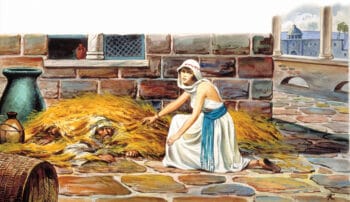
Image © Review & Herald Publishing at Goodsalt.com
Hebrews 11:31 confirms her faith in casting her lot with the spies instead of choosing to hold on to a corrupt culture. James 2:25 commends her offer of lodging to the two Israelite spies and for giving them directions on how to return by a safe route. In the middle of a decadent, corrupt culture and Rahab’s own sinful lifestyle, God, in His grace, saw a spark of faith through which He could save her. God used what was good in Rahab—which was manifest faith in Him and in her choice to belong to His people—but never commended everything she did. God valued Rahab for her exceptional courage, for her brave faith, for being an agent of salvation, and for choosing Israel’s God.
After seeing what was happening, she declared, “ ‘For the Lord your God, He is God in heaven above and on earth beneath’ ” (Joshua 2:11, NKJV). It’s significant to hear a Canaanite woman acknowledging that Yahweh is the only God, especially on a roof where, in her pagan religion, prayers were usually offered to what they believed were celestial deities.
The expression of Rahab is previously found only in the context of God’s exclusive right to receive worship (Exodus 20:4, Deuteronomy 4:39, Deuteronomy 5:8). Her words bear witness to a premeditated, conscientious choice to acknowledge that the God of the Israelites is the only true deity. Her confession demonstrates her understanding of the close relationship between God’s sovereignty and the judgment under which Jericho is doomed.
Her moral choice recognizes that, in light of Yahweh’s judgment, there were only two possibilities: to continue in rebellion against Him and be annihilated, or to choose to surrender in faith. By choosing the God of the Israelites, Rahab became an example of what could have been the destiny of all the inhabitants of Jericho had they turned to Israel’s God for mercy.
|
What does this story teach us about how God must have our ultimate allegiance? |
 (1)
(1)Source: https://ssnet.org/blog/25d-02-value-in-unexpected-places/