Daily Lesson for Sunday 26th of July 2026
Read 1 Corinthians 8:1-13. Why does Paul contrast knowledge with love, and what is the context here? What point is he making?
Paul uses the theme of food offered to idols in order to address a deeper issue: the lack of love for others (1 Corinthians 8:1-13). The matter of food offered to idols split the church of Corinth into two groups. Some believed that their knowledge about the nonexistence of other gods gave them the right to eat anything (1 Corinthians 8:4). These are referred to as the “strong” (1 Corinthians 4:10). Those who opposed this behavior are called the “weak” (1 Corinthians 8:9-12). Paul uses such a label because they did not overcome some superstitious beliefs that marked their previous pagan experience. When seeing the “strong” eating food offered to idols, they might conclude that Christianity and idolatry were compatible. So, Paul did not want the “strong” to become a stumbling block to the weak.
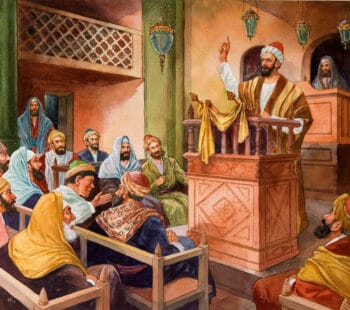
Image © Review & Herald Publishing at Goodsalt.com
The Bible sees the act of eating food offered to idols very negatively (Acts 15:20,29; Acts 21:25; compare with Revelation 2:14,20). However, Paul does not utter as radical statements as one sees in these passages. This is because his primary concern regards the lack of unity that the misuse of knowledge could cause. Paul is not criticizing knowledge as evil in itself; instead, he’s against the kind of knowledge that leads to arrogance and division in the church. Knowledge without love is not true knowledge at all (1 Corinthians 8:2). True knowledge arises only when one loves God and is known by Him (1 Corinthians 8:3).
Quoting Deuteronomy 6:4, Paul shows that believers must know that there is only one God (1 Corinthians 8:4-6). Interestingly, he follows the same idea one sees in Deuteronomy 6:4-5, where the statement that our God is one is followed by the command “You shall love the Lord your God” (NKJV). For both Paul and Moses, knowledge without love is worthless.
Confident in their knowledge, the “strong” believed that eating food sacrificed to idols was harmless. As we will see on Wednesday and Thursday, Paul conceded to them that right under certain conditions. However, if that became a stumbling block for the “weak” (1 Corinthians 8:9), it should be avoided. Christians are supposed to practice self-denial out of love for Christ and others.
|
Paul argues that, without love, knowledge may become a bad thing (1 Corinthians 8:1-13). In what situations can knowledge without love indeed be bad? |