Daily Lesson for Sunday 22nd of February 2026
Read Colossians 1:21-22. What is Paul alluding to with his reference to alienation and being enemies? And what is the expected end result of Christ’s death (see also Ephesians 5:27)?
Paul has always painted a dark picture of humanity, at least humanity apart from the righteousness of Christ. And who today, almost two thousand years later, could argue with that sentiment? Someone once said that the one Christian doctrine that doesn’t need to be taken on faith is the sinfulness of humanity.
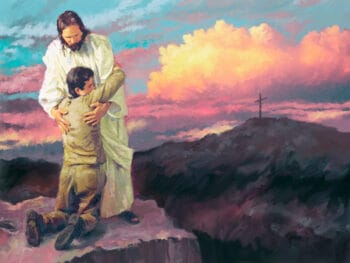
Image © Lars Justinen at Goodsalt.com
However, since the entrance of sin, God has taken the initiative to reconcile us, as bad as we are, to Himself. That is, from the start, God has worked to solve the problem of sin, even if the solution could be found only in His own death on the cross.
In Eden, He called out to Adam, His masterpiece of creation, “Where are you?” (Genesis 3:9, NKJV). And today, He continues to seek His one lost sheep—us. He seeks us out one by one. He has a perfect plan to reach us, applying the embryonic gospel promise of Genesis 3:15, putting enmity between us and Satan.
Sometimes the gospel is made so complicated and theoretical that it has little practical meaning for twenty-first-century living. But it’s really quite simple and straightforward.
The gospel has three parts:
First, because we are helpless to save ourselves, Jesus came and died for our sins. (See Romans 5:6-8.)
Second, by accepting His death as ours through faith, repentance, and baptism, we are justified and set free from the condemnation of sin. (See Romans 5:9-11; Romans 6:6-7.)
Third, the life we live now is the result of being united with Christ, experiencing His re-creating power, and His living His life in us. (See 2 Corinthians 5:17-21, Galatians 2:20.)
These are not necessarily separate steps or events. They can happen all at once, as soon as we are ready to accept Jesus into our lives. And they can be renewed every day as we give ourselves to Him each morning. Regardless of how each one of us has experienced the saving work of Christ in our lives, the foundation rests always upon the death of Jesus. To that we must always return.
|
When you look at yourself, your character, and your innermost being, what does the sight tell you about your need of the Cross? |