Daily Lesson for Thursday 20th of August 2026
Read 1 Corinthians 15:54-57. What does this passage tell us about our ultimate victory over death?
Paul begins the last paragraph in 1 Corinthians 15:1-58 with an intriguing statement: “Flesh and blood cannot inherit the kingdom of God” (1 Corinthians 15:50, NKJV). Many Bible readers use this declaration to say that Paul defends an immaterial existence in heaven. But the context indicates otherwise. The parallelism of 1 Corinthians 15:50 suggests that “flesh and blood” is in parallel with “corruption,” such as “the kingdom of God” is in parallel with “incorruption.” Just as happened in 1 Corinthians 15:42-49, here, as well, Paul is contrasting the body now (or even the corpse) to the resurrected body. The buried body is marked by corruption and mortality, whereas the resurrected body is characterized by incorruption and immortality (1 Corinthians 15:50,53-54). Simply put, Paul is saying that our bodies need to undergo a radical transformation in order to inherit heaven.
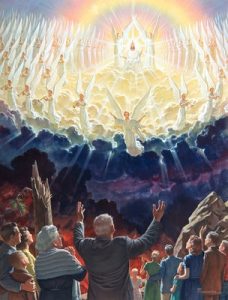
Image © Review and Herald Publishing Assn. Goodsalt.com
In short, Paul uses the ideas of corruption and mortality to refer to our sinful nature. In Jewish writings, “flesh and blood” is a phrase for fallen humanity, which is why our bodies must be transformed and purged of all imperfection at His return.
Only when our sinful nature is removed (1 Corinthians 15:54) and we go through the experience of glorification (1 Corinthians 15:51-53, 1 Thessalonians 4:13-17) will the proclamation “ ‘Death is swallowed up in victory’ ” (1 Corinthians 15:54, NKJV) be fulfilled. Then, this bold and defiant hymn will be sung: “ ‘O Death, where is your sting? O Hades, where is your victory?’ ” (1 Corinthians 15:55, NKJV). This all will take place at the second coming of Christ (1 Corinthians 15:51-52).
Think about it: we close our eyes in death, and the next thing we will experience is the second coming of Jesus, when He raises us from the dead. No matter when a believer died, even thousands of years ago, “in a moment, in the twinkling of an eye,” they will be made alive “at the last trumpet. For the trumpet will sound, and the dead will be raised incorruptible, and we shall be changed” (1 Corinthians 15:52, NKJV).
|
Who hasn’t bemoaned how quickly life passes us by? In our own experience, that’s how quickly the second coming of Jesus will seem. Perhaps our first thought at His return will be “Wow, Lord, Your coming really was soon!” How does this idea help us better come to terms with what is seen as “the delay”? |