[vimeo 867735096 w=640 h=360]
The beauty of the church is that it is incredibly diverse. However, it is not without its challenges. We come from different backgrounds and cultures and do not…Source: https://vimeo.com/867735096
Closer To Heaven
|
|
|
[vimeo 867735096 w=640 h=360]
The beauty of the church is that it is incredibly diverse. However, it is not without its challenges. We come from different backgrounds and cultures and do not…Source: https://vimeo.com/867735096
AWR360° Japan – Three Amazing Women of Prayer—and Action! Ep.6 #awr #evangelism #bible #short Source: https://www.youtube.com/watch?v=w9H3NCLgnCs
Study: Lesson 13: Waging Peace — Pramod Hansdak THANK YOU. Media Ministry needs your continued financial support. To donate visit, "https://adventistgiving.org/#/org/ANB4RC/envelope/start" and select “Media Ministries”. Connect With Us
X: RemnantSDA
Facebook: RemnantSDAchurch.org
Instagram: RemnantSDAchurch Source: https://www.youtube.com/watch?v=S4NaCvcKY1A
But ye have a custom, that I should release unto you one at the passover: will ye therefore that I release unto you the King of the Jews? John 18:39.
The great controversy between the Prince of light and the prince of darkness has not abated one jot or tittle of its influence as time has gone on….
In our behalf Christ met the specious temptations of Satan and left to us an example as to how to overcome Satan in the conflict. He exhorts His followers, saying, “Be of good cheer; I have overcome the world.” Satan has made masterly efforts to perpetuate sin. He arrayed all his evil agencies to war against Jesus Christ in an active, desperate conflict, in order that he might bruise the heart of infinite Love. He seduced the people to bow to idols, and thus gained supremacy over earthly kingdoms. He considered that to be the god of this world was the next best thing to gaining possession of the throne of God in heaven. In a large measure he has been successful in his plans. When Jesus was on earth Satan led the people to reject the Son of God and to choose Barabbas, who in character represented Satan, the god of this world.
The Lord Jesus Christ came to dispute the usurpation of Satan in the kingdoms of the world. The conflict is not yet ended, and as we draw near the close of time, the battle waxes more intense. As the second appearing of our Lord Jesus Christ draws near, satanic agencies are moved from beneath. Not only will Satan appear as a human being, but he will personate Jesus Christ, and the world who has rejected the truth will receive him as the Lord of lords and the King of kings. He will exercise his power and work upon human imagination. He will corrupt both the minds and the bodies of people, and will work through the children of disobedience, fascinating and charming, as does a serpent. What a spectacle will the world be for heavenly intelligences! What a spectacle for God, the Creator of the world, to behold!
The form Satan assumed in Eden when leading our first parents to transgress was of a character to bewilder and confuse the mind. He will work in [just] as subtle a manner as we near the end of earth’s history. All his deceiving power will be brought to bear upon human subjects, to complete the work of deluding the human family. So deceptive will be his working that people will do as they did in the days of Christ, and when asked, “Whom shall I release unto you, Christ or Barabbas?” the almost universal cry will be “Barabbas, Barabbas!” And when the question is asked, “What will ye then that I shall do unto him whom ye call the King of the Jews?” the cry again will be “Crucify Him!”—Manuscript 39, 1894 (The Review and Herald, April 14, 1896).
Christ Triumphant p. 274
~~~~~~~~~~~~~~~~~~~~~~~~~~~~~~~~
Prayer Requests
—-Please pray for Kim and family. Her mother just died and now her son is accused of a crime we suspect he did not commit. Pray that the truth will come out and also that Kim and her family will find comfort in this trying time. Ron
—-Please pray for Richard who suffered many serious injuries when a car fell on him. Sandra
—-My friend can’t find his passport and he really needs it. Could you pray that it will turn up also pray that he will give his life to the Lord. Rosemary
~~~~~~~~~~~~~~~~~~~~~~~~~~~~~~~~~~~
Dear Friends,
In the 1940’s, in Kalamazoo, Michigan, three boys were sitting on the porch with nothing to do. It was one of those lazy days of summer, when the temperature put a person in one of those “moods.” As they were sitting there bored and drowsy, Bob suggested that they shake off their feeling by doing something different.
Soon, the ten-year-old boy were walking along looking for something new and exciting to do. First one would suggest something and then the other, but they had done those things a hundred times before.
Before long, they found themselves by the gravel pit that was in their neighborhood. Now they had been warned many times to stay away from those mounds of gravel, but none of them wanted to be called a “sissy.” They climbed first one “hill” of gravel and then another. As they played and pushed and shoved each other, they felt like all the warnings their parents had given them were not needed. It seemed safe and was lots of fun.
Suddenly, the gravel shifted under their feet. Before they could escape, they were sucked down into and buried by the loose stones. Their cries for help as they were being covered were heard by one of the workmen who had not noticed the boys until then. Shouting at the other worker to get help, one worker ran over to where he had seen the boys disappear.
Frantically he started digging. He had to be careful not to become buried himself, but he could not think of that. He had to reach those boys before they smothered. As word got passed from one person to another, men closed their businesses and every available man rushed to the scene. (One of those men was my father who owned a gas station near there.) Soon many men arrived on the scene. But all those men digging their hardest could not save those boys. It was too late.
It is a sad story, but this story is repeated daily in the lives of many people we meet. They are not literally buried in a gravel pit, but they are being smothered by a life of sin. Some cry out for help. Some do not realize their danger and think theirs is a normal life. No matter what their feelings in the matter, they are all in the same condition with their feet anchored nowhere, sliding down to a Christless grave, being crushed by the weight of their sins.
Our Dear Saviour came to this world “to seek and to save that which was lost.” Luke 19:10 He asks us to do as He has done. Just before His ascension forty days after His resurrection, Jesus gave His followers His final instructions. Those instructions are for us as well. “But ye shall receive power, after that the Holy Ghost is come upon you: and ye shall be witnesses unto me both in Jerusalem, and in all Judaea, and in Samaria, and unto the uttermost part of the earth.” Acts 1:8 He asks us to start witnessing to those closest to us before going to others far away.
We have the promise “that he which converteth the sinner from the error of his way shall save a soul from death, and shall hide a multitude of sins” if we will share the Gospel with those being smothered by a life of sin. James 5:19,20 Paul admonishes us, “Brethren, if a man be overtaken in a fault, ye which are spiritual, restore such an one in the spirit of meekness; considering thyself, lest thou also be tempted.” Gal 6:1 We are to “save [them] with fear, pulling them out of the fire; hating even the garment spotted by the flesh.” Jude 23
May we ask our loving Saviour to open our eyes to notice the perishing ones around us, that we bring them to the foot of the Cross where they will find “grace to help in time of need.” Heb 4:16
Rose
Source: https://rosesdevotional.org/will-you-choose-jesus.html
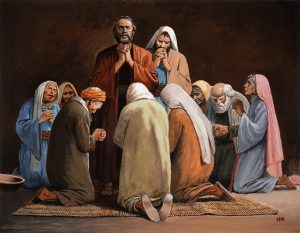
Image © Lifeway Collection at Goodsalt.com
Visitors to London climb on board the London Eye, a Ferris-Wheel-like attraction. From 450 feet above the River Thames you can see it all: Big Ben, the Houses of Parliament, and the many historic palaces and cathedrals. For New Testament scholar Nicholas Thomas “Tom” Wright, “the letter to the Ephesians stands in relation to the rest of Paul’s letters rather like the London Eye. It isn’t the longest or fullest of his writings, but it offers a breathtaking view of the entire landscape. From here, as the wheel turns, you get a bird’s-eye view of one theme after another.”—Paul for Everyone: The Prison Letters (London: S.P.C.K. [Society for Promoting Christian Knowledge Publishing], 2004), p. 3.
In Ephesians, Paul is not focused on issues of local concern. The letter reads as though Paul were addressing believers everywhere and Christian churches wherever they exist. The letter’s timeless feel allows the “breathtaking view” Paul offers to invade our own world and thought. As we review each chapter, let’s keep this question in mind: What important truths embedded in Ephesians should continue to shape our lives as believers?
Someone has described Ephesians as the Alps of the New Testament. Paul, our mountaineering guide, takes us on a rapid ascent in Ephesians 1:1-23. We are quickly breathless and amazed at the view from the summit.
Ephesians 1:3-14 functions like a map at a mountain’s summit that identifies the peaks on the horizon, as Paul orients us to our blessed place in the vast landscape of the plan of salvation. The scenery covers the full span of salvation history, from eternity past, through God’s grace-filled actions in Christ, to eternity future. God’s redemption of believers reflects divine initiatives taken “before the foundation of the world” (Ephesians 1:4), which are now being worked out in our lives (see Ephesians 1:7-8, Ephesians 1:13, Ephesians 1:14). These pre-creation strategies will be fully accomplished at the end of time (Ephesians 1:9-10). Then, “all things,” both “in heaven” and “on earth” will be gathered together or united in Christ, and God’s plan for “the fullness of time” (ESV) will be fulfilled (Ephesians 1:10). Then, we will experience fully God’s mysterious plan (Ephesians 1:9). In the present, we may be certain that the Christ-centered salvation in which we stand is an important part of God’s wide-reaching plan for the redemption of “all things.”
Being on a mountaintop inspires thanksgiving. In Ephesians 1:15-19, Paul gives thanks to God as he prays that believers may experience the salvation God has planned for them. We find ourselves on another steep climb as he points us upward to the risen, ascended, exalted Christ, who rules over every imaginable power for all time (Ephesians 1:20-23).
Through the grace of God expressed in Christ Jesus, we may live this day on the mountaintop!
“But God. . . .” Those two words must be the most hope-filled ones known to humankind. In Ephesians 2:1-10, Paul describes the grim past of his audience. Sharing the plight of all humanity, they were bent toward rebellion against God, their lives dominated by sin and Satan (Ephesians 2:1-3). “But God, who is rich in mercy. . . . ” And what did God do for them and for us? 1. He made us alive with Christ—Christ’s resurrection is our own. 2. He raised us up with Christ—Christ’s ascension is our own. 3. In heaven, he seated us with Christ—Christ’s coronation is our own (Ephesians 2:4-7). We are not just bystanders to the cosmos-shifting events of Christ’s life! God takes these remarkable actions, not because of any merit in us, but because of His grace (Ephesians 2:8-9), and He intends believers to live in solidarity with Jesus and practice “good works” (Ephesians 2:10).
If Ephesians 2:1-10 teaches that we live in solidarity with Jesus, Ephesians 2:11-22 teaches that we live in solidarity with others as part of His church. Jesus’ death has both vertical benefits, establishing the believer’s relationship with God (Ephesians 2:1-10), and horizontal ones, cementing our relationships with others (Ephesians 2:11-22). Through His cross, Jesus demolishes all that divides Gentile believers from Jewish ones, including the misuse of the Law to widen the gulf (Ephesians 2:11-18). Jesus also builds something—an amazing, new temple composed of believers. Gentiles, once excluded from worship in sacred places of the temple, now join Jewish believers in becoming one. We too become part of God’s church, a “holy temple in the Lord” (Ephesians 2:19-22).
Through the grace of God, you have the privilege of living this day in solidarity with Jesus and your fellow believers.
Ephesians 2:8-10 has played a role in the conversion of many. Martin Luther found in these verses a grace that won his heart, and he discovered as well some central affirmations of the Reformation: salvation comes by faith alone, through grace alone, by Christ alone, and to the glory of God alone. In 1738, eighteen days after experiencing conversion in London’s Aldersgate Street, John Wesley preached at Oxford University, offering “a cry from the heart” and “the manifesto of a new movement.” His text? Ephesians 2:8. (See A. Skevington Wood, “Strangely Warmed: The Wesleys and the Evangelical Awakening,” Christian History [magazine], vol. 5, no. 1 [1984]).
We are encouraged when we hear church members say positive things about the church. However, the most enthusiastic among us falls short of Paul’s exuberant testimony in Ephesians 3:1-21 about the church. Paul starts a report of his prayers for believers in Ephesus (Ephesians 3:1; compare Ephesians 1:15-23, NKJV) but breaks off to discuss God’s creation of the church (Ephesians 3:2-13), and then completes his prayer report (Ephesians 3:14-21). Along the way we come to understand important things about God’s “plan” or “mystery”:
This understanding of the church motivates Paul to pray for believers. Why not imagine him praying the heartfelt prayer of Ephesians 3:14-21 about you? Why not imagine him praying that you will be “filled with all the fullness of God” (Ephesians 3:19) and participate fully in the amazing, unfolding mystery of a unified church?
Ephesians 4:1-32 begins and ends with calls to care for each other as church members (Ephesians 4:1-3, Ephesians 4:32). Between these invitations, Paul offers strong support for the idea that we should nourish unity in the church. He begins by listing seven “ones”: There is one body, one Spirit, one hope, one Lord (Jesus Christ), one faith, one baptism, one God and Father (Ephesians 4:4-6). We are bound together by these spiritual realities. We are, in fact, united.
While unity is a theological certainty, it requires our hard work. So we should always be “endeavoring to keep the unity of the Spirit” (Ephesians 4:3, NKJV). One way each of us may do so is by being an active “part” of the body of Christ (Ephesians 4:7-16). Every member is a gifted part of the body and should contribute to the health of it (Ephesians 4:7, Ephesians 4:16). And all should benefit by the work of apostles, prophets, evangelists, pastors, and teachers (Ephesians 4:11-12). These, like ligaments and tendons, have a unifying function, helping us grow up together into Christ who is the Head of the body (Ephesians 4:13, Ephesians 4:15).
At the time, Paul also told them “that we should no longer be children, tossed to and fro and carried about with every wind of doctrine, by the trickery of men, in the cunning craftiness of deceitful plotting” (Ephesians 4:14, NKJV), words that clearly suggest that the early church faced some internal struggles from “the trickery of men.”
As Paul moves toward his final appeal, to “be kind to one another, tenderhearted, forgiving one another” (Ephesians 4:32, NKJV), he asks believers to avoid their former hard-heartedness (Ephesians 4:17-24) and to avoid anger and harsh speech, substituting instead language that builds up and imparts grace (Ephesians 4:25-31).
This chapter on unity is easy enough to read when things are peaceful. It is more challenging—and important—to read it when we become embroiled in some conflict. Are you remembering today to experience the unity of the body of Christ, the unity for which He died?
What are ways that we can contribute to the unity of our church, both at the local and worldwide level? Why is it important that we do what we can?
If you start reading Ephesians 5:1-33 at its beginning, you may miss the full power of an important theme. So start instead with Ephesians 4:32, in which Paul tells the Ephesians to “be kind one to another, tenderhearted, forgiving one another, even as God in Christ forgave you” (NKJV).
As believers, we are called to model our behavior toward others on God’s forgiveness and grace toward us. We are to imitate God! (Compare Matthew 5:43-48.)
Paul contrasts this imitating-the-love-of-God lifestyle with the usual, pagan approach. Instead of treasuring others as brothers or sisters in the family of God, humans all too often use others for their own sexual pleasure and then brag about it (Ephesians 5:3-4). He warns that such an approach has no future in the new world God is planning (Ephesians 5:5-7).
Instead, believers are to turn from the darkness of their past and “walk as children of light” (Ephesians 5:8-10), mimicking the Father’s love. Again, Paul warns us away from “works of darkness” done “in secret” (Ephesians 5:11-12). By contrast, we are to live in the light of Christ (Ephesians 5:13-14). Rather than wasting our lives in drunkenness, we will be “redeeming the time” by offering thanks to God for His love (see Ephesians 5:15-21).
Paul extends his theme of imitating God’s love as he advises Christian husbands and wives. Christ’s self-sacrificing love for the church becomes the model for Christian husbands (Ephesians 5:25-33), while the loyalty of the church toward Christ becomes the model for Christian wives (Ephesians 5:22-24). Rather than using the gift of human sexuality in a debauched and selfish way, a Christian husband and wife focus on valuing and treasuring each other, becoming “one flesh” (Ephesians 5:28-33).
“Be imitators of God as dear children” (Ephesians 5:1, NKJV). By God’s grace, you are called today to live out that exhortation in your relationships with others.
We conclude by reflecting on Ephesians 6:1-24 , where we discover that we, the church, are the peace-waging army of God.
In Ephesians, Paul has portrayed the church as the body of Christ (Ephesians 1:22-23; Ephesians 4:11-16), as God’s temple (Ephesians 2:19-22), and as the bride/wife of Christ (Ephesians 5:21-33). In Ephesians 6:10-20, Paul describes the church as God’s army and offers a vigorous call to arms. It is a passage that offers much benefit and risks misunderstanding.
We could misunderstand Paul’s words as a call to take up military weapons or to be combative in our relationships with others. Paul, though, has been emphasizing unity, edifying speech, and tenderheartedness (see especially Ephesians 4:25-5:2). He describes God’s good news as “the gospel of peace” (Ephesians 6:15). Through this vivid military metaphor, the church is not exhorted to wage war in the traditional sense. Rather, we are to wage peace in the spiritual battle against evil. Paul steps onto the battlefield of the great controversy and calls us to enlist in God’s army.
We should do so with a realistic assessment of the enemy in view since it will never do to underestimate the forces arrayed against us. We don’t confront just human enemies but “spiritual hosts of wickedness in the heavenly places” (Ephesians 6:12, NKJV), led by a wily general, the devil (Ephesians 6:11). However, we need not be daunted by our enemies. God is present with us in the battle (Ephesians 6:10) and has supplied us with the finest of weaponry, His own armor, the “armor of God” (Ephesians 6:11; compare Isaiah 59:15-17). He has placed at our disposal truth, righteousness, peace, faith, salvation, and the Spirit (Ephesians 6:13-17). With God going before us and our being equipped from head to toe in the armor He has supplied, we cannot fail. Victory is assured.
1. Though we are not saved by our works, what does Paul mean when he writes that we were “created in Christ Jesus for good works, which God prepared beforehand that we should walk in them” (Ephesians 2:10, NKJV)? What, then, is the purpose of our good works?
2. Paul writes: “Now to Him who is able to do exceedingly abundantly above all that we ask or think, according to the power that works in us” (Ephesians 3:20, NKJV). What power works in us, and how should this power be made manifest in our lives?
 (0)
(0)The post Lesson Helps 14: Ephesians in the Heart appeared first on Sabbath School Net.
Source: https://ssnet.org/blog/lesson-helps-ephesians-in-heart/
 Intercer is a website with biblical materials in Romanian, English, Hungarian and other languages. We want to bring the light from God's Word to peoples homes. Intercer provides quality Christian resources...[Read More]
