Daily Lesson for Wednesday 9th of September 2026
|
Read 2 Corinthians 8:1-5. What possible reason could have been behind the Macedonians’ willingness to give their offerings with such generosity? |
The positive attitude of the Macedonians can be seen in several ways.
First, they gave with abundant joy (2 Corinthians 8:2). Paul says that the Macedonians’ “abundance of joy and their extreme poverty have overflowed in a wealth of generosity” (2 Corinthians 8:2, ESV). He later mentions that “God loves a cheerful giver” (2 Corinthians 9:7, NKJV). The Greek word rendered as “cheerful” occurs only here in the New Testament. A term from the same family occurs elsewhere: “The one who does acts of mercy [must do it] with cheerfulness” (Romans 12:8, ESV). Terms from this word family sometimes appear in extra-biblical literature, with a sense of gladness and happiness. In 2 Corinthians 9:7, being a cheerful giver means giving without reluctance.
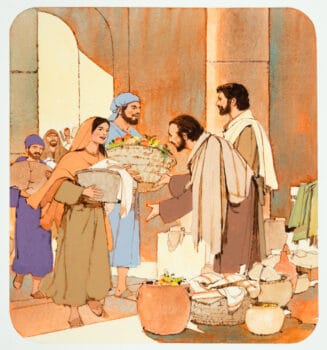
Image © Lifeway Collection at Goodsalt.com
Second, they gave with generosity (2 Corinthians 8:2). Before Paul mentioned the Macedonians’ generosity, he first referred to their “extreme poverty” (ESV). The word “generosity” (in Greek, haplotētos) appears twice more in 2 Corinthians 8:1-24 and 9. Paul says, “You will be enriched in every way so that you can be generous on every occasion” (2 Corinthians 9:11, NIV; emphasis supplied), meaning that we are given so that we can then give. A little further, he mentions “the generosity of your contribution” (2 Corinthians 9:13, ESV; emphasis supplied). In this passage, being generous in contributing is a way of confessing Christ’s gospel.
Third, they gave “of their own free will” (2 Corinthians 8:3, NLT). This means that they gave voluntarily. This becomes even more admirable when one sees they did not give out of their surplus, for their resources were extremely limited. Paul uses the same idea to characterize Titus’s willingness to visit the Corinthians. He went to Corinth voluntarily (2 Corinthians 8:17).
Fourth, they gave with a sense that giving is a privilege (2 Corinthians 8:4). This attitude is perceptible in the Macedonians’ request to participate in the collection. “They urgently pleaded with us for the privilege of sharing in this service” (2 Corinthians 8:4, NIV).
Finally, they participated in the collection as an act of total consecration (2 Corinthians 8:5). Paul says, “They gave themselves first to the Lord and then by the will of God to us” (2 Corinthians 8:5, ESV). Giving oneself to the Lord results in giving oneself to others. The Macedonians expanded their mission involvement beyond financial assistance. That is, giving and being generous is not limited to money alone.
Source: https://ssnet.org/blog/26c-11-attitude/?utm_source=rss&utm_medium=rss&utm_campaign=26c-11-attitude