
– Visit our Bible Question Archive on our website here: https://www.amazingfacts.org/media-library/listen/archives/o/24/t/bible-question-archive
– You can download this clip from our media library here: https://www.amazingfacts.org/media-library/media/e/22790/f/6/t/how-do-you-really-know-when-god-is-trying-to-give-you-a-message-or-tell-you-something- What is the will of God for our lives and how can we be certain? Does the Bible give any insights or guidelines on how we can know for sure? Join Pastor Doug Sunday at 7:00pm Pacific. Call 1-800-GOD-SAYS during the broadcast to have your question answered live on the air! Find a broadcast in your area using our station locator: https://www.amazingfacts.org/media-library/station-locator/mt/214/t/radio Transcript
————–
Pastor Doug: All right, we're going to talk next to Mrs. Pamela? Hi, How are you, Pamela? Thanks for calling in. Pamela: Hi, Pastor Doug, how are you? Pastor Doug: I'm doing wonderfully. I appreciate your call. Pamela: I have a question. How do you really know when God is trying to give you a message or tell you something? Pastor Doug: There's a variety of ways. The first and foremost, God will speak to you through His word. When you read the word you'll say, "Oh, Wow, God is telling me in His word, do this or don't do that," but not every decision in life comes via the Bible. Sometimes God guides us through Christian counsel. If you've got several friends that maybe, they got a good relationship with the Lord, and they're counseling you in a certain direction, He may be trying to speak to you through them. Sometimes providence will tell you. When I say providence, things happen, and God will start closing the door because He's nudging you in another direction, or He may open a new door and He's nudging you towards this new opportunity. You look at things happening around you, God does speak to us through our spirit but that's not always the safest guide because sometimes we get our own desires mixed up with the Holy Spirit and we can't tell the difference. That can be a little bit dicey saying, "Or is it God's Spirit telling me this, or is it my own desires?" Even the devil can give you feelings. The feelings are not the safest guide. You just pray for providential indicators, and spend time in prayer, because if you commit your way to the Lord, He will direct your path. Pamela: Okay. Thank you so much, Pastor Doug. Pastor Doug: Absolutely. Pamela, I've got a book I'll send you for free. It's called, How to know the will of God. If you call the resource line, I'll be happy to send that to you. That's 800-835-6747, and tell them you're listening to Bible Answers Live and you've been offered the book, How to know the will of God. That sounds like it's up the alley of your question. Source: https://www.youtube.com/watch?v=Gq0zWYJ1lKw
Called to Paint
https://vimeo.com/356233468
We all know that God calls people to be evangelists, doctors, nurses, pastors and teachers. But what if I were to add artist to the list? One woman said her missionary parents told her (when she was a child) that she should not pursue visual art as a career because that would be outside of the realm of God’s service. Really. Actually God called and used artists to help Israel build the wilderness Tabernacle. And He did it again later with Solomon’s temple. It is only fitting the the greatest Designer/Artist in the universe would call men and women to create art that echos HIs creative genius. Donald Towns is an Adventist member in Tehachapi, California, who, at an early age, heard that call.
Keep watching for the bonus feature at the end.
Cast: Stories of Faith
Source: https://vimeo.com/356233468
Wednesday: Paul’s Guide to Living and Loving Well
Paul’s letter to the Romans is best known for its in-depth explanations of the great doctrine of salvation by faith through of the death of Christ. But after 11 chapters of such teaching, there is a change of emphasis. Paul offers a practical guide to living and loving well, based on the grace and love of God as revealed in Jesus and the gospel story: “Therefore, I urge you, brothers and sisters, in view of God’s mercy, to offer your bodies as a living sacrifice, holy and pleasing to God—this is your true and proper worship” (Rom. 12:1, NIV). In effect, Paul is saying that because of what God has done for us in Jesus, this is how we should live.
Read and summarize Rom. 12:1-21, particularly noticing the instructions to love and care for others, especially those in need.
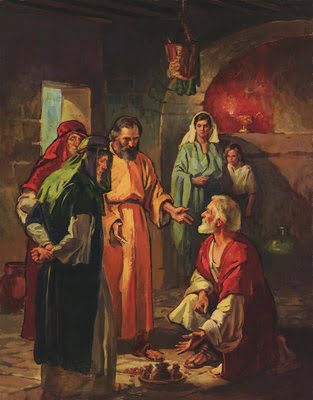
Paul
In a sense, Romans 12 acts as a summary of many of the topics Paul gives more detailed attention to in some of his other letters. He talks about the different roles and gifts within the church body, including serving and encouraging others, and giving generously (see vss. 3-8 Rom. 12:3-8). But not only should these things be done, they should be done well, with enthusiasm and—above all—with love (see vss. 9-11 Rom. 12:9-11).
Paul describes in practical terms what this kind of life is about. He urges the believers to be patient in difficulties and persecution, to care for the needy, to be peacemakers wherever and whenever possible and—as we have seen previously—to respond to evil and injustice with kindness, overcoming evil by doing good (see Rom. 12:20-21).
This chapter outlines what it means to live as a new person, serving God individually and as part of a community of faith. Paul told these new followers of Jesus that their lives, priorities, and actions should be changed because of their response to what Jesus had done for them by His death on the cross and the hope of eternal life. Living as they were in an oppressive and often cruel society in the heart of the Roman Empire, Paul instructs them to live differently: “Do not conform to the pattern of this world, but be transformed by the renewing of your mind” (Rom. 12:2, NIV).
| What are some attitudes and practices you need to resist in your community to help you live and love well as a follower of Jesus today? |
Amen! (0)
(0)
(0) Source: http://feedproxy.google.com/~r/SabbathSchoolNet/~3/7fBehmgJFNE/
Laypeople Urged to Do Business, Serve, and Live Like Jesus
Click here for the full article.
9.4 Paul’s Guide to Living and Loving Well – MINISTRY IN THE NEW TESTAMENT | Pastor Kurt Piesslinger, M.A.
Series THE LEAST OF THESE with Pastor Kurt Piesslinger, M.A. |
9.MINISTRY IN THE NEW TESTAMENT |
The Church of the followers of Jesus became a new kind of community. They were known as people who love each other.
9.4 Paul’s Guide to Living and Loving Well
My God bless you today and always.
Download
[soundcloud url=”https://api.soundcloud.com/tracks/671692544″ params=”color=#ff5500&auto_play=false&hide_related=false&show_comments=false&show_user=true&show_reposts=false&show_teaser=true” width=”100%” height=”166″ iframe=”true” /]
Bangladesh: Thousands Affected By Slum Fire Lose Everything; ADRA Works With Authorities To Provide Aid
From ADRA – 26 August 2019 | Reports estimate that more than 15,000 people were heavily affected by a recent fire that swept across a densely populated slum in Dhaka, the capital city of Bangladesh, leaving three people injured, and over 2,000 houses damaged beyond repair. The local government has been working to place people […] Source: https://atoday.org/bangladesh-thousands-affected-by-slum-fire-lose-everything-adra-works-with-authorities-to-provide-aid/
Jeremiah 14:7
Although our sins testify against us, do something, LORD, for the sake of your name. For we have often rebelled; we have sinned against you.
http://feedproxy.google.com/~s/dailybible/main/?i=http://dailybiblepromise.com/verse/2019/08/27



 Source: http://feedproxy.google.com/~r/dailybible/main/~3/EEkn2cUPulo/27
Martedi 27 Agosto 2019
* Proverbi 15:1 * La risposta dolce calma la collera, ma la parola pungente eccita l'ira. Testo di Barbara Zordan presentato in studio da Elvira Franzoni
Meditazione giornaliera, serie "Apri la porta del tuo cuore". https://hopechannel.it Source: https://www.youtube.com/watch?v=laRarNffHy8
La guarigione del cieco di Betsaida
Roberto Schino Source: https://www.youtube.com/watch?v=HV-qG3VuAuI
Tuesday: Giving as a Way of Sharing
After his conversion, the apostle Paul took up the mission to bring the gospel to the Gentile world. The success God gave him raised significant questions about the relationship between the Jewish roots of the emerging Christian faith and the new Gentile followers of Jesus. A council of Jewish and Gentile Christian leaders met in Jerusalem to discuss the matter and seek God’s guidance in relation to these complicated questions. The meeting and its outcomes are recorded in Acts chapter 15.
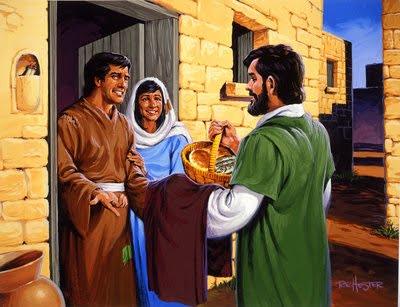
Giving
However, in Paul’s report of this meeting found in Galatians 2, he adds another important element to the instructions he received from the Jerusalem council for his continuing ministry among the Gentiles: “All they asked was that we should continue to remember the poor, the very thing I had been eager to do all along” (Gal. 2:10, NIV).
And Paul continued to pursue this focus personally (see, for example, Acts 20:35) and throughout his ministry. Like the early church in Jerusalem, Paul expanded the vision of the Christian community to embrace all fellow believers.
Read 2 Corinthians 8:7-15. How does Paul link the gospel and giving generously?
Paul also drew on two Old Testament references to urge the believers to generosity and care for their fellow believers in difficult circumstances. He cited the story of God’s generous provision of manna to the Israelites in the wilderness as a model of giving and sharing among the wider church community (see 2 Cor. 8:15). He also quoted from Psalm 112:9—“They have freely scattered their gifts to the poor; their righteousness endures forever” (2 Cor. 9:9, NIV).
Paul urged his readers to be intentional about giving, to put aside regularly a portion of their income so that it would be easy to give when he or Titus visited their church to collect their offerings and deliver them to the Christians in need in Jerusalem. He used the example of one church to encourage other churches to similar generosity. “Because of the service by which you have proved yourselves”, Paul wrote, “others will praise God for the obedience that accompanies your confession of the gospel of Christ, and for your generosity in sharing with them and with everyone else” (2 Cor. 9:13, NIV).
| How should we prioritize giving when we are unable to give to every cause or need presented to us? |
Amen!(0)
(0) Source: http://feedproxy.google.com/~r/SabbathSchoolNet/~3/R5lAA7Q0yH4/

