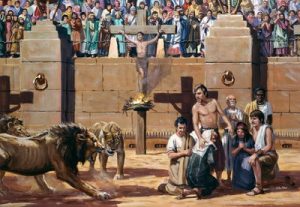
It’s been more than 2,000 years since Jesus walked the dusty roads of Palestine. Yet, God is the same today as He was yesterday—reaching His hand out in reconciliation. Pastor Ted Wilson and his wife, Nancy, explore this topic, including God’s ministry of healing wounds, making people whole, and offering us the opportunity to be united in Him. As prophecy foretold, we believe that Jesus came to this earth as a babe, lived a life filled with a heaven-sent purpose, died and rose again, and is now ministering on our behalf in the heavenly sanctuary. And soon, He will come again to take us home! Follow this weekly series with Pastor Ted Wilson to counter the devil's deception with the truth of God. 🔗 For a detailed look at the ministry of Jesus for, to, and toward us, visit https://www.adventist.org/who-are-seventh-day-adventists/salvation-in-jesus-alone/. Source: https://www.youtube.com/watch?v=LR9MDmeygaQ
Lesson 12: Esther and Mordecai | 12.6 Summary

12.6 Summary
Lesson 12 discusses the Book of Esther in the Old Testament. Esther, a Jewish orphan, is elevated to the position of Queen of Persia and plays a crucial role in saving her people from imminent destruction by the malicious Haman. Her faith, determination, and courage, even risking her own life, make her an inspiring example of loyalty and trust in God. The book also emphasizes how God’s hand often works behind the scenes, even when His name is not explicitly mentioned. The lesson encourages reflection on one’s own faith convictions and becoming aware of the challenge to remain steadfast in difficult situations.
Discussion Questions:
-
The Book of Esther leaves some questions unanswered, especially regarding Esther’s role at the king’s court, despite her elevation to queen. How can these things be reconciled with her faith, or is it even possible?
The biblical portrayal of Esther in the Book of Esther allows for some interpretation and leaves certain details open, particularly regarding her relationship with the king and her behavior at the court. Here are some considerations:
-
Esther’s presence in the royal palace: Esther became queen under extraordinary circumstances after the previous queen, Vashti, was deposed. The Bible does not provide detailed information on how Esther came into this position, but it is implied that she was chosen due to her exceptional beauty and grace (Esther 2:17). There are no clear indications that she actively sought to become queen.
-
Her identity as a Jew: Esther kept her Jewish identity a secret, following Mordecai’s instructions (Esther 2:10). This decision could be attributed to the fact that it was not safe or advantageous to openly discuss her ethnic background at that time. It could be seen as a strategy to avoid potential biases or difficulties.
-
Acting in secret: Although the name of God is not directly mentioned in the Book of Esther, God’s work is evident through events in the background. Esther and Mordecai may have acted in secret to fulfill God’s plan. The book emphasizes divine providence and how seemingly normal events are integrated into God’s plan.
-
Risks for her people: As queen, Esther had an influential position at the court, which later proved crucial for the salvation of her people. However, there was a significant risk for her to approach the king without an invitation (Esther 4:11). Her actions required courage, and she recognized the potential dangers.
Overall, the story of Esther shows that people in difficult situations are sometimes forced to make wise decisions to uphold their convictions while achieving the best possible outcomes. Esther is portrayed in the Bible as a crucial figure for the salvation of her people, and her actions can be considered part of God’s plan, even if she did not explicitly act through divine revelation.
2.The famous words of Esther, “If I perish, I perish” (Esther 4:16 NIV), resonate as an example of loyalty even in the face of death throughout the millennia. How do her words reflect what God’s people will experience in the end times when the themes in Revelation 13 become a reality?
Esther’s famous words, “If I perish, I perish” (Esther 4:16), attest to her dedication, courage, and willingness to advocate for her people, even if it might cost her own life. These words serve as an impressive example of loyalty and steadfastness, even under extreme conditions.
Regarding the end times and the themes in Revelation 13, Esther’s words could serve as inspiration for God’s people when faced with challenges and persecutions. Here are some parallels:
-
Steadfastness in faith and convictions: Esther demonstrated through her words that she was willing to stand up for her convictions, even if it involved personal sacrifice. In the end times, believers may face similar challenges where they must choose to remain faithful to their belief in God, even when it becomes difficult.
-
Willingness to advocate for others: Esther not only stood up for herself but also for her people. In the end times, it will be crucial for God’s people to advocate for each other and show solidarity, especially when it comes to principles of faith and protecting religious freedom.
-
Trust in God’s sovereignty: Esther’s words also reflect a deep trust in God’s sovereignty. Similarly, believers in the end times may need to rely on their trust in God and be conscious that their ultimate security and salvation come from Him.
-
Willingness to take personal risks: Esther was willing to take personal risks to fulfill her duty to God and her people. In the end times, believers may face decisions where they need to make personal sacrifices to remain true to their faith.
-
Remembrance of God’s providence: Although God’s name is not explicitly mentioned in the Book of Esther, His providence is evident through the events. Believers in the end times may be encouraged by Esther’s example that even in difficult times, God’s plan is at work.
Overall, Esther’s words can serve as timeless encouragement that true loyalty to God and the principles of faith can endure even in the most challenging times.
3.Discuss the question at the end of the Monday section about whether we should hide our faith at certain times. Should that even be an option for us?
The question of whether we should hide our faith at certain times touches upon a complex issue that depends on various factors. Here are some considerations:
-
Security concerns: In some situations, openly discussing one’s faith can indeed be dangerous. In countries or environments where religious freedom is restricted or persecuted, it may be necessary to be cautious and not publicly disclose one’s faith to ensure personal safety.
-
Wisdom and tact: There are situations where tact and wisdom are necessary to effectively share the Gospel. Sometimes, choosing an approach that is appealing and respectful can promote understanding and openness, rather than provoking rejection or hostility through open confrontation.
-
Testimony through lifestyle: Even if there are times when direct preaching or evangelizing is challenging, one’s lifestyle can be a powerful testimony. A life reflecting the love and principles of Jesus can often be as effective as words.
-
Professional or social consequences: In some environments, openly confessing one’s faith could lead to professional or social consequences. In such cases, believers may need to weigh how much they are willing to sacrifice for their faith.
-
Seeking God’s guidance: Ultimately, it is important to seek God’s guidance in this matter. Through prayer and spiritual considerations, one can receive guidance on how to act in specific situations.
The Bible encourages us to be wise and humble in how we live and share our faith. For example, Colossians 4:5-6 (NIV) says, “Be wise in the way you act toward outsiders; make the most of every opportunity. Let your conversation be always full of grace, seasoned with salt, so that you may know how to answer everyone.”
Overall, hiding one’s faith should not be a permanent option, as we are called to be the “light of the world” (Matthew 5:14) and proclaim the Gospel. However, it is about proceeding wisely and lovingly, depending on the circumstances we face.
Source: https://fulfilleddesire.net/lesson-12-esther-and-mordecai-12-6-summary/
Volunteers Bring Hope to a Prison Through Radio Nuevo Tiempo Perú
“Thank you for teaching me to know God and his Word.” “God will take care, and soon I will have my freedom.” “Now I feel peace and the hope of being at home.” “Pray for me. Here, I have no one.” These…… Source: https://adventist.news/en/news/volunteers-bring-hope-to-a-prison-through-radio-nuevo-tiempo-peru
More Than 60,000 in Southern Brazil Gather to Celebrate 160th Anniversary of Adventism

20 December 2023 | Southern Brazil recently witnessed grand celebrations marking the 160th anniversary of the Seventh-day Adventist Church, according to a recent article by the Adventist News Network. Over 60,000 people participated in events across Paraná, Santa Catarina, and Rio Grande do Sul, featuring music, baptisms, and community outreach. The Curitiba event, titled Impacto […] Source: https://atoday.org/more-than-60000-in-southern-brazil-gather-to-celebrate-160th-anniversary-of-adventism/
When Should we Reveal our Identity?
Monday’s section in this week’s lesson asks the question, “What circumstances might you think of where it could be prudent not to be overt about our faith? Or should we never do that? And if not, why not?” This question reminded me about the story about the unclean spirits and why Jesus told them to be quiet when they revealed Him as the Son of God.
And unclean spirits, when they saw him, fell down before him, and cried, saying, Thou art the Son of God. And he straitly charged them that they should not make him known. Mark 3:11-12
Many people, even in our own ranks, accuse Seventh-day Adventists of being dishonest, when we cover up our church sign when holding evangelistic meetings. Often we drape a makeshift sign over the name “Seventh-day Adventist” with the speaker’s name, or the theme of the meetings. Maybe we start the meetings in a neutral meeting hall and announce later, after a few meetings, that we are Seventh-day Adventists. Why be so secretive? I have heard people say, “I am not ashamed to be an Adventist, so why do I need to hide it?”

Well Jesus was not ashamed to be the Son of God, but He still told the demons to be quiet when they announced it to the world. You see, for four thousand years, Satan had been telling humanity all kinds of lies about God and His character. Satan had even worked through un-Godlike priests and teachers to make God look stern, unforgiving and tyrant like. Jesus came with humanity draped over His divinity, to give people a chance to get to know Him first, before He revealed Himself to humanity as the Son of God. Thanks to Satan, there was too much prejudice against Him to just come right and say He was God, from the very beginning. People would have never given Him a chance with all their preconceived ideas about God. With humanity draped over His divinity, like a makeshift sign draped over a church sign, Jesus let the people find out how warm, caring and compassionate He was, and then once He had their confidence, He could let them know He was God.
Satan also told many lies about God’s remnant church. Many think we are a cult, or legalistic, so while being careful not to lie, some evangelists like to reveal that they are Adventists, after being given time to show that the Adventist church is a Bible-based, Christian, compassionate church. It has nothing to do with being ashamed or deceptive. It is the same principle Jesus used when telling the demons not to tell who He was.
Of course as we spend more effort reaching out to unchurched people, we find less prejudice. After all, it was mostly “religious” people who were prejudiced against Jesus. It is often other denominations that are prejudice against Adventists, but not so much the unchurched community. I understand the principles of evangelists, who do not like to announce upfront that they are Adventists. However, if asked directly what denomination I represent, I do not stutter or stammer. I say confidently that I am a Seventh-day Adventist. I then assure them that we are Christian Bible-based believers. I tell them, we believe Jesus is our only hope of salvation and our only example, therefore we go to church on the Bible Sabbath just like Jesus. Just like the woman at the well was receptive, when Jesus revealed Himself to her, I find many unchurched people receptive when I reveal our Bible based and Jesus centered beliefs.
While Jesus told the demons not to announce to the whole world who He was, He used wisdom in deciding when and to whom to reveal Himself. I do not always know who is prejudiced and who is not, so I pray for God to give me wisdom and the right words to say to each individual.
(0)The post When Should we Reveal our Identity? appeared first on Sabbath School Net.
Source: https://ssnet.org/blog/when-should-we-reveal-our-identity/