https://www.youtube.com/watch?v=xAAS1OJadRs
Source: https://www.youtube.com/watch?v=xAAS1OJadRs
Thursday: The Temple
Look at Nehemiah 10:32-39 again. Why were the temple’s practices essential for the Israelites, as shown by “we will not neglect the house of our God” (Neh. 10:39, NKJV)? Why was the Temple so important for the faith as a whole? (See also Heb. 8:1-7).
The Israelites pledged to take care of the temple. Even though they were a small group financially oppressed by the kings, they decided they needed to give from the little they had in order for the temple to thrive and not just survive. Therefore, they chose to give a third of a shekel for the temple service every year, instead of just when the census happened, as the law commanded. 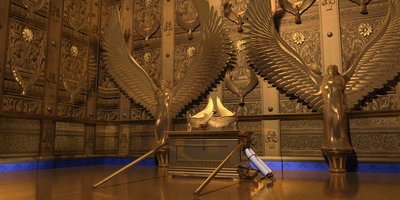 The nation saw a need to go beyond what was required. Additionally, they allotted the responsibility for burning firewood on the altar to specific families, as they recognized that without organization the practice would wane.
Firstfruits, firstborns, and tithes and offerings were aspects of the temple service that provided for the ministry of the priests and Levites. A tenth of everything was to go to the Levites. Also, firstborns were redeemed by money, adding to the amount the Levites received. However, a tenth of the Levites’ tenth went to the priests.
The temple served as the heartbeat of the Israelite nation. It was so central to their faith that the greatest tragedy occurred when Nebuchadnezzar tore down the temple and carried away the sacred objects.
When the temple was properly managed, it gave the nation a vibrant spiritual life because it pointed the people to the ultimate solution to the sin problem, which was through the death of a lamb. When Jesus died on the cross, that solution was provided (Rom. 5:5-10). Moreover, through the yearly service of the Day of Atonement, the people learned that ultimately God has a plan to get rid of evil and sin for good. In other words, the temple served as the setting for revealing to the people the entire plan of salvation. The lessons we can gain through looking at the temple services are immense and necessary to give us a bigger picture of God’s character and to illuminate the plan of salvation.
| “This is a faithful saying and worthy of all acceptance, that Christ Jesus came into the world to save sinners, of whom I am chief” (1 Tim. 1:15, NKJV). What was Paul’s hope, and how can we make it our own hope, as well? |
Amen! (0)
(0)
(0) Source: http://feedproxy.google.com/~r/SabbathSchoolNet/~3/XuQHouIU94A/
Call for Workers
For the Son of man is a man taking a far journey, who left his house, and gave authority to his servants, and to every man his work, and commanded the porter to watch. Mark 13:34.
The angels of God are ready and waiting to go with humble men who with their Bibles in their hands will go to those who have not had this light, and read to them a “Thus saith the Lord.”
Those who have the gift of song are needed. The melody of praise is the atmosphere of heaven. Often by the words of sacred songs, the springs of penitence and faith have been unsealed. Song is one of the most effective means of impressing spiritual truth upon the heart.
Let little companies of workers go out as the Lord’s missionaries, and do as Christ commissioned the first disciples to do. Let them go into the different parts of our cities, two and two, and give the Lord’s message of warning. Tell the people the story of Creation, and how at the close of His work the Lord rested upon and blessed the Sabbath day, setting it apart as a memorial of His work.
Church members young and old should be educated to go forth to proclaim this last message to the world. If they will go in humility, angels of God will go with them, teaching them to lift up the voice in prayer, how to raise the voice in song, and how to proclaim the gospel message for this time. We have not a moment to lose….
Who will take up this work of teaching Bible truth to old and young? Who will carry the message, following Christ’s plan of labor? … Many there are in every city who feel the need of gospel shepherds. We need men who will read the truth, practice the truth, and explain the truth.
Brethren, Christ calls you. Will you heed His voice? Will you become His messengers? Will you seek the sheep that are lost? Will you teach the Word in all humility and earnestness to those who will hear?
Young men and women, take up the work to which God calls you. Tell the wondrous story of the cross. Christ will lead you, and teach you to use your abilities to good purpose. As you receive the quickening influence of the Holy Spirit, and you seek to teach others, your minds will be refreshed, and you will be enabled to present words that are new and strangely beautiful to your hearers. Pray, and sing, and speak the word….
Spiritual freedom will come to those who consecrate themselves unreservedly, and the quickening grace of Christ will bring light and peace and joy. The saving influence of truth will sanctify the soul of the receiver.—Letter 108, March 18, 1907, to “Our Brethren in Graysville, Tennessee.”
The Upward Look p. 91
~~~~~~~~~~~~~~~~~~~~~~~
Prayer Requests
—-My husband fell at work and injured his leg that was partially amputated. Requesting prayers. Laurie
—-I ask prayer for my son Evenezer to have a permanent job where he can utilize his course and that he surrender his life fully to the Lord. Sally
~~~~~~~~~~~~~~~~~~~~~~~~
Dear Friends,
A normal part of a child’s development is to think of what they will be and who they would like to marry when they grow up. I was no exception. Even though I lived in a neighborhood where most of the people were elderly, there was a boy named Gary, who lived several blocks away who used to come to my house and play. Over the years, our friendship deepened until we used to plan that when we grew up, we would marry. His goal was to be an architect and often drew floor plans of what our house would look like. It was a completely normal part of growing up. It was all in innocence.
Our friendship even survived my moving to the other side of town when my mother got married again. We didn’t see each other as often, but we did keep in contact. When he was in his late teens, however, I no longer heard from him. A mutual friend explained the reason. Gary had become acquainted with an older man who led him down the wrong path. He had changed completely. He no longer had the same goals and desires. He dropped out of college and drifted farther and farther from his old self until he hardly seemed like the same person. It was very sad. I called him a few years ago. Instead of
becoming an architect, he does telephone sales. After talking with him for a few minutes, it became apparent the he was a miserable person. The friendship he had made as a teenager, ruined his life.
Amos asked, “Can two walk together, except they be agreed? How careful we must be in choosing our friends. How discerning we must be in deciding which voice to listen to. How vital to our present and future happiness it is that we follow the path our Great Leader speaks about, “Enter ye in at the strait gate: for wide is the gate, and broad is the way, that leadeth to destruction, and many there be which go in thereat: Because strait is the gate, and narrow is the way, which leadeth unto life, and few there be that find it. Beware of false prophets, which come to you in sheep’s clothing, but inwardly they are ravening wolves. Ye shall know them by their fruits. Do men gather grapes of thorns, or figs of thistles? Even so every good tree bringeth forth good fruit; but a corrupt tree bringeth forth evil fruit. A good tree cannot bring forth evil fruit, neither can a corrupt tree bring forth good fruit. Every tree that bringeth not forth good fruit is hewn down, and cast into the fire. Wherefore by their fruits ye shall know them.” Matt 7:13-20
Paul advises, “Be ye not unequally yoked together with unbelievers: for what fellowship hath righteousness with unrighteousness? and what communion hath light with darkness? And what concord hath Christ with Belial? or what part hath he that believeth with an infidel? And what agreement hath the temple of God with idols? for ye are the temple of the living God; as God hat said, I will dwell in them, and walk in them; and I will be their God, and they shall be my people. Wherefore come out from among them, and be ye separate, saith the Lord, and touch not the unclean thing; and I will receive you, And will be a Father unto you, and ye shall be my sons and daughters, saith the Lord Almighty. Having therefore these promises, dearly beloved, let us cleanse ourselves from all filthiness of the flesh and spirit, perfecting holiness in the fear of God.” 2 Cor 6:14-7:1
May we choose our friends well, for they can draw us closer to Jesus or farther away from Him. May we allow our Best Friend to change us into His Image. May we “give diligence to make [our] calling and election sure: for if [we] do these things, [we] shall never fall: For so an entrance shall be ministered unto [us] abundantly into the everlasting kingdom of our Lord and Saviour Jesus Christ.” 2 Peter 1:10, 11
Rose
 Source: http://feedproxy.google.com/~r/rosesdevotional/~3/RVC91Gv-10o/call-for-workers.html
Loma Linda Cardiologists Use Nation’s First Alternative Access Point For Heart Device To Save Veteran
From Loma Linda University Health – 19 November 2019 | In a first of its kind in the United States, cardiologists at Loma Linda University International Heart Institute have performed a pioneering coronary intervention with an Impella heart assist device and stent placement through single access from the axillary artery in the shoulder. The new […] Source: https://atoday.org/loma-linda-cardiologists-use-nations-first-alternative-access-point-for-heart-device-to-save-veteran/
Mercoledi 20 novembre 2019
Salmo 108: 4 Perché la tua bontà giunge fino ai cieli e la tua fedeltà fino alle nuvole. Testo di Alejandro Bullon, presentato in studio da Anna Cupertino. Meditazione giornaliera, serie "Apri la porta del tuo cuore". https://hopemedia.it Source: https://www.youtube.com/watch?v=v7kh0TSAneE

