The Remnant Church in the Changing World — Pr. Paul Dhanaraj THANK YOU for your continued financial support of our Media Ministries. Please donate by visiting "https://adventistgiving.org/#/org/ANB4RC/envelope/start" and select “Media Ministries”. Connect With Us
X: RemnantSDA
Facebook: RemnantSDAchurch.org
Instagram: RemnantSDAchurch Source: https://www.youtube.com/watch?v=G25hUYjBXvM
Sunday: Heavenly-Mindedness
Daily Lesson for Sunday 8th of March 2026
Read Colossians 3:1-4. What condition does Paul indicate is necessary for us to be heavenly-minded? What do you think that means?
From a mountaintop, it is possible to survey a vast landscape that is all around you. From time immemorial, mountains have been frequented by those seeking a closer experience with God (see Psalms 121:1-2). Even human-made mountains, called ziggurats, have been constructed by pagans for a similar purpose—to meet with the gods. Interestingly, the city of Ur, which Abram was called to leave, had a very large ziggurat visible from miles around. But changing one’s elevation will never by itself draw anyone closer to heaven in a spiritual sense. Human effort never could.
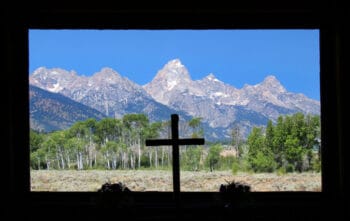
Image © John Baker at Goodsalt.com
Instead, only through a miracle of grace, whereby we died with Christ and were raised with Him (figuratively pictured by baptism [Colossians 2:12-13]), is it possible to draw nearer to heaven.
Notice that from the beginning of Colossians 3:1-25, the repeated emphasis on what is above, that is, what there is in heaven: “those things which are above,” “where Christ is,” “things above,” “with Christ in God,” “with Him in glory” (Colossians 3:1-4, NKJV).
Admittedly, there is much in the Christian life that defies explanation. How can a person really “die” and “be raised” when, to all appearances, he or she is the same person and has had no such life-and-death experience? There is much that does not make sense to the natural mind, uninfluenced by the Holy Spirit. But to those who are spiritually-minded, because they have received the new heart promised by God, death to sin and being raised with Christ are genuine realities. As the hymn affirms: “You ask me how I know He lives? He lives within my heart.”
Nevertheless, Paul gives these commands because there is a constant need for this spiritual life to be renewed (see 2 Corinthians 4:16). We can, indeed, fall away and be lost! And we are never safe from temptation in this life.
We must, therefore, choose daily to “seek those things which are above” (Colossians 3:1). Our eternal life is safely “hidden with Christ in God” (Colossians 3:3, NKJV), but the outward expression of that life will be anything but hidden.
|
Where are your thoughts: usually above or usually below? If the latter, how do you change their direction? |
“Center” | Sarah Andrews
"Center" | Sarah Andrews
03 07 2026 THANK YOU for your continued financial support of our Media Ministries. Please donate by visiting "https://adventistgiving.org/#/org/ANB4RC/envelope/start" and select “Media Ministries”. Connect With Us
X: RemnantSDA
Facebook: RemnantSDAchurch.org
Instagram: RemnantSDAchurch Source: https://www.youtube.com/watch?v=2QrLdbgeY3o
“No More night” | Sarah Andrews
"No More night" | Sarah Andrews
03 07 2026 THANK YOU for your continued financial support of our Media Ministries. Please donate by visiting "https://adventistgiving.org/#/org/ANB4RC/envelope/start" and select “Media Ministries”. Connect With Us
X: RemnantSDA
Facebook: RemnantSDAchurch.org
Instagram: RemnantSDAchurch Source: https://www.youtube.com/watch?v=j_dCFWLFCuw
Liberality and Love for God’s Work
“Let neither man nor woman do any more work for the offering of the sanctuary.” And the people were restrained from bringing. Exodus 36:6.
Under the Jewish system, the people were required to cherish a spirit of liberality, both in sustaining the cause of God and in supplying the wants of the needy. At the harvest and the vintage, the firstfruits of the fields—corn, wine, and oil—were to be consecrated as an offering to the Lord. The gleanings and the corners of the fields were reserved for the poor. The firstfruits of the wool when the sheep were shorn, of the grain when the wheat was threshed, were to be offered to the Lord; and at the feast it was commanded that the poor, the widows, the orphans, and the strangers should be invited. At the close of every year all were required to make solemn oath whether or not they had done according to the command of God.
This arrangement was made by the Lord to impress upon the people that in every matter He must be first. They were, by this system of benevolence, reminded that their gracious Master was the true proprietor of their fields, their flocks, and their herds, that the God of heaven sent them sunshine and rain for their seed-time and harvest, and that everything which they possessed was of His creation. All was the Lord’s, and He had made them stewards of His goods.
The liberality of the Jews in the construction of the tabernacle evinced a spirit of benevolence which has not been equaled by the people of God at any later date. The Hebrews had just been freed from their long bondage in Egypt, they were wanderers in the wilderness; yet scarcely were they delivered from the armies of the Egyptians who pursued them in their hasty journey, when the word of the Lord came to Moses, “Speak unto the children of Israel, that they bring me an offering: of every man that giveth it willingly with his heart ye shall take my offering.” …
All gave with a willing hand, not a certain amount of their increase, but a large portion of their actual possessions. They devoted it gladly and heartily to the Lord. They honored Him by so doing. Was it not all His? Had He not given them all that they possessed? If He called for it, was it not their duty to give back to the lender His own? No urging was needed. The people brought even more than was required; and they were told to desist, for there was already more than could be appropriated.—The Review and Herald, October 17, 1882.
From the Heart p. 76
~~~~~~~~~~~~~~~~~~~~~~~~~~~~~~~~~
Prayer Requests
—-Praise—Ron got out of the hospital today! Please pray for him that his blood pressure will be under control from now on. Rose
—-Please pray for the grandmother of a lady I met in the ICU waiting room. Also a man was there whose wife is in end-stage kidney disease. The man has cancer and also needs prayer. I didn’t think to get names. Rose
—-A mission team from Alaska is in a difficult situation, and needs to return home. Please pray for this team’s safety and flight home. Jeanie
—-I need prayer for healing. Lucyanne
~~~~~~~~~~~~~~~~~~~~~~~~~~~~~~~
Dear Friends,
Not too many years ago, the man who sent out news of happenings in our highschool class. He sent out an obituary for one of the girls I had gone to school with in second grade. (We had a very large senior class, so she and I did not have any classes together.) As I looked at Lonnie’s picture and read her obituary, it reminded me of an incident many years before high school that made my seven-year-old heart break.
It was the first day of school after the Thanksgiving vacation in 1952. I was proudly wearing my new coat that my mother had bought me. It was a grayish-green wool and very warm—just what I needed for the cold winters of Michigan. I entered the second grade cloakroom and hung my coat on a hook alongside about 30 other coats, went to my desk, and sat down. Soon all thoughts of my coat vanished as Miss Kramer began teaching our lessons.
Soon it was time to go home for lunch. Some children had quite a way to get home, but not me. All I had to do was walk across the street to my house. We all walked quietly to the cloakroom to get our coats. When I got there, however, I had a hard time finding my coat. It was the first time I had worn it, and I could not remember exactly what it looked like. After searching a bit, I found it. To my surprise there was a beautiful Christmas corsage pinned to it. I looked at that corsage and wondered how it had gotten there. In my seven-year-old imaginings, I thought that maybe my mother had tiptoed into the cloakroom while no one was looking and had pinned it on my coat to surprise me. It was such a wonderful thought that I felt like crying for joy!
Suddenly, I felt a sharp pain on my arm. To my horror, I saw someone’s fingernails making deep scratches on my forearm: one was so deep that it actually bled and left a scar which I had for many years. There stood Lonnie. (I was always a little afraid of this girl because she was so mean.) Now here she was looking very angry and screaming at me about stealing her coat. Gradually, I realized that she and I must have the same color coat. I looked around. There on another hook not far away was my new coat. I told her that I was sorry and reached for my coat. Then she saw that we had matching coats and her anger melted a little. She grabbed her coat and ran off, while I stood there with a bleeding arm and a breaking heart.
How easy it is for us to become just as confused as I was that day. We may think that we know what is right, but we are so wrong. Solomon observed, “There is a way that seemeth right unto a man, but the end thereof are the ways of death.” Prov 14:12 Jesus urges us, “Enter ye in at the strait gate: for wide is the gate, and broad is the way, that leadeth to destruction, and many there be which go in thereat: Because strait is the gate, and narrow is the way, which leadeth unto life, and few there be that find it.” Mat 7:13 ,14
The evil one is a master at deception. Peter warns, “Be sober, be vigilant; because your adversary the devil, as a roaring lion, walketh about, seeking whom he may devour.” 1 Peter 5:8 He, Who is the Way, the Truth, and the Life warns, “Beware of false prophets, which come to you in sheep’s clothing, but inwardly they are ravening wolves.” Matt 7:15
Isaiah give us the way to tell the genuine from the false, “To the law and to the testimony: if they speak not according to this word, it is because there is no light in them.” Isa 8:20
How carefully we must test everything we hear, everything we see by the Word of God. How important it is to compare what is told us that the Bible says. The Great Author of the Bible desires for us to gather all of the texts dealing with a certain subject in order to get the whole picture. “Whom shall he teach knowledge? and whom shall he make to understand doctrine? them that are weaned from the milk, and drawn from the breasts. For precept must be upon precept, precept upon precept; line upon line, line upon line; here a little, and there a little.” 28:9,10
May we pray for the Holy Spirit, Who guided those who wrote the Scriptures, to guide us in understanding them. (2 Peter 1:21) May we “study to show [ourselves] approved unto God, a workman that needeth not to be ashamed, rightly dividing the word of truth.” 2 Tim 2:15
Rose
Source: https://rosesdevotional.org/liberality-and-love-for-gods-work.html
- « Previous Page
- 1
- …
- 473
- 474
- 475
- 476
- 477
- …
- 8791
- Next Page »

