❤️ Subscribe to our channel – https://www.youtube.com/AdventistWorldRadio
👉 More Miracle Stories from AWR360° – https://www.youtube.com/playlist?list=PLGPdsC4UKngudVFE5iCjJbxlTDTDWDZ2h
God is using AWR's many broadcasts and platforms to bypass harsh governments and hostile cultures to beam the love of Jesus directly into homes and hearts! Thank you for your support. ✅ Donate at https://awr.org/give
✅ Like us on Facebook: https://www.facebook.com/AWR360
✅ Follow us on Twitter: https://twitter.com/awr360 #awr360 #miraclestories #adventistworldradio #shorts Source: https://www.youtube.com/watch?v=fw1nM1VjUIU
He Died for Us – Hit the Mark
We had to extend the time of this broadcast on He Died For Us as we covered the death of Christ and the example it sets for us. Come join the discussion.

Amen! (0)
(0)
(0)The post He Died for Us – Hit the Mark first appeared on Sabbath School Net.
The post He Died for Us – Hit the Mark appeared first on Sabbath School Net.
I found something in Ellen White that contradicts the Bible!
31 October 2022 | Dear Aunt Sevvy, Genesis 3:6 says that Eve gave the forbidden fruit to her husband who was with her. Patriarchs & Prophets (pp. 53-56) paints a different picture: that Eve wandered away from her husband and his sensible control over her, so that she was alone at the tree—and when she […] Source: https://atoday.org/i-found-something-in-ellen-white-that-contradicts-the-bible/
Tuesday: “It is Finished”
Read John 19:1-30. What is the crucial message to us in Jesus’ statement, “It is finished”?
Finally, the crucial moments for Christ, for humankind, and for the whole universe had arrived. With deep agony, He struggled against the powers of darkness. Slowly He made His way through the Garden of Gethsemane, through His unfair trials, and up to the mountain of Calvary.
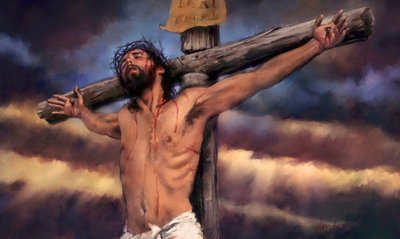
Image © Lars Justinen from GoodSalt.com
Evil angels were trying to overcome Him. While Jesus was hanging on the cross, the chief priests, the scribes, and elders mocked Him, saying, “He saved others; Himself He cannot save. If He is the King of Israel, let Him now come down from the cross, and we will believe Him” (Matthew 27:42, NKJV).
Could Christ have come down from the cross and saved Himself? Yes, He was able but not willing to do so. His unconditional love for all humanity, including those mockers, did not allow Him to give up. Actually, “the mockers were among those whom He was dying to save; and He could not come down from the cross and save Himself, because He was held, not by the nails, but by His will to save them.” — Alfred Plummer, An Exegetical Commentary on the Gospel According to S. Matthew (London: Elliot Stock, 1910), p. 397.
Here, in the suffering of Christ, Jesus was defeating the kingdom of Satan, even though it was Satan who had instigated the events that led to the cross, including Judas’s betrayal (John 6:70; John 13:2, John 13:27). “Somehow, in a way the Evangelist does not try to describe, the death of Jesus is both an act of Satan and an act in which Jesus wins the victory over Satan.” — George E. Ladd, A Theology of the New Testament, rev. ed. (Cambridge, UK: Lutterworth Press, 1994), p. 192.
Crying from the cross, “It is finished” (John 19:30), Christ implied not only that His agony had come to an end, but especially that He had won the great cosmic-historic controversy against Satan and his evil forces. “All heaven triumphed in the Saviour’s victory. Satan was defeated, and knew that his kingdom was lost.” — Ellen G. White, The Desire of Ages, p. 758.
It’s hard to grasp the amazing contrast here: in the utter humiliation of the Son of God He had won, for us and for the universe, the greatest and most glorious victory.
| Think about how bad sin must be that it took the death of Christ to atone for it. What should this truth teach us about how useless our works are for attaining merit before God? After all, what can we do to add to what Christ has already done for us? Bring your answer to class on Sabbath. |
Amen!(0)
(0)The post Tuesday: “It is Finished” first appeared on Sabbath School Net.
The post Tuesday: “It is Finished” appeared first on Sabbath School Net.
Psalm 96:3

Declare his glory among the nations, his marvelous deeds among all peoples.
The post Psalm 96:3 appeared first on Daily Bible Promise.
Source: https://api.follow.it/track-rss-story-click/v3/jL28dc7E3KDvbUBzFiWyKkQqW5gBv7mX

