To comment, click/tap here. Source: https://atoday.org/can-we-hear-an-amen/
Death and the Resurrection in Both the Old and New Testaments
The Bible has the answer to the question of where the dead are now. In the Old Testament, Daniel was not told that he would be in heaven the moment he died. Instead he was told,
“But you, go your way till the end; for you shall rest, and will arise to your inheritance at the end of the days.” Daniel 12:13 NKJV
In the New Testament Jesus did not tell His disciples they would be with Him in heaven the moment they died. He told them He would have to come again so they could be with Him again.

Image © Kevin Carden at Goodsalt.com
“And if I go and prepare a place for you, I will come again and receive you to Myself; that where I am, there you may be also.” John 14:3 NKJV
Both the Old and New Testaments agree about what happens when we die, and the hope we have in the resurrection. Let’s take a look at Death and then the resurrection in both the Old and New Testaments.
Death
Overview:
Death is a state of unconscious sleep. The dead do not know anything at this time and are not awakened until the last trump at Christ’s second coming. See Ecclesiastes 9:5-6, Job 14:12, 1 Corinthians 15:51-55, 1 Thessalonians 4:13-18.
Why is it important to know the truth about death:
The teaching that you don’t really die is a lie Satan started in the Garden of Eden when he told Eve, “Ye shall not surely die.” By telling this lie Satan hoped to get Eve and all mankind to believe that there is really no consequence for disobeying God. He also wants us to believe that we are all immortal even if we have no relationship with God. This opens the door for spiritualism in which people may actually communicate with the devil and his angels, thinking they are speaking with their loved ones.
Our salvation does not come from knowing what happens when we die. Our salvation is found alone in God’s love. However, no lie is ever harmless, and when Satan told the lie, “Ye shall not surely die,” not only was he lying, but he was also calling God a liar.
Why understanding death in the light of the cross is important:
If you don’t really die, then Jesus did not really die for us, and we still need a Savior. The lie that we don’t really die destroys the cross and everything Jesus endured and accomplished on it. If Jesus was not really tasting death like Hebrews 2:9 says He did, then we have just minimized the cross to a six-hour pain endurance marathon.
I remember sitting in a funeral for a little girl who was hit and killed by a car. Her mother sat on the front pew, sobbing uncontrollably. Meanwhile the pastor talked about how happy the little girl and Jesus were right now up in heaven. Do you know how cruel that made Jesus look to the poor mother? Would Jesus tear a mother’s heart apart just to go have fun with her daughter? I think not! The little girl is resting in her grave and will be united with Jesus in heaven when the mother is reunited with her at the second coming.
For Further study on Death:
What did Adam become?
And the LORD God formed man [of] the dust of the ground, and breathed into his nostrils the breath of life; and man became a living soul. Genesis 2:7
What returns to God?
Then shall the dust return to the earth as it was: and the spirit shall return unto God who gave it. Ecclesiastes 12:7
What is the spirit?
All the while my breath is in me, and the spirit of God is in my nostrils; Job 27:3
Note that this is an example of poetic parallelism, which is used a lot in Scripture. In this case, both parallel passages are synonymous. In other words, “my breath is in me” means the same as “the spirit of God is in my nostrils.” This “spirit” is the same as the “breath of life” God breathes into Adam’s nostrils. It is not the same as the Holy Spirit.
What does God take that turns the body to dust?
Thou hidest thy face, they are troubled: thou takest away their breath, they die, and return to their dust. Psalm 104:29
What age-old question did Job ask?
But man dieth, and wasteth away: yea, man giveth up the ghost, and where [is] he? Job 14:10
What is the Bible answer?
So man lieth down, and riseth not: till the heavens [be] no more, they shall not awake, nor be raised out of their sleep. Job 14:12
Do the dead know what happens to the living?
His sons come to honour, and he knoweth [it] not; and they are brought low, but he perceiveth [it] not of them. Job 14:21
How much do the dead know?
For the living know that they shall die: but the dead know not any thing, neither have they any more a reward; for the memory of them is forgotten. Also their love, and their hatred, and their envy, is now perished; neither have they any more a portion for ever in any [thing] that is done under the sun. Ecclesiastes 9:5–6
What did Jesus call death?
These things said he: and after that he saith unto them, Our friend Lazarus sleepeth; but I go, that I may awake him out of sleep. Then said his disciples, Lord, if he sleep, he shall do well. Howbeit Jesus spake of his death: but they thought that he had spoken of taking of rest in sleep. Then said Jesus unto them plainly, Lazarus is dead. John 11:11-14
How long had Lazarus been dead?
Then when Jesus came, he found that he had [lain] in the grave four days already. John 11:17
Did Martha believe Lazarus was in heaven?
Martha saith unto him, I know that he shall rise again in the resurrection at the last day. John 11:24
What did Mary say?
Then when Mary was come where Jesus was, and saw him, she fell down at his feet, saying unto him, Lord, if thou hadst been here, my brother had not died. John 11:32
Was Lazarus called from heaven, hell or the grave?
And when he thus had spoken, he cried with a loud voice, Lazarus, come forth. And he that was dead came forth, bound hand and foot with grave clothes: and his face was bound about with a napkin. Jesus saith unto them, Loose him, and let him go. John 11: 43-44
The Resurrection
When does the book of Daniel tell us that the dead will awaken?
And many of those who sleep in the dust of the earth shall awake, Some to everlasting life, Some to shame and everlasting contempt. Daniel 12:2
“But you, go your way till the end; for you shall rest, and will arise to your inheritance at the end of the days.” Daniel 12:3
When are the dead raised?
For if the dead rise not, then is not Christ raised: And if Christ be not raised, your faith is vain; ye are yet in your sins. Then they also which are fallen asleep in Christ are perished. If in this life only we have hope in Christ, we are of all men most miserable. But now is Christ risen from the dead, and become the firstfruits of them that slept. For since by man came death, by man came also the resurrection of the dead. For as in Adam all die, even so in Christ shall all be made alive. But every man in his own order: Christ the firstfruits; afterward they that are Christ’s at his coming. 1 Corinthians 15:16-23
When do we receive immortality?
Behold, I show you a mystery; We shall not all sleep, but we shall all be changed,In a moment, in the twinkling of an eye, at the last trump: for the trumpet shall sound, and the dead shall be raised incorruptible, and we shall be changed. For this corruptible must put on incorruption, and this mortal [must] put on immortality. So when this corruptible shall have put on incorruption, and this mortal shall have put on immortality, then shall be brought to pass the saying that is written, Death is swallowed up in victory. 1 Corinthians 15:51-54
Our hope and comfort:
But I would not have you to be ignorant, brethren, concerning them which are asleep, that ye sorrow not, even as others which have no hope. For if we believe that Jesus died and rose again, even so them also which sleep in Jesus will God bring with him. for this we say unto you by the word of the Lord, that we which are alive [and] remain unto the coming of the Lord shall not prevent them which are asleep. For the Lord himself shall descend from heaven with a shout, with the voice of the archangel, and with the trump of God: and the dead in Christ shall rise first: Then we which are alive [and] remain shall be caught up together with them in the clouds, to meet the Lord in the air: and so shall we ever be with the Lord. Wherefore comfort one another with these words. 1 Thessalonians 4:13-18
Amen! (0)
(0)
(0)The post Death and the Resurrection in Both the Old and New Testaments first appeared on Sabbath School Net.
The post Death and the Resurrection in Both the Old and New Testaments appeared first on Sabbath School Net.
Source: https://ssnet.org/blog/death-and-the-resurrection-in-both-the-old-and-new-testaments/
A Mind Submissive
That he would grant you, according to the riches of his glory, to be strengthened with might by his Spirit in the inner man. Ephesians 3:16.
The gospel of Christ makes progress in every human agent that is consecrated to the Lord’s service. The Holy Spirit takes possession of everyone who has a willing mind, not that that person may work the Holy Spirit, but that the Holy Spirit may work its miracle through the grace that is poured upon the human agency. The goodness of God becomes a working power through a consistent life, through fervent love for Jesus, and through heaven-inspired zeal. Those who are in association with Jesus will partake of His melting love, and manifest His overflowing sympathy for souls who are yielding to Satan’s specious temptations. They will plan and study and exercise tact, in order that they may make a success of so presenting the unselfish love of Christ that sinful and impenitent hearts may be won to loyalty to Jesus, who gave His life for them….
Lose no time; confess Christ without delay. It is the Holy Spirit, the Comforter, the Spirit of truth that testifies of Christ. Jesus said, “Ye shall receive power, after that the Holy Ghost is come upon you: and ye shall be witnesses unto me both in Jerusalem, and in all Judea, and in Samaria, and unto the uttermost part of the earth” (Acts 1:8).
To grieve the Holy Spirit which would make you a witness of Christ is a terrible thing. You know not when you may grieve the Spirit for the last time. The Holy Spirit does not work upon the human heart to compel you to give yourself to Christ, to force you to yield your conscience: but [the Spirit] shines into the chambers of the mind in a way to convict of sin, and to entice you unto righteousness. If you do not confess Christ now, the time will come when, overwhelmed with a sense of the great things that you have lost, you will make confession. But why not confess Christ now while mercy’s voice invites you?—The Youth’s Instructor, August 1, 1895
Ye Shall Receive Power p. 300
~~~~~~~~~~~~~~~~~~~~~~~~~~~~~~~~~
Prayer Requests
—-Please pray for guidance for E and children. R
—-Please pray for Dr. T as he recovers from a mini stroke. Rose
—-I have been asked to pray for a small child about three years old, his name is Bentley.
They think he may have cancer, but are needing more tests to complete the diagnosis.
He is being raised by his grandmother. His legs hurt alot and when the doctor touched them the child screamed out in pain. B
~~~~~~~~~~~~~~~~~~~~~~~~~~~~~~~~~
Dear Friends,
Before I retired from working in the court system, one of my duties was to schedule alcohol evaluation appointments for the defendants who had pled guilty to driving while intoxicated. (This consists of an interview and a test. The evaluator then sends a report with recommendations to the sentencing judge.) For years, I would try to find an appointment that fit their schedule the best, but so many defendants did not appreciate my trying to accommodate them but hassle me and argue with me so much, that I finally decided to assign the appointments on a first come first serve basis. There were a few defendants, however, who did ask if there were a better time for their appointment. Those who asked I tried to accommodate.
Occasionally, a defendant would not go for his evaluation even though I warned him what would happen if he did not. (If one failed to get the alcohol evaluation, the judge often issued a bench warrant.) Just so, our Great Redeemer has provided the way of salvation, but how seldom we appreciate it. How often we fail to reach out and accept His free gift. (Rom 6:23) The consequences of that failure are far more serious than a bench warrant!
How often we wound His Great Heart of Love by our ingratitude. He has a plan for our life. Yet, how often we grumble and complain and fight against the very One Who was wounded for our transgressions and bruised for our iniquities. (Isa 53) He knows what is best, yet so many times we want our own way. If we follow His plan, we will have the joys of a clear conscience and peace in our heart. If we do not, we cause ourself much grief.
May we cooperate with our Dear Saviour as He guides us on that rough and rugged path that leads to His Heavenly Kingdom, “because strait is the gate, and narrow is the way, which leadeth unto life, and few there be that find it.” Matt 7: May we “work out [our] own salvation with fear and trembling. For it is God which worketh in [us] both to will and to do of his good pleasure.” Phil 2:12, 13 14 May we “give diligence to make [our] calling and election sure. For so an entrance shall be ministered unto [us] abundantly into the everlasting kingdom of our Lord and Saviour Jesus Christ.” 2 Peter 1:10
Rose
Wednesday: “Your Dead Shall Live”
Read Isaiah 26:14 and Isaiah 26:19. What is the contrast between those who will perish forever (Isaiah 26:14; see also Malachi 4:1) and those who will receive eternal life (Isaiah 26:19)?
The book of Isaiah presents a major contrast between the majesty of God and our human fragility (see Isaiah chapter 40). Though we are like the grass that withers and the flower that fades, the word of God remains forever (Isaiah 40:6-8). Despite our human sinfulness, however, God’s saving grace is available to all human beings and becomes effective even to the Gentiles who embrace His covenant and keep the Sabbath (Isaiah chapter 56).
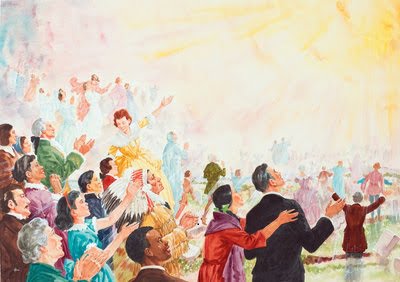
Image © Review & Herald Publishing at Goodsalt.com
In the book of Isaiah, the hope of the resurrection is broadened significantly. While previous biblical allusions to the resurrection were expressed more from personal perspectives (Job 19:25-27, Psalm 49:15, Psalm 71:20), the prophet Isaiah speaks of it as including both himself and the covenantal community of believers (Isaiah 26:19).
Isaiah 26:1-21 contrasts the distinct destinies of the wicked and the righteous. On one side, the wicked will remain dead, without ever being brought to life again, at least after the “second death” (Revelation 21:8). They will be completely destroyed, and all their memory will perish forever (Isaiah 26:14). This passage underscores the teaching that there are no surviving souls or spirits that remain alive after death. Speaking about the final destruction of the wicked, which comes later, the Lord stated elsewhere that the wicked will be completely burned up, leaving them “neither root nor branch” (Malachi 4:1, NKJV).
On the other side, the righteous dead will be raised from death to receive their blessed reward. Isaiah 25:1-12 highlights that the Lord God “will swallow up death forever” and “will wipe away tears from all faces” (Isaiah 25:8, NKJV). In Isaiah 26:1-21 we find the following words: “Your dead shall live; together with my dead body they shall arise. Awake and sing, you who dwell in dust; for your dew is like the dew of herbs, and the earth shall cast out the dead” (Isaiah 26:19, NKJV). All the resurrected righteous will participate in the joyful feast that the Lord will prepare for all people (Isaiah 25:6). The final resurrection will bring together all the righteous from all ages, including your beloved ones who already died in Christ.
| Imagine if we didn’t have any hope, any assurance, any reason to think that our death was anything but the end of everything for us. And then, even worse, anyone who ever knew us would be gone, and soon it would be as if we never existed and that our life never meant anything at all. How does this fate contrast to the hope that we have? |
Amen!(1)
(1)The post Wednesday: “Your Dead Shall Live” first appeared on Sabbath School Net.
The post Wednesday: “Your Dead Shall Live” appeared first on Sabbath School Net.
Source: https://ssnet.org/blog/wednesday-your-dead-shall-live/
The Old Testament Hope – Hit the Mark
In Lesson 4, The Old Testament Hope, we learn valuable insight into dealing with death. Join the discussion.

Amen!(0)
(0)The post The Old Testament Hope – Hit the Mark first appeared on Sabbath School Net.
The post The Old Testament Hope – Hit the Mark appeared first on Sabbath School Net.
Source: https://ssnet.org/blog/the-old-testament-hope-hit-the-mark/

