News reports from Oakwood University, Brazil, Serbia, Romania and Andrews University: Captain! From an Oakwood University Facebook update: The US Public Health Service (PHS) Commissioned Corps, led by the US Surgeon General, recently announced that Antoinette Percy-Laurry, DrPH, was awarded the new rank of Captain through a very competitive promotion process. During Dr. Percy-Laurry’s 14-year […] Source: https://atoday.org/news-briefs-for-september-29-2022/
Young Men Will Dream
The Internship Symposium organised by the British Union Conference (BUC) Ministerial Association took place from 20-22 September. Interns and their supervisors from across the British Isles gathered at the Union offices in order to share experiences and learn.
The programme included many learning opportunities, including presentations from Pastors Samuel Ouadjo (BUC Ministerial Association Secretary), Hezron Adingo (SEC Ministerial Association Secretary), Eglan Brooks (BUC President), Dr Steve…Source: https://adventist.uk/news/article/go/2022-09-29/young-men-will-dream/
Inside Story: Set Free From Chains
Set Free From Chains
By Andrew McChesney
Screams pierced the air in the rural village in Laos.
A Seventh-day Adventist pastor, who was visiting the village with a small team of church workers, headed toward the loud cries to find out what was happening. He was surprised to see a 16-year-old boy chained to the wooden floor of his family home. “What happened to your boy?” he asked the parents. “Why is he chained up?”
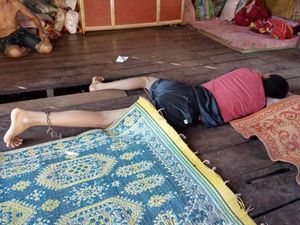
Image © Pacific Press
The parents looked sad. “Our son Aer has been sick for many years,” his father said. “He becomes normal for several hours but then he loses his mind again, several times a day,” his mother said.
The parents had spent all their money trying to find a cure. But the situation steadily had gotten worse until they reluctantly decided to leave Aer in chains all the time to prevent him from harming himself and others. He had been bound to the wooden floor for the past six months.
The pastor spoke with Aer and told him and his parents about the saving love of Jesus. “If Jesus is willing, He can heal Aer,” he said.
He asked for permission to pray for the boy. Aer’s parents happily agreed. Hope shone in the faces that their son would be healed.
A few days later, the pastor and his team again visited Aer and prayed for him. The pastor invited the family to worship in the nearest Adventist church in a neighboring village.
The next Sabbath, the parents arrived at church with Aer, his hands bound in chains. Each church member prayed for Aer, and then the pastor asked the boy’s father also to pray for him. All heads bowed as the father prayed to Jesus on behalf of his son. From that day, the boy was healed. He returned to normal and no longer needed to be chained up.
Neighbors were amazed, and they deluged Aer’s parents with questions.
“Is this the boy who was ill for many years and was chained up?” one said.
“Why is he OK now?” said another. “Who healed him?”
The parents explained that the Christian God had healed their boy.
Not only did Aer’s parents accept Jesus as their personal Savior after the healing, but many other families did so as well. Those families are among 122 people who were baptized at the church in April 2021, filling the church building to overflowing.
“We praise God for performing so many miracles in this area, resulting in many people coming to Him to be saved,” said the Lao pastor who shared the story with Adventist Mission.
Thank you for your Sabbath School mission offerings that support the spread of the gospel in Laos and around the world.
Amen! (3)
(3)
(3)The post Inside Story: Set Free From Chains first appeared on Sabbath School Net.
The post Inside Story: Set Free From Chains appeared first on Sabbath School Net.
Source: https://ssnet.org/blog/inside-story-set-free-from-chains/
British Union Conference Executive Votes New Strategic Plan
On 15 September, the British Union Conference (BUC) Executive Committee voted to adapt a new strategic plan to guide its operations from January 2023. Focusing on 12 key priorities, the plan addresses not only the spiritual mission of the Church and the implementation of the GC, ‘I WILL GO’ initiative, but also acknowledges the Union’s responsibilities as a registered charity and a corporate organisation.
The process of developing a strategic plan began with a weekend retreat where the…Source: https://adventist.uk/news/article/go/2022-09-29/british-union-conference-executive-votes-new-strategic-plan/
Friday: Further Thought ~ Rebellion in a Perfect Universe
Further Thought: Read Ellen G. White, “Why Was Sin Permitted?” Pages 33-43, in Patriarchs and Prophets; “The Origin of Evil,” Pages 492-504, in The Great Controversy.

Image © Stan Myers from GoodSalt.com
“There was no possible hope for the redemption of those [Satan and his angels] who had witnessed and enjoyed the inexpressible glory of heaven, and had seen the terrible majesty of God, and, in presence of all this glory, had rebelled against Him. There were no new and wonderful exhibitions of God’s exalted power that could impress them so deeply as those they had already experienced. If they could rebel in the very presence of glory inexpressible, they could not be placed in a more favorable condition to be proved. There was no reserve force of power, nor were there any greater heights and depths of infinite glory to overpower their jealous doubts and rebellious murmuring. Their guilt and their punishment must be in proportion to their exalted privileges in the heavenly courts.” — Ellen G. White, Confrontation, p. 21.
“From the beginning, God and Christ knew of the apostasy of Satan, and of the fall of man through the deceptive power of the apostate. God did not ordain that sin should exist, but He foresaw its existence, and made provision to meet the terrible emergency. So great was His love for the world, that He covenanted to give His only-begotten Son, ’that whosoever believeth in Him should not perish, but have everlasting life.’ John 3:16.” — Ellen G. White, The Desire of Ages, p. 22.
Discussion Questions:
|
Amen!(2)
(2)The post Friday: Further Thought ~ Rebellion in a Perfect Universe first appeared on Sabbath School Net.
The post Friday: Further Thought ~ Rebellion in a Perfect Universe appeared first on Sabbath School Net.
Source: https://ssnet.org/blog/friday-further-thought-rebellion-in-perfect-universe/

