From a Loma Linda University Health news report – 23 February 2020 | Cases of people contracting the novel coronavirus — COVID-19 — have reached nearly 75,000 since the disease began its spread late last year. The quick nature of transition and unknown elements of the strain have led to many questions with few answers. […] Source: https://atoday.org/loma-linda-expert-on-whether-lung-disease-increases-coronavirus-death-risk/
Monday: The Rise of the Little Horn
Read Daniel 8:8-12 carefully. In which directions is this little horn moving, and why is this important to understand?
After depicting four horns spreading to the four winds of heaven, the biblical text says that from one arose a little horn. The question here is whether this horn/power comes from one of the four horns, which, as we saw yesterday, represent the four generals of Alexander — or one of the four winds.
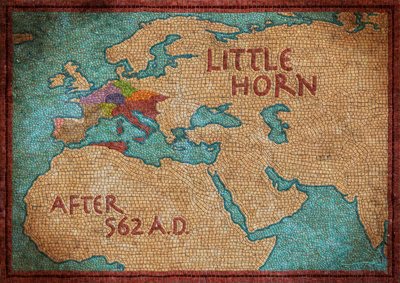
Image © Lars Justinen Creative Collection at Goodsalt.com
The grammatical structure of the text in the original language indicates that this horn comes from one of the four winds of heaven. And since this power arises after the Grecian Empire and its four offshoots, a common understanding is that this horn is Rome, first pagan and then papal. “This little horn represents Rome in both its phases, pagan and papal. Daniel saw Rome first in its pagan, imperial phase, warring against the Jewish people and the early Christians, and then in its papal phase, continuing down to our own day and into the future”. — The Seventh-day Adventist Bible Commentary, vol. 4, p. 841.
According to the biblical text, the little horn first undertook a horizontal movement and “grew exceedingly great toward the south, toward the east, and toward the Glorious Land” (Dan. 8:9, NKJV). These three directions correspond to the three major areas that fell under the domination of pagan Rome.
As the little horn becomes the main player in the vision, its vertical expansion receives detailed attention. In this regard, the horn corresponds closely to the little horn of Daniel chapter 7, as the following comparison shows: (1) Both horns are little in the beginning (Dan. 7:8, Dan. 8:9). (2) Both become great later on (Dan. 7:20, Dan. 8:9). (3) Both are persecuting powers (Dan. 7:21, Dan. 7:25; Dan. 8:10, Dan. 8:24). (4) Both are self-exalting and blasphemous (Dan. 7:8, Dan. 7:20, Dan. 7:25; Dan. 8:10-11, Dan. 8:25). (5) Both target God’s people (Dan. 7:25, Dan. 8:24). (6) Both have aspects of their activity which are delineated by prophetic time (Dan. 7:25; Dan. 8:13-14). (7) Both extend until the time of the end (Dan. 7:25-26; Dan. 8:17, Dan. 8:19). (8) And both face supernatural destruction (Dan. 7:11, Dan. 7:26; Dan. 8:25). Lastly, because the little horn of Daniel chapter 7 represents the papacy, the vertical expansion of the little horn in Daniel chapter 8 must represent the same power. Thus, as in Daniel chapters 2 and 7, the final main power is Rome, both pagan and papal.
Amen! (0)
(0)
(0) Source: http://feedproxy.google.com/~r/SabbathSchoolNet/~3/ry5pIAjpmyI/
Not So Lucky for the Rabbit
by Fred Cornforth | 21 February 2020 | God must be a Kansas City Chiefs fan—which will surely disappoint my San Francisco 49ers fan wife. Just listen to how many players give God the credit for touchdowns and games won on miraculous plays. Athletes receiving on-field glory clearly want to give the credit to someone […] Source: https://atoday.org/the-unlucky-rabbit/
Sunday: The Ram and the Goat
Read Daniel 8:1-27. What is this vision all about and how does it parallel what we have seen in Daniel chapters 2 and 7?
As in Daniel chapters 2 and 7, we are given here another vision of the rise and fall of world empires, though with a different kind of symbolism. This symbolism is directly related to God’s sanctuary.
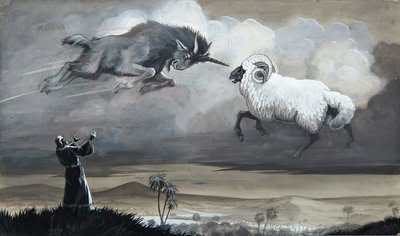
Image © Review and Herald Publishing collection at GoodSalt.com
In this case, the symbols of a ram and a goat are used because of their connection with the Day of Atonement sanctuary ritual, a time of judgment for ancient Israel. Rams and goats were used as sacrificial offerings in the sanctuary service. But only on the Day of Atonement are the two mentioned together. Hence, these two animals are intentionally chosen here to evoke the Day of Atonement, which is a major focus of the vision.
As the vision unfolds, Daniel sees a ram pushing in three different directions: westward, northward, and southward (Dan. 8:4). This triple movement indicates the expansion of this power: “so that no animal could withstand him; nor was there any that could deliver from his hand, but he did according to his will and became great” (Dan. 8:4, NKJV). As the angel explains, the ram with two horns represents the Medo-Persian Empire (Dan. 8:20), and the three directions most likely literally pointed to the three major conquests of this world power.
Next, a goat emerges with a big horn, which represents the Greek Empire under the command of Alexander the Great (Dan. 8:21). That the goat moves “without touching the ground” (Dan. 8:5, NKJV) signifies that it is moving quickly. This symbolism conveys the rapidity of Alexander’s conquest, which Daniel 7 presents as a winged leopard. But, as the prophecy indicates, when the goat “became strong, the large horn is broken” (Dan. 8:8, NKJV) and gives way to four horns, which extend to the four quadrants of the compass. This is fulfilled when Alexander dies in Babylon in June of 323 B.C., and his kingdom is divided among his four generals.
| Between Daniel 2:38 and Daniel 8:20-21, three of the four empires revealed in the visions have been named for us. How should this amazing fact help confirm the correctness of our interpretation of these prophecies? |
Amen!(2)
(2) Source: http://feedproxy.google.com/~r/SabbathSchoolNet/~3/_AHvTqNr7wk/
Turning GenZers into Radical (OK, Boomer!)
Turning GenZers into Radical (OK, Boomer!)



 Source: https://pmcdata.s3.amazonaws.com/pmc-audio/2020-02-22.mp3

