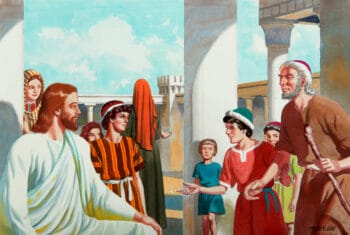
Our Sabbath School program has always been linked to the support of the Seventh-day Adventist Mission program. This video provides a little insight into this important work.
(0)Closer To Heaven
|
|
|
By admin
Our Sabbath School program has always been linked to the support of the Seventh-day Adventist Mission program. This video provides a little insight into this important work.
(0)By admin
Inside Story for Friday 24th of October 2025
By Laurie Denski-Snyman
A missionary and his local partner were selling Christian books in a non-Christian neighborhood in a large city in southern Asia. They could see residents’ religious devotion by their clothing. Women wore scarves; men had long beards. Some people even had dark spots on their foreheads from bowing their faces to the floor for long prayers.
At one house, a man with an angry face came to the front gate. “What do you want?” he asked gruffly, without opening the gate.
“We are working on a project in your community and selling books,” said the missionary, David. “Would you be willing to take a few minutes to look at these books?”
“I’ll be back in just a minute,” the man said harshly and left.
The missionary’s local partner, Maria, was afraid. “Let’s pray,” she said. “He looks scary. I think he’s a fanatic, a radical member of his faith.“
“Maybe he’s just hungry,” David said. It was the time of the year when devout religious men fasted for a month during the daytime.
Then the man returned. “Why don’t you come in?” he said.
Inside the house, he spoke abruptly. “What do you want?” he said.
David pulled several health books from his bag.
The man looked intrigued. “My wife will be interested in these because she’s a nutritionist,” he said, and called her to come and look at the books.
As he and his wife thumbed through the books, he commented with enthusiasm, “Wow, this is really good,” and “This looks really helpful.”
Then he asked bluntly, “Who are you working for?“
“We are Seventh-day Adventists,” David replied.
Abruptly, the man stood up and walked away. Then he returned and sat down. He stared at the visitors. The silence grew uncomfortable.
His wife broke the silence. “You know, I have Adventist clients,” she said. “They are very good people. But I really don’t know much about them.”
The man started to pace. He seemed agitated. Then he sat down again.
“What are those other books that you have?” his wife asked.
David opened his bag and pulled out The Great Controversy. “This book is all about true love, true forgiveness, and true peace,” he said.
She looked through it excitedly. David also showed her Steps to Christ and Thoughts From the Mount of Blessing. The man stood up, stared at the visitors, and sat down. His wife asked, “What do you believe?”
The man stood up again and walked over. He seemed determined to hear every word. Pulling out his cell phone, he started to record the conversation.
Pray for missionaries as they seek to proclaim the gospel around the world. Thank you for your Sabbath School mission offering that supports missionaries. Read the rest of this mission story next week.
(0)By admin
Daily Lesson for Friday 24th of October 2025
Read Ellen G. White, “The Fall of Jericho,” Pages 487–493, in Patriarchs and Prophets.
When rebellion against God’s authority arose in the universe, either God was going to cease to be what He essentially, immutably, and eternally is and give away the leadership of the whole universe to one of His rebellious creatures, or He was going to be the holy, righteous, loving, and merciful Father of all that exists. The Bible presents the second picture, and in this case, the clash between the forces of evil and His power is inevitable.
When political or sociohistorical powers associated with chaotic and rebellious cosmic forces manifested the same defiant attitude against Yahweh, He, as the Sovereign Lord of the universe, intervened. The motif of Yahweh as a warrior becomes a prefiguration of that ultimate victory, which will finally put an end to the ongoing cosmic conflict between good and evil (Revelation 20:8-10). Moreover, Israel’s divine wars not only reflect a glimpse of the cosmic conflict as in a mirror but are part and parcel of the same controversy, anticipating God’s end-time judgment in the sphere of present history.
“God had made it their privilege and their duty to enter the land at the time of His appointment, but through their willful neglect that permission had been withdrawn. . . . It was not His purpose that they should gain the land by warfare, but by strict obedience to His commands.”—Ellen G. White, Patriarchs and Prophets, p. 392.
Discussion Questions
|
(0)By admin
Introduction: Do you love it when a reasonable and logical plan of action comes together in success? I do. In our study of the Bible, we have been looking at some difficult-to-understand plans of action. Before crossing the Jordan, God told the people to consecrate themselves instead of preparing for war.
They crossed the Jordan when it was flooding, even though they did not need to cross immediately. The ark led during the crossing of the Jordan, rather than the soldiers. In their next adventure in conquest, the directions become even more bizarre. Let’s dive into our study of Joshua and find lessons for our life in the way God leads His people!
I. The Covenant Confirmed
A. Read Joshua 5:1-3. Consider this practical question. If you were going to circumcise all the men, would you do it on the Jericho side of the Jordan, or would you do it before you crossed the Jordan? Perhaps by the time everyone healed up, the flooding would have subsided. (If I made the decision, I would have done this in the relative safety of having a flooding river between the army of Jericho and me.)
B. Read Joshua 5:9. Has the relationship between God and His people improved? (Read Genesis 17:8-11. The final fulfillment of God’s promise to Abraham is beginning now. Part of that start is to show that they are in covenant relationship with God.)
II. The Commander
A. Read Joshua 5:13. The first thing we learn is that Joshua is near Jericho. The second thing we learn is that he is looking down. What kind of things would you guess were going through his mind? (I’ll bet he was concerned. He was probably thinking about how to take the city. What to do to win and not get too many of his men killed.)
B. Read Joshua 5:14-15. Does this seem to be the correct answer? God is not on the side of Joshua and the Israelites? (This gets back to the old saying, “The question is not whether God is on our side, but rather whether we are on His side?”)
a. Can you reconcile your picture of Jesus with a “mighty warrior” who has a drawn sword?
III. The Command
A. Read Joshua 6:1. What does this tell you about the mindset of those in Jericho? What does it tell you about the extent of the problem faced by Joshua and the Israelites?
B. Read Joshua 6:2-5. Jesus gives the battle plan to Joshua. What is it? (1. For six days march all the armed men around the city once, and the seven priests with them will blow their trumpets. 2. On the seventh day, they will march around seven times, and the last time around, the priests blow their trumpets. 3. When the trumpets give a loud blast, shout! 4. The walls will collapse, and they can take the city.)
C. Assume that your congregation wants to build a new church. I say I have a message from God. The members of your church are to get in their cars and drive around the building site once a day for six days. On the seventh day, they drive around seven times, blow their car horns, then shout, and the structure of the church will arise. Would you believe me?
D. Put yourself in the place of one of Joshua’s military leaders and you hear, “Well, guys, here is the plan.” What kinds of questions do you think they asked?
E. Do you think the Hebrews felt foolish marching around? Imagine on the sixth day of this a citizen of Jericho calls out from the city wall, “Now we know why you guys were 40 years in the wilderness.”
F. We learn additional details in the verses that follow. Read Joshua 6:9-10. Was it only the priests and the armed men who marched around Jericho? (This reveals that all the people were part of the marching.)
a. What do you think is the psychological impact of this wordless group circling the city? (The people of Jericho already believed the Hebrews were aided by supernatural power. These odd and menacing actions would increase their fear.)
G. Was there any glory to be gotten by any man from following this plan?
IV. The Result
A. Read Joshua 6:15–16 and Joshua 6:20. The lesson continues that this is a spiritual battle. Why did God have the people march around the city?
B. Read Zechariah 4:6. Is this account of the defeat of Jericho a universal Christian truth? (If it is, I’m crushed and need to repent because I’m a big planner. Look at verse six: “Not by might, nor by power, but by my Spirit.” Does this say that God has a problem with planning? No, He has a problem with us thinking that we get credit. Neither our might nor power do it, but God’s Spirit does!)
V. The Plunder
A. Read Joshua 6:17–19. Verse 17 says that the city and all that are in it are “devoted” (ESV/NIV), “accursed” (KJV), “doomed” (NKJV). The Hebrew word is herem, which means a “net” or something “dedicated to destruction.” Why was the city devoted for destruction?
B. Read Genesis 15:16. This suggests it was judgment on the people of Jericho. They were so wicked that God was executing judgment.)
C. Look again at Joshua 6:19. Do you think the treatment of Jericho had something to do with the fact that it was the first city that was conquered? (Several answers seem relevant. First, this is God’s victory, so He owns the conquest. Because Jericho was first, this might reflect the “firstfruits” concept of Mosaic law. The collapse of the walls and total destruction would terrorize the surrounding peoples. Joshua 8:2 tells us that the Hebrews were able to take plunder from Ai, the next city conquered.)
D. Friend, the lesson from Jericho is that we must totally trust God even though we do not understand the way God is leading. We should let Him lead. We should trust Him and not try to take the glory for ourselves. Will you commit to total trust in God?
VI. Next week: God Fights for You.
Copr. 2025, Bruce N. Cameron, J.D. All scripture references are to the New International Version (NIV), copr. 1973, 1978, 1984 International Bible Society, unless otherwise noted. Quotations from the NIV are used by permission of Zondervan Bible Publishers. Suggested answers are found within parentheses. If you normally receive this lesson by e-mail, but it is lost one week, you can find it by clicking on this link: http://www.GoBible.org. Pray that the Holy Spirit will guide your mind as you study.
(0)By admin
What are the lessons from the manner in which Jericho was taken? Join the Hit the Mark Sabbath School panel as they discuss Lesson 4 – The Conflict Behind All Conflicts. It’s the fastest hour of the week!
(0)