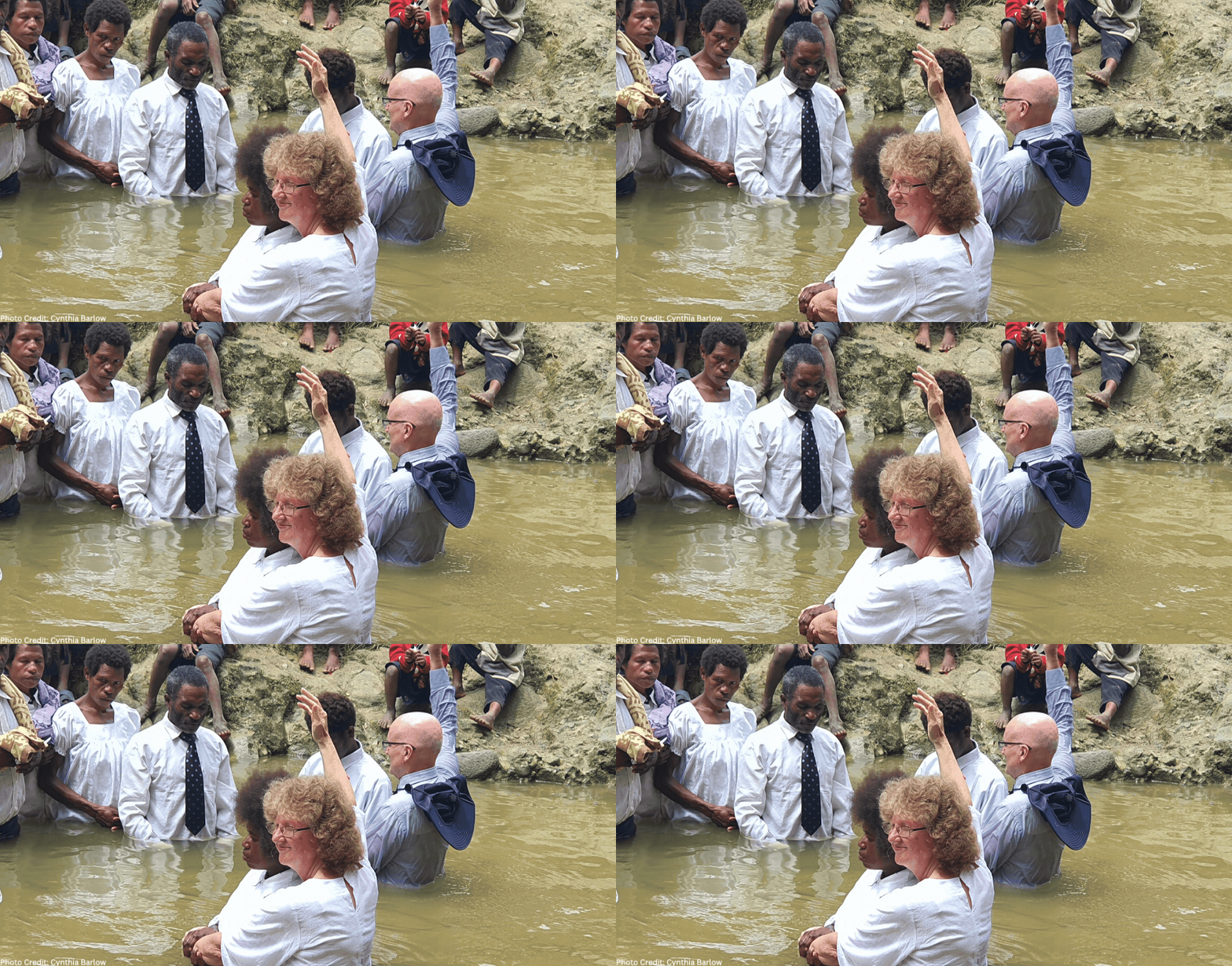
Witness the transformative power of faith and dedication in this episode. God is mightily working through those who have devoted their lives to His service. Thanks to the support of Adventist World Radio, incredible things are happening in the remotest parts of the earth. Together, we are creating a ripple effect, from broadcast to baptism, spreading God's message far and wide. Tune in and become part of this journey
#AWR360 #BroadcastToBaptism #RadioEvangelism #Faith #Dedication Source: https://www.youtube.com/watch?v=7h7e8gDzx40
Deuteronomio 1:32,33 – Domenica 30 giugno 2024
“Nonostante questo, non aveste fiducia nell’Eterno vostro Dio, che andava davanti a voi nel cammino, per cercarvi un luogo dove piantare le tende, con il fuoco di notte e con la nuvola di giorno, per mostrarvi per quale via dovevate andare.”(Deuteronomio 1:32,33) Meditazione giornaliera “Apri la porta del tuo cuore”. Rubrica a cura di Anna Cupertino. Speaker: Abigail Grace Miguel Source: https://www.youtube.com/watch?v=qHOMZnAousg
Lesson 1.The Beginning of the Gospel | 1.1 The Failed Missionary


1.1 The Failed Missionary
Introduction and Early Setback of John Mark
Read Acts 12:12. How is Mark introduced in the book of Acts?
John Mark, the most likely author of the Gospel of Mark, is introduced in an interesting way in the book of Acts. In Acts 12:12, he is presented as the son of Mary, an obviously wealthy supporter of the church who hosted a famous prayer meeting in her house. Although he does not play an active role in this passage, his introduction lays the foundation for his later connection with Barnabas and Saul. The events surrounding Peter’s spectacular prison escape and the contrasting incidents involving the death of Herod are rich in meaning and even humorous contrasts between Peter and the king. These stories provide a deep insight into the dynamic development of the early Christian community and the individual challenges its members faced.
Read Acts 13:1–5, 13. How did John Mark get attached to Saul and Barnabas, and what was the outcome?
John Mark plays a remarkable, albeit brief, role in the first missionary journey of Saul and Barnabas as described in Acts 13. His introduction in this narrative occurs in verse 5, where he is simply mentioned as a helper or servant. This position highlights his support for the main missionaries without taking a leading role.
The abrupt end of his participation in the missionary journey, as described in verse 13, raises many questions since no reasons for his return to Jerusalem are given. This lack of detail leaves much room for speculation and interpretation regarding his motives. Ellen G. White offers a possible explanation, suggesting that Mark was overwhelmed by fear and discouragement. This reaction could be due to his unfamiliarity with the hardships and dangers of missionary life, leading him to withdraw.
The brief mention of John Mark and his subsequent withdrawal underline the challenges and uncertainties faced by early Christians. It also shows the human side of the Acts of the Apostles, where even the most dedicated followers can be overwhelmed by fear and doubt at times. This episode teaches us that setbacks and difficulties are part of the journey of faith and that it is important to learn from them and grow.

The story of John Mark has profound connections to our daily lives and faith. It teaches us valuable lessons about the importance of grace, forgiveness, and the power of second chances.
-
Humility and Recognition of One’s Limits:
-
Daily Life: In everyday life, we often recognize our own limits and need to learn how to deal with them. This can mean seeking help or setting realistic goals.
-
Faith: In our faith journey, humility shows us that we are dependent on God’s help and guidance. It reminds us that we don’t have to face everything alone.
-
-
Growth Through Setbacks:
-
Daily Life: Mistakes and failures offer us opportunities to learn and grow. They help us become more resilient and wiser.
-
Faith: Setbacks in our faith can bring us closer to God if we learn to trust Him and accept His plans.
-
-
Importance of Community:
-
Daily Life: Support from family and friends is essential in difficult times. A strong community helps us overcome challenges.
-
Faith: The church community provides encouragement and support, especially when we struggle with doubts and difficulties.
-
-
Strength in Prayer:
-
Daily Life: Prayer can give us peace and clarity in stressful times. It helps us organize our thoughts and find tranquility.
-
Faith: In prayer, we find a direct connection to God. It allows us to express our fears and gratitude and seek His guidance.
-
-
Self-Reflection and Trust in God’s Plan:
-
Daily Life: Regular self-reflection helps us rethink and adjust our goals and actions.
-
Faith: Trust in God’s plan gives us confidence that even difficult times and failures are part of a greater plan.
-
The story of John Mark teaches us that we should not give up despite setbacks and challenges on our journey of faith. Instead, we should use these experiences as opportunities to learn and grow, both in our daily lives and in our faith.
Setbacks are not defeats, but steps of learning on the path to a stronger faith and a more fulfilling life.
Source: https://fulfilleddesire.net/lesson-1-the-beginning-of-the-gospel-1-1-the-failed-missionary/
The Growth of Home Church Services
In this episode, we continue to follow Mama Cisit's faith journey in Madagascar. As her family's prayers were answered, neighbors and family members began to join their home church services. Over the years, the numbers grew, leading to the construction of three churches to accommodate all the new members. Mama Cisit and her husband continue to lead the work, witnessing the blessings that God has brought to their community through Adventist World Radio. Join us to witness the transformative power of radio evangelism
#AWR360 #Madagascar #RadioEvangelism #Faith #CommunityGrowth Source: https://www.youtube.com/watch?v=xHSF5nNhrBs
Growing Old Gracefully
Cast me not off in the time of old age; forsake me not when my strength faileth. Psalm 71:9.
David entreated the Lord not to forsake him in old age. And why did he thus pray? He saw that most of the aged around him were unhappy, because of the unfortunate traits of their character being increased with their age. If they had been naturally close and covetous, they were most disagreeably so in mature years. If they had been jealous, fretful, and impatient, they were especially so when aged.51The S.D.A. Bible Commentary 3:1148.
David was distressed as he saw that kings and nobles who seemed to have the fear of God before them while in the strength of manhood, became jealous of their best friends and relatives when aged. They were in continual fear that it was selfish motives which led their friends to manifest an interest for them. They would listen to the hints and the deceptive advice of strangers in regard to those in whom they should confide. Their unrestrained jealousy sometimes burned into a flame because all did not agree with their failing judgment. Their covetousness was dreadful. They often thought that their own children and relatives were wishing them to die in order to take their place and possess their wealth, and receive the homage which had been bestowed upon them. And some were so controlled by their jealous, covetous feelings as to destroy their own children.
David marked that although the lives of some while in the strength of manhood had been righteous, as old age came upon them they seemed to lose their self-control. Satan stepped in and guided their minds, making them restless and dissatisfied….
David was deeply moved; he was distressed as he looked forward to the time when he should be aged. He feared that God would leave him and that he would be as unhappy as other aged persons whose course he had noticed, and would be left to the reproach of the enemies of the Lord. With his burden upon him he earnestly prays: “Cast me not off in the time of old age; forsake me not when my strength faileth.” 52Testimonies For The Church 1:422, 423.
Conflict and Courage p. 186
~~~~~~~~~~~~~~~~~~~~~~~~~~~~~~
Prayer Requests
—-Please pray for my brother Dennis. He has a tear in an artery in his neck which caused him to have a mild stroke. Please pray for the doctors that God will give them wisdom in how to deal with this condition. Ron
—-I am still receiving some very strong implied death threats from some very dangerous people. Please pray for a hedge of protection to be put around me and my whole family. Thank you so much. Connie
~~~~~~~~~~~~~~~~~~~~~~~~~~~~~~
Dear Friends,
When I was a little girl, my grandfather told me many stories of the long ago when he was a boy “riding the rails” up and down the east coast of the United States. As he rode along, he would pretend that he was the engineer driving that huge, cinder-spouting engine. That was his goal and ambition, but it was not to be. He was forced into learning the family trade of bookbinding. It was much against his will, but somehow his father was able to force him into it. To compensate for the long hours inside the bindery, he often dreamed that the huge arm of the press he used to bind the books was the throttle of a gigantic locomotive.
Many of his stories were about trains. He looked upon the times that he spent “riding the rails” as the happiest times of his life. He had felt the train’s power. He had felt so free. Often, on the way home from work, he would stop by the rail yard just admire the powerful engines and wish that he were a part of it all. Sometimes, he would take me with him, so we could watch the trains together. He would explain every detail and instilled within me a love for trains also. For awhile, I even decided that I would someday become an engineer just as my grandfather had wanted to be. Of course, my interests changed and I did not pursue that career.
As I look back upon my grandfather’s life, I now can see how unhappy he really was. He was in great demand as a bookbinder because of his skill in that occupation, but it brought him no pleasure, no satisfaction. He just went through the motions. His heart was not in it. Even so, it is possible for us to do the same in our walk with Christ. We can have a form of godliness, but deny His power thereof to change us. (2 Tim 3:5) We desire to follow our Dear Saviour, but never quite do so. We talk about religion, but it never seems to change our heart. We dream of the place He has gone to prepare for us, (John 14:1-3; Rev 21, 22) but we fail to fulfill the conditions for entrance into His Heavenly Kingdom. The free gift of salvation has been provided, but we must reach out and take it. It is not forced upon us.
God never forces. Force is the devil’s way. God loves us enough to give us the freedom of choice. He plainly sets before us in His Holy Word the way to life and blessing and explains the everlasting death we will receive if we turn away from His great gift. With tears in His eyes, He pleads with us, “choose life, that both thou and thy seed may live.” “Come now, and let us reason together, saith the LORD: though your sins be as scarlet, they shall be as white as snow; though they be red like crimson, they shall be as wool. If ye be willing and obedient, ye shall eat the good of the land: But if ye refuse and rebel, ye shall be devoured.” “I have no pleasure in the death of the wicked; but that the wicked turn from his way and live: Turn ye, turn ye from your evil ways; for why will ye die?” “Come unto me, all ye that labour and are heavy laden, and I will give you rest. Take my yoke upon you, and learn of me; for I am meek and lowly in heart: and ye shall find rest unto your souls. For my yoke is easy, and my burden is light.” Deut 30:19; Isa 1:18-20; Eze 33:11; Matt 11:28-30
Our Great Redeemer has provided the way for us to be saved, but we have to ask for it, to reach out and take it. This most familiar of verses brings us the hope of a better life to come for those who do. The verses following are full of meaning as well. “God so loved the world, that he gave his only begotten Son, that whosoever believeth in him should not perish, but have everlasting life. For God sent not his Son into the world to condemn the world; but that the world through him might be saved. For God sent not his Son into the world to condemn the world; but that the world through him might be saved. He that believeth on him is not condemned: but he that believeth not is condemned already, because he hath not believed in the name of the only begotten Son of God. And this is the condemnation, that light is come into the world, and men loved darkness rather than light, because their deeds were evil. For every one that doeth evil hateth the light, neither cometh to the light, lest his deeds should be reproved. But he that doeth truth cometh to the light, that his deeds may be made manifest, that they are wrought in God.” John 3:16-21
“Playing church,” going through the motions, does no good. We must have a daily heart-changing experience, a daily conversion.
Our Loving Redeemer promises, “a new heart also will I give you, and a new spirit will I put within you: and I will take away the stony heart out of your flesh, and I will give you an heart of flesh. And I will put my spirit within you, and cause you to walk in my statutes, and ye shall keep my judgments, and do them.” Eze 36:26,27 Peter advises, “Wherefore the rather, brethren, give diligence to make your calling and election sure: for if ye do these things, ye shall never fall.” 2 Peter 1:10 John adds, “Love not the world, neither the things that are in the world. If any man love the world, the love of the Father is not in him. For all that is in the world, the lust of the flesh, and the lust of the eyes, and the pride of life, is not of the Father, but is of the world. And the world passeth away, and the lust thereof: but he that doeth the will of God abideth for ever.” 1 John 2:15-17 “For this is the will of God, even your sanctification.” 1 Thes 4:3
How are we sanctified? How can we receive that change of heart that we so much need? In that great prayer of Jesus, we find the key. Our Dear Saviour prayed, “Sanctify them through thy truth: thy word is truth.” John 17:17 David adds, “Wherewithal shall a young man cleanse his way? by taking heed thereto according to thy word. With my whole heart have I sought thee: O let me not wander from thy commandments. Thy word have I hid in mine heart, that I might not sin against thee.” Ps 119:9-11 Solomon adds, “My son, keep my words, and lay up my commandments with thee. Keep my commandments, and live; and my law as the apple of thine eye. Bind them upon thy fingers, write them upon the table of thine heart.” “Let us hear the conclusion of the whole matter: Fear God, and keep his commandments: for this is the whole duty of man.” Pro 7:1-3; Ecc 12:13
May we accept God’s Great Provision, serving Him in singleness of heart from this day onward, not just going through the motions, not just “playing church;” but having that heart-changing experience He longs for us to have by daily studying God’s Holy Word, that we may as “with open face beholding as in a glass the glory of the Lord, [be] changed into the same image from glory to glory, even as by the Spirit of the Lord.” 2 Cor 3:18
Rose
Source: https://rosesdevotional.org/growing-old-gracefully-2.html
AWR360° Tanzania – The Singing Girl Part 6
AWR360° Tanzania – The Singing Girl Part 6 #adventistworldradio #awr360 #thesinginggirl #tanzania #missionstories MB01NUPT0KWHUWI #short Source: https://www.youtube.com/watch?v=rqua2JRpZpk
AWR360° Tanzania – The Singing Girl Part 5
AWR360° Tanzania – The Singing Girl Part 5 #adventistworldradio #awr360 #thesinginggirl #tanzania #missionstories MB01GZVCEDRWFJF #short Source: https://www.youtube.com/watch?v=_G4r4Dk4DL0
The Book of Mark – Lesson 1.The Beginning of the Gospel | Sabbath School with Pastor Mark Finley

Series THE BOOK OF MARK with Pastor Mark Finley |
Lesson 1.The Beginning of the Gospel |
Jesus’ Early Ministry in Mark
Lesson 1 delves into the early stages of Jesus’ ministry as narrated in the Gospel of Mark. It begins with John the Baptist’s role in preparing the way for Jesus, emphasizing the significance of repentance and baptism. The lesson highlights Jesus’ baptism, where He is affirmed by God and anointed by the Holy Spirit, marking the start of His public ministry. It also covers Jesus’ proclamation of the gospel, calling people to repent and believe as the kingdom of God is near. Additionally, the lesson explores the selection of the first disciples and Jesus’ early miracles, establishing His divine authority and mission.
Memory Text: Mark 1,14.15 – “Now after John was put in prison, Jesus came to Galilee, preaching the gospel of the kingdom of God, and saying, ‘The time is fulfilled, and the kingdom of God is at hand. Repent and believe in the gospel.’ ”
Content:
1.1 The Failed Missionary
Introduction and Early Setback of John Mark
John Mark is introduced in Acts 12:12 as the son of Mary, a wealthy supporter of the early church who hosted prayer meetings at her home. Although he does not play a significant role in the events of Acts 12, this introduction sets the stage for his later involvement with Barnabas and Saul. In Acts 13:1–5, 13, we learn that John Mark accompanied Saul and Barnabas on their first missionary journey, serving as a helper. However, in verse 13, it is noted that he returned to Jerusalem, leaving the mission. Ellen G. White suggests that fear and discouragement led to his departure, as he was unaccustomed to the hardships of missionary work. This early setback did not define his entire ministry, as John Mark would later be recognized for his contributions to the Gospel.
1.2 A Second Chance
The Redemption of John Mark
Paul rejected John Mark because he had previously deserted them and not continued in the ministry, as noted in Acts 15:38. Paul viewed the missionary work as demanding and needing reliable companions, making him reluctant to trust Mark again. However, Barnabas, seeing potential in Mark and unwilling to give up on him, chose to give him a second chance, leading to a sharp disagreement between Paul and Barnabas. This dispute resulted in them parting ways, with Paul taking Silas and Barnabas taking Mark. Later New Testament references, including Colossians 4:10 and 2 Timothy 4:11, indicate Mark’s significant recovery and valuable contribution to the ministry, showing that Barnabas’s faith in him was well-placed.
1.3 The Messenger
John the Baptist: Preparing the Way
Mark 1:1-8 introduces three main characters: Jesus Christ, God the Father, and John the Baptist. John is depicted as a preacher preparing the way for Jesus, fulfilling Old Testament prophecies from Exodus, Isaiah, and Malachi, which all speak of a journey. John calls for repentance and emphasizes the coming of someone much greater than himself, referring to Jesus. His humility is highlighted when he states he is not worthy to untie Jesus’ sandals. These verses set the stage for the beginning of Jesus’ ministry and the journey that will lead to His sacrificial death.
1.4 Jesus’ Baptism
The Baptism and Temptation of Jesus
Jesus’ baptism in Mark 1:9-13 includes significant figures and events. John baptizes Jesus in the Jordan River, and as Jesus emerges from the water, the heavens open, and the Holy Spirit descends like a dove. God’s voice proclaims, “You are my beloved Son; with you I am well pleased.” This moment highlights the presence of the Trinity, affirming the start of Jesus’ ministry. Following His baptism, the Spirit drives Jesus into the wilderness, where He faces temptation from Satan. This scene underscores both Jesus’ divinity and humanity, illustrating His unique role as both God and man.
1.5 The Gospel According to Jesus
The Gospel According to Jesus: Fulfillment, Kingdom, and Call to Repentance
Mark 1:14-15 presents Jesus’ gospel message in three key parts: the fulfillment of time prophecy, the nearness of God’s kingdom, and the call to repentance and belief. The time prophecy Jesus refers to is the 70-week prophecy from Daniel 9:24-27, which predicts significant events in Jesus’ life. This prophecy began in 457 B.C. and pointed to A.D. 27 when Jesus was baptized and started His ministry. His crucifixion occurred three and a half years later, with the prophecy’s completion marked by Stephen’s stoning in A.D. 34. This moment signaled the broader spread of the gospel to the Gentiles.
1.6 Summary
Jesus’ Early Ministry
Lesson 1 focuses on the early ministry of Jesus as described in the Gospel of Mark. It highlights significant events such as Jesus’ baptism by John the Baptist, which marks the beginning of His public ministry and the affirmation of His divine sonship. The lesson also covers Jesus’ initial proclamation of the gospel message, emphasizing the fulfillment of time prophecy, the nearness of God’s kingdom, and the call to repentance and belief. Additionally, the lesson addresses the selection of the first disciples and Jesus’ early miracles, which establish His authority and mission. Overall, it sets the stage for understanding Jesus’ role and the transformative power of His message.
Lesson 13: “The Triumph of God’s Love”
Study: Lesson 13, The Triumph of God's Love — Kishore Isaac THANK YOU. Media Ministry needs your continued financial support. Please donate by visiting "https://adventistgiving.org/#/org/ANB4RC/envelope/start" and select “Media Ministries”. Connect With Us
X: RemnantSDA
Facebook: RemnantSDAchurch.org
Instagram: RemnantSDAchurch Source: https://www.youtube.com/watch?v=nmaLxssMd0M
Sunday: The Failed Missionary
Daily Lesson for Sunday 30th of June 2024
Read Acts 12:12. How is Mark introduced in the book of Acts?
It seems probable that John Mark, the most likely author of the Gospel of Mark, was a young man when the events in Acts 12:1-25 occurred, probably in the A.D. mid-40s. He is introduced in verse 12 as the son of a woman named Mary. She was evidently a wealthy supporter of the church and held the prayer meeting at her home, made famous in Acts 12:1-25.
Image © Lifeway Collection at Goodsalt.com
from the background are Barnabas and Paul. Barnabas looks worried and Paul looks angry.
The story of Peter’s escape from prison and the subsequent actions and then the death of Herod are replete with striking, even humorous, contrasts between Peter and the king. John Mark does not really play any role in the story, but the introduction of him at this point prepares for his later connection with Barnabas and Saul.
Read Acts 13:1-5, 13. How did John Mark get attached to Saul and Barnabas, and what was the outcome?
Acts 13:1-52 describes the first missionary journey of Saul and Barnabas, starting about A.D. 46. John Mark is not mentioned until verse 5, and his role is simply as a helper or servant. No other reference is made to the young man until verse 13, where the brief account notes that he returned to Jerusalem.
No reason is given for this departure, and the absence of any description of his feelings or emotions leaves to the imagination what motivated his withdrawal from the missionary effort, which no doubt was filled with peril and challenges. Ellen G. White indicates that “Mark, overwhelmed with fear and discouragement, wavered for a time in his purpose to give himself wholeheartedly to the Lord’s work. Unused to hardships, he was disheartened by the perils and privations of the way.”—The Acts of the Apostles, p. 169. In short, things simply got too hard for him, and so he wanted out.
Recall a time when you backed off from something—or even flat out failed at it—in your Christian walk. What did you learn from the experience?
(0)The post Sunday: The Failed Missionary first appeared on Sabbath School Net.
Source: https://ssnet.org/blog/24c-01-the-failed-missionary/