• Home
  • Devotionals
  • BiblePhone
  • Blogs
  • TV
  • Prayer
    • Submit Prayer Request
    • Prayer Requests List
  • Contact us
  • Romanian

Intercer Adventist News

Closer To Heaven

  • About us
    • About Adventist Church
    • About Intercer Adventist News
    • About Intercer
    • About Lucian Web Service
    • Latest News
    • Romanian Church News
  • News and Feeds
    • Intercer Adventist News
    • 60 Second SlideShows
    • “Adventist Tweets” Paper
    • Adventists on Twitter
    • Adventists on Google Plus
    • Bible Resources
      • Adventist Universities Daily Bible
      • Answers For Me
        • Dear God
        • Healthy Living
        • Life Notes
        • Spiritual applications
        • Vegetarian recipes
      • Better Sermons
        • Spirit Renew Quotes
      • Daily Bible Promise
      • E-GraceNotes
        • Bible Says
        • City Lights
        • Family First
        • Staying Young
      • Story Harvest
        • Personal Stories
      • SSNet.org
    • Churches & Organizations
      • Adventist News Network
      • Adventist Review
      • Adventist World Radio
      • Avondale College
      • Babcock University Nigeria
      • BC Alive
      • British Union Conference
      • Canadian Adventist Messenger
      • Canadian Union
      • North American Division News
      • Outlook Magazine
      • PM Church – Pastor’s Blog
      • Potomac Conference
      • Record Magazine – Australia
      • Review and Herald
      • Trans-European Division
      • Washington Conference
    • Health
      • Dr.Gily.com
      • Vegetarian-Nutrition.info
    • Ministries
      • 7 Miracle (Youth)
      • A Sabbath Blog
      • Adventist Blogs
      • Adventist Today
      • ADvindicate
      • Creative Ministry
      • Grace Roots
      • Romanian Church News
      • Rose’s Devotional
      • UNashamed
    • Personal
      • Alexandra Yeboah
      • Iasmin Balaj
      • Jennifer LaMountain
      • McQue’s View
      • Refresh with Tia
      • Shawn Boonstra
  • Sermons & Video Clips
    • Churches
      • Downey Adventist Church
      • Fresno Central SDA Church
      • Hillsboro Adventist Church
      • Mississauga SDA Church
      • New Perceptions Television (PM Church)
      • Normandie Ave SDA Church
      • Remnant Adventist Church
    • Organizations
      • Adventist News Network (ANN)
      • ADRA Canada
      • Adventists About Life
      • Adventist Education
      • Adventist Mission
      • Amazing Facts
      • Adventist Church Connect
      • BC Adventist
      • Church Support Services
      • In Focus (South Pacific)
      • IIW Canada
      • NAD Adventist
      • NAD Church Resource Center (Vervent)
      • NARLA
      • Newbold
      • Review & Herald
      • SECMedia
      • Video Avventista (Italy)
    • Ministries
      • 3AngelsTube.com
      • Answered.TV
      • AudioVerse.org
      • AYO Connect
      • Christian Documentaries
      • GAiN #AdventistGeeks
      • GYC
      • Intercer Websites
      • Josue Sanchez
      • LightChannel
      • Pan de Vida
      • Revival and Reformation
      • Stories of Faith
      • SAU Journalism/Communication
      • Spirit Flash
      • The Preaching Place (UK)
      • Toronto East Youth Nation
    • Personal
      • Esther-Marie Hartwell
      • McQuesView
      • Pastor Manny Cruz
    • Sabbath School
      • Ecole du Sabbat Adventiste
      • Sabbath School Audio Podast
      • Sabbath School daily
  • Resources
    • Bible and Bible Studies
    • Health
    • Music
  • All articles
  • G+ News & Marketplace
    • G+ News & Marketplace Group
    • G+ Page
You are here: Home / Archives for Adventist Sermons & Video Clips / Fulfilled Desire

7.10.2024 – John Chapter 1 | BELIEVE HIS PROPHETS

October 6, 2024 By admin

The Message of the Book of John
The Gospel of John, one of the four Gospels in the New Testament, differs in style and content from the Synoptic Gospels (Matthew, Mark, and Luke). The message of the Gospel of John can be summarized in several central themes:
1.The Divinity of Jesus Christ
The Gospel of John strongly emphasizes the divine nature of Jesus. From the beginning (John 1:1-14), Jesus is depicted as the “Word” (Logos) who was with God and is God Himself. This emphasis underscores that Jesus is not only a human being but also divine.
2.Faith and Eternal Life
A central theme is the belief in Jesus as the Son of God who brings eternal life. The Gospel emphasizes that faith in Jesus Christ is the path to salvation and eternal life (John 3:16). The idea that faith in Jesus is directly connected to access to God is highlighted repeatedly.
3.Light and Darkness
John uses the metaphor of light and darkness to represent the contrast between good and evil, truth and falsehood, as well as knowledge and ignorance. Jesus is described as the light of the world that comes into darkness to illuminate it (John 1:4-5).
4.Miracles and Signs
The Gospel of John presents various miracles, also referred to as “signs,” that testify to Jesus’ divine authority. These signs are meant to inspire people to believe in Jesus and recognize His divine mission (e.g., the turning of water into wine, the healing of the man born blind).
5.God’s Love
Another central theme is the love of God, which is manifested in Jesus’ life and teachings. Particularly noteworthy is the command to love one another as Jesus has loved us (John 13:34-35). This love is a hallmark of Jesus’ followers and is meant to show the world that they are His disciples.
6.Jesus’ Farewell Discourses and Teachings
The Gospel of John includes detailed farewell discourses by Jesus to His disciples, in which He gives them instructions, offers comfort, and announces His future return. These passages emphasize the spiritual unity and eternal bond between Jesus and His followers (John 14-17).
7.The New Commandment
Jesus gives His disciples a new commandment: “That you love one another as I have loved you” (John 13:34). This commandment underscores the importance of love as a fundamental principle of Christian life.
8.The Role of the Holy Spirit
The Gospel also speaks about the Holy Spirit as a Comforter and Helper who will guide and empower believers (John 14:16-17). The Holy Spirit is an essential part of God’s plan to support believers.
Summary
The Gospel of John conveys the message that Jesus Christ is the divine Son of God who came to redeem humanity through His death and resurrection. It emphasizes the necessity of faith in Him for eternal life, the central role of love, and the presence of the Holy Spirit. Through its unique teachings and signs, the Gospel invites believers to cultivate a personal and profound relationship with Jesus Christ.


October 7, 2024
DAILY BIBLE READING – John Chapter 1
1 In the beginning was the Word, and the Word was with God, and the Word was God.
2 The same was in the beginning with God.
3 All things were made by him; and without him was not any thing made that was made.
4 In him was life; and the life was the light of men.
5 And the light shineth in darkness; and the darkness comprehended it not.
6 There was a man sent from God, whose name was John.
7 The same came for a witness, to bear witness of the Light, that all men through him might believe.
8 He was not that Light, but was sent to bear witness of that Light.
9 That was the true Light, which lighteth every man that cometh into the world.
10 He was in the world, and the world was made by him, and the world knew him not.
11 He came unto his own, and his own received him not.
12 But as many as received him, to them gave he power to become the sons of God, even to them that believe on his name:
13 Which were born, not of blood, nor of the will of the flesh, nor of the will of man, but of God.
14 And the Word was made flesh, and dwelt among us, (and we beheld his glory, the glory as of the only begotten of the Father,) full of grace and truth.
15 John bare witness of him, and cried, saying, This was he of whom I spake, He that cometh after me is preferred before me: for he was before me.
16 And of his fulness have all we received, and grace for grace.
17 For the law was given by Moses, but grace and truth came by Jesus Christ.
18 No man hath seen God at any time, the only begotten Son, which is in the bosom of the Father, he hath declared him.
19 And this is the record of John, when the Jews sent priests and Levites from Jerusalem to ask him, Who art thou?
20 And he confessed, and denied not; but confessed, I am not the Christ.
21 And they asked him, What then? Art thou Elias? And he saith, I am not. Art thou that prophet? And he answered, No.
22 Then said they unto him, Who art thou? that we may give an answer to them that sent us. What sayest thou of thyself?
23 He said, I am the voice of one crying in the wilderness, Make straight the way of the Lord, as said the prophet Esaias.
24 And they which were sent were of the Pharisees.
25 And they asked him, and said unto him, Why baptizest thou then, if thou be not that Christ, nor Elias, neither that prophet?
26 John answered them, saying, I baptize with water: but there standeth one among you, whom ye know not;
27 He it is, who coming after me is preferred before me, whose shoe’s latchet I am not worthy to unloose.
28 These things were done in Bethabara beyond Jordan, where John was baptizing.
29 The next day John seeth Jesus coming unto him, and saith, Behold the Lamb of God, which taketh away the sin of the world.
30 This is he of whom I said, After me cometh a man which is preferred before me: for he was before me.
31 And I knew him not: but that he should be made manifest to Israel, therefore am I come baptizing with water.
32 And John bare record, saying, I saw the Spirit descending from heaven like a dove, and it abode upon him.
33 And I knew him not: but he that sent me to baptize with water, the same said unto me, Upon whom thou shalt see the Spirit descending, and remaining on him, the same is he which baptizeth with the Holy Ghost.
34 And I saw, and bare record that this is the Son of God.
35 Again the next day after John stood, and two of his disciples;
36 And looking upon Jesus as he walked, he saith, Behold the Lamb of God!
37 And the two disciples heard him speak, and they followed Jesus.
38 Then Jesus turned, and saw them following, and saith unto them, What seek ye? They said unto him, Rabbi, (which is to say, being interpreted, Master,) where dwellest thou?
39 He saith unto them, Come and see. They came and saw where he dwelt, and abode with him that day: for it was about the tenth hour.
40 One of the two which heard John speak, and followed him, was Andrew, Simon Peter’s brother.
41 He first findeth his own brother Simon, and saith unto him, We have found the Messias, which is, being interpreted, the Christ.
42 And he brought him to Jesus. And when Jesus beheld him, he said, Thou art Simon the son of Jona: thou shalt be called Cephas, which is by interpretation, A stone.
43 The day following Jesus would go forth into Galilee, and findeth Philip, and saith unto him, Follow me.
44 Now Philip was of Bethsaida, the city of Andrew and Peter.
45 Philip findeth Nathanael, and saith unto him, We have found him, of whom Moses in the law, and the prophets, did write, Jesus of Nazareth, the son of Joseph.
46 And Nathanael said unto him, Can there any good thing come out of Nazareth? Philip saith unto him, Come and see.
47 Jesus saw Nathanael coming to him, and saith of him, Behold an Israelite indeed, in whom is no guile!
48 Nathanael saith unto him, Whence knowest thou me? Jesus answered and said unto him, Before that Philip called thee, when thou wast under the fig tree, I saw thee.
49 Nathanael answered and saith unto him, Rabbi, thou art the Son of God; thou art the King of Israel.
50 Jesus answered and said unto him, Because I said unto thee, I saw thee under the fig tree, believest thou? thou shalt see greater things than these.
51 And he saith unto him, Verily, verily, I say unto you, Hereafter ye shall see heaven open, and the angels of God ascending and descending upon the Son of man.
King James Version. Public Domain


Commentary
Introduction:
John Chapter 1 is a fundamental section in the Gospel of John that highlights the preexistent nature of Jesus Christ as well as His incarnation into the world. This chapter lays the foundation for understanding Jesus as the eternal Word (Logos), who was with God and is God Himself. It introduces central themes such as light and darkness, testimony and faith, as well as the calling of the first disciples. Through its poetic and theologically profound language, the Gospel of John distinguishes itself from the Synoptic Gospels and offers a unique perspective on the nature and mission of Jesus.
Commentary:
1.The Word Became Flesh (John 1:1-14):
  • Preexistence of the Word: John begins with a majestic statement about the Word (Logos), who was in the beginning with God and is God Himself. This emphasizes the eternal existence of Jesus and His divine nature.
  • Creation through the Word: All things were made through the Word, highlighting Jesus’ all-encompassing power as Creator.
  • Life and Light: In Jesus was life, and that life was the light of all mankind. Light and darkness serve as metaphors for good and evil, truth and error.
  • Incarnation: “The Word became flesh and made his dwelling among us” (v.14) emphasizes the humanity of Jesus, which is a central theme in Christian belief. Jesus is described as the only Son from the Father, full of grace and truth.
2.The Testimony of John the Baptist (John 1:15-34):
  • John the Baptist: John bears witness to Jesus, identifying Him as the true Light that enlightens the world. He makes it clear that he is not the Light himself but only a witness to it.
  • Preparation for Jesus’ Coming: John describes Jesus as the one who comes after him and is greater than him. This highlights Jesus’ superiority and prepares the listeners for Jesus to take on the divine mission.
  • The Image of the Father: John sees the Spirit come down like a dove upon Jesus and recognizes Him as the Son of God. This confirms Jesus’ divine authority and His role as the mediator between God and humanity.
3.The First Disciples (John 1:35-51):
  • Calling of the First Disciples: The first two disciples follow John and are then called by Jesus to follow Him. This shows the transformative impact of Jesus’ testimony and His attracting power.
  • Recognition of Jesus as the Messiah: Andrew brings his brother Simon Peter to Jesus, and Nathanael recognizes Jesus as the “King of Israel” and the “Son of God.” This recognition is crucial for the spread of the early Church.
  • Promise of Greater Revelations: Jesus promises Nathanael that he will see greater things, indicating future revelations and miracles that further confirm Jesus’ divine nature.
Summary:
John Chapter 1 serves as the prologue of the Gospel of John and introduces central theological concepts that shape the entire Gospel text. It emphasizes the preexistence and divinity of Jesus Christ as the eternal Word who became flesh to dwell among humans. Through the testimony of John the Baptist, Jesus’ divine mission is affirmed, and the calling of the first disciples demonstrates the immediate impact of Jesus’ words and actions. The chapter lays the foundation for understanding light and darkness, grace and truth, and redemption through faith in Jesus. Overall, John Chapter 1 presents Jesus as the divine Messiah who came to redeem humanity and enable a personal relationship between God and people.


WEEKLY SPIRIT OF PROPHECY READING – Ellen White | The Desire of Ages
Chapter 68—In the Outer Court
This chapter is based on John 12:20-42.
Read online here


Commentary
Introduction
Chapter 68 is based on John 12:20-43 and deals with a pivotal event in Jesus’ life, when Greeks expressed the desire to see him. This chapter highlights the transition from Jesus’ earthly ministry to his impending sacrificial death on the cross, which would hold significance not only for the Jews but for all humanity. The desire of the Greeks to see Jesus symbolizes the universal appeal of his sacrifice and the expansion of the Gospel beyond the Jewish people.
Commentary
The chapter begins with the Greeks’ request to see Jesus, which Jesus interprets as a sign of his imminent glorification through his death on the cross. This encounter is reminiscent of the Magi who came at Jesus’ birth, signaling that Jesus’ mission is now extending beyond the borders of Israel. Jesus seizes the moment to compare his death to a grain of wheat that must die to bear fruit, emphasizing the necessity of his sacrifice for the salvation of the world.
The chapter underscores the importance of self-sacrifice, both in Jesus’ life and in the lives of his followers. Jesus speaks of his coming exaltation on the cross as the moment when he will draw all people to himself. Despite these revelations, many remain in disbelief, and even some of the leaders are afraid to publicly confess their faith.
Summary
Chapter 68 describes the final moments of Jesus before his crucifixion, interpreting the Greeks’ desire to see him as a sign of the expansion of his mission. Jesus explains that his death, like the death of a grain of wheat, is necessary to bring forth new life. The chapter emphasizes the universal significance of Jesus’ sacrifice and the spread of the Gospel beyond Israel. It calls for self-sacrifice, both for Christ and his followers, while reflecting the deep sorrow over the continued disbelief of many.


WEEKLY SPIRIT OF PROPHECY READING – Ellen White | The Desire of Ages
Chapter 69—On the Mount of Olives
This chapter is based on Matthew 24; Mark 13; Luke 21:5-38.
Read online here


Commentary
Introduction
Chapter 69 is based on the writings of Matthew 24, Mark 13, and Luke 21:5-38. It addresses Jesus’ prophetic announcements regarding the destruction of Jerusalem and His second coming. This discourse, delivered on the Mount of Olives, provides the disciples and future generations with guidance and warnings about upcoming trials and God’s ultimate triumph. Jesus instructs His disciples on the signs of the times and calls for vigilance and faithfulness in light of the forthcoming events.
Commentary
In this chapter, Jesus warns His disciples about the impending destruction of Jerusalem while simultaneously alluding to His second coming. He intertwines these two events in His prophetic announcements, emphasizing the necessity of vigilance. The signs that indicate the destruction of Jerusalem also serve as harbingers of the end times. Jesus speaks of false prophets, wars, famines, and persecutions that will precede the final judgment. He reminds His disciples not to be deceived and to maintain their faithfulness to God, even in the face of persecution. Finally, He points to the inevitable coming of the Son of Man in power and glory and encourages believers to remain steadfast in prayer and in anticipation of His return.
Summary
Chapter 69 describes Jesus’ significant sermon on the Mount of Olives, in which He prophesies the destruction of Jerusalem and His second coming. He provides the disciples with signs of the impending events and calls for constant vigilance. By linking the fall of Jerusalem with the end times, Jesus urges believers to examine their hearts, avoid deception, and faithfully await His return. The chapter underscores that both the destruction of Jerusalem and the second coming of Christ are part of the divine plan and that God will ultimately save His believers.

Source: https://fulfilleddesire.net/7-10-2024-john-chapter-1-believe-his-prophets/

Share this:

  • Share on Facebook (Opens in new window) Facebook
  • Share on LinkedIn (Opens in new window) LinkedIn
  • Share on X (Opens in new window) X
  • Share on Pinterest (Opens in new window) Pinterest

Like this:

Like Loading…

Filed Under: Adventist Sermons & Video Clips, Fulfilled Desire

Lesson 2.Signs of Divinity | 2.1 The Feeding of the Five Thousand | THEMES IN THE GOSPEL OF JOHN | LIVING FAITH

October 5, 2024 By admin

Lesson 2.Signs of Divinity      
The Revelation of Jesus’ Divinity through His Miracles
Lesson 2 focuses on the revelation of Jesus’ divinity through His miracles and signs, as described in the Gospel of John. These miracles are more than just supernatural events—they are messages conveying deeper spiritual truths. Every sign that Jesus performs demonstrates that He is more than a prophet or teacher: He is the Son of God, possessing power over nature, illness, blindness, and even death itself.
The signs in this lesson call us to view Jesus not merely as a miracle worker but as the one who has come to bring spiritual life and to redeem humanity. In each miracle, a piece of His divine nature and His mission to deepen people’s faith is revealed. As Jesus feeds the crowds, heals the blind, and raises the dead, it becomes clear: He is the “Bread of Life,” the “Light of the World,” and the “Resurrection and the Life.” This lesson invites us to look beyond the signs and recognize in faith who Jesus truly is.
2.1 The Feeding of the Five Thousand
The Revelation of Jesus’ Divinity through the Feeding of the Five Thousand
Read John 6:1–14. What parallels can be found here between Jesus and Moses? In other words, what did Jesus do here that was meant to remind people of the liberation their ancestors experienced through the ministry of Moses?
The Gospel of John highlights important parallels between Jesus and Moses. A central detail is the temporal proximity of the feeding to the Passover festival, which commemorates the liberation of Israel from Egypt. John 6:4–5 emphasizes that Jesus wanted to remind people of the significance of Passover and the redemption through the sacrifice of the Passover lamb, which ultimately symbolizes His own sacrifice on the cross (cf. 1 Corinthians 5:7).
Through His actions in John 6:1–14, Jesus is portrayed as the “new Moses,” who not only provides physical sustenance in the form of bread but also points to His role as Savior and Redeemer. Just as Moses led the people out of bondage, Jesus comes to accomplish an even greater liberation: the redemption of humanity from sin.
Some key parallels between Jesus and Moses in this episode are:
  1. Passover Time: The narrative takes place during Passover, reminding people of the liberation through Moses.
  2. Mountain: Jesus ascends a mountain, similar to how Moses ascended Mount Sinai to receive the commandments from God.
  3. Testing: Jesus tests Philip, much like the Israelites were tested in the wilderness.
  4. Multiplication of Bread: The multiplication of bread echoes the manna provided to the Israelites in the wilderness.
  5. Twelve Baskets: The collection of leftovers, especially twelve baskets full, symbolizes the twelve tribes of Israel and recalls God’s provision.
  6. Prophet like Moses: The people recognize in Jesus the “Prophet” referenced in Deuteronomy 18:15.
Through these events, Jesus hints at His divinity. He is not merely a prophet like Moses but the promised Messiah who has come to save the world.
Read Isaiah 53:4–6 and 1 Peter 2:24. What great truth do these passages teach about Jesus as the Lamb of God? How is His divinity connected to this truth, and why is this truth the most important truth we can ever know?
The Great Truth about Jesus as the Lamb of God
Both passages clearly state that Jesus, though Himself without sin, took upon Himself the suffering and punishment for humanity’s sins. Isaiah describes how He was “pierced” and “crushed for our iniquities,” a clear foreshadowing of His sacrificial death on the cross. 1 Peter builds on this by emphasizing that Jesus “bore our sins in His body on the tree,” so that we might die to sin and live for righteousness, and through His wounds, we are healed.
The central truth of these texts is the substitutionary atonement of Jesus: He took our guilt and punishment upon Himself, though He was sinless. He is the sacrificial lamb slain for us so that we might receive life through His death. This concept directly corresponds to the Passover lamb, which symbolically replaced the death of the firstborn and saved Israel from destruction.
Connection to His Divinity
Jesus’ divinity is crucial for understanding this truth. Only a divine being, free from sin and moral guilt, could offer the perfect sacrifice for humanity’s sins. As the God-man, fully divine and fully human, He could pay the price for the world’s sins and restore the bridge between God and humanity.
  • His divinity means His sacrifice has infinite value, applicable not just to one person but to all humanity.
  • His humanity means He could fully identify with us by enduring pain, suffering, and death.
Why is this the Most Important Truth?
This truth is the foundation of the Christian faith. It answers the fundamental question of how a just God can forgive sin without compromising His justice. The answer lies in Jesus’ sacrificial death. Through His death, the way to God is opened; through His wounds, we are spiritually and morally healed. Without this truth, there would be no forgiveness or hope for eternal life.
Indeed, this is the most important truth we can ever know because it offers the possibility of reconciliation with God. It reveals God’s love and grace in their deepest form and provides us with the redemption that we could never achieve on our own.

This great truth—that Jesus is the Lamb of God who carries the sins of the world—is profoundly relevant to our everyday lives and faith. Here are some aspects of how this biblical teaching shapes our daily life and faith:
  1. Freedom from Guilt and Forgiveness Since Jesus has borne our sins and died in our place, we can live each day in the freedom granted by the forgiveness of sins. This means we do not have to live under the burden of past mistakes and sins. The assurance of forgiveness allows us to renew ourselves and live in peace, strengthening our relationship with God and others as we learn to practice grace and forgiveness towards others.
  2. Hope and Healing The verses from Isaiah 53 and 1 Peter 2:24 show that healing comes through His wounds. This encompasses not only physical healing but, more importantly, the healing of our hearts, minds, and souls. In difficult times or when facing pain and suffering, we can trust that Jesus understands and bears both our physical and spiritual wounds. This truth brings us comfort and a living hope that we are not alone in life’s challenges.
  3. A Life of Righteousness Through Jesus’ sacrifice, we are invited to die to sin and live in righteousness (1 Peter 2:24). This means our daily lives should be characterized by a pursuit of holiness and justice. We are no longer slaves to sin but can live a new life empowered by Jesus, grounded in God’s righteousness. This is reflected in our ethics, decisions, and how we treat others. Living in righteousness means keeping God’s commandments and reflecting His love in all aspects of our lives.
  4. Trust in God’s Provision The Feeding of the Five Thousand demonstrates that Jesus cares not only for people’s spiritual needs but also for their physical needs. This powerful reminder assures us that we can trust God to provide for us in our daily lives, whether materially or in moments of emotional or spiritual need. Just as the bread was multiplied, God can bless and multiply our limited resources when we trust Him.
  5. Part of the Plan of Redemption Understanding that Jesus is the “new Moses” who brings not only physical but also spiritual liberation means that we are part of a larger plan of redemption. Every believer has a role in God’s kingdom. Just as people in Jesus’ time witnessed His miracles and signs, we today can witness God’s work in our lives and the world. Our daily lives become a testimony of His redemption and grace.
  6. Humility and Gratitude The fact that Jesus, the Son of God, was willing to sacrifice Himself should lead us to deep humility and gratitude. Each day, we can remember the great sacrifice He made for us, prompting us to serve Him with a grateful and obedient heart. Our gratitude towards God helps us live in love and humility towards others.
  7. Expectation of His Return The parallels between Jesus and Moses in liberating the people and the promise of the coming prophet show that Jesus not only came to redeem humanity from sin but will also return to complete His work of redemption. This hope of Christ’s return should motivate us daily to stay vigilant and ready, living our lives in accordance with God’s will.
Conclusion:
The revelation of Jesus’ divinity through His actions, such as the Feeding of the Five Thousand and His sacrifice as the Lamb of God, holds deep significance for our faith and daily lives. It teaches us to live in freedom and forgiveness, practice righteousness, trust in God’s provision, and maintain hope for ultimate redemption. This is the most important truth because it forms the foundation of our relationship with God and our eternal salvation.

Give God what you have and trust that He can do more with it than you ever imagined.

Source: https://fulfilleddesire.net/lesson-2-signs-of-divinity-2-1-the-feeding-of-the-five-thousand-themes-in-the-gospel-of-john-living-faith/

Share this:

  • Share on Facebook (Opens in new window) Facebook
  • Share on LinkedIn (Opens in new window) LinkedIn
  • Share on X (Opens in new window) X
  • Share on Pinterest (Opens in new window) Pinterest

Like this:

Like Loading…

Filed Under: Adventist Sermons & Video Clips, Fulfilled Desire

6.10.2024 – Luke Chapter 24 | BELIEVE HIS PROPHETS

October 5, 2024 By admin

October 6, 2024
DAILY BIBLE READING – Luke Chapter 24
1 Now upon the first day of the week, very early in the morning, they came unto the sepulchre, bringing the spices which they had prepared, and certain others with them.
2 And they found the stone rolled away from the sepulchre.
3 And they entered in, and found not the body of the Lord Jesus.
4 And it came to pass, as they were much perplexed thereabout, behold, two men stood by them in shining garments:
5 And as they were afraid, and bowed down their faces to the earth, they said unto them, Why seek ye the living among the dead?
6 He is not here, but is risen: remember how he spake unto you when he was yet in Galilee,
7 Saying, The Son of man must be delivered into the hands of sinful men, and be crucified, and the third day rise again.
8 And they remembered his words,
9 And returned from the sepulchre, and told all these things unto the eleven, and to all the rest.
10 It was Mary Magdalene and Joanna, and Mary the mother of James, and other women that were with them, which told these things unto the apostles.
11 And their words seemed to them as idle tales, and they believed them not.
12 Then arose Peter, and ran unto the sepulchre; and stooping down, he beheld the linen clothes laid by themselves, and departed, wondering in himself at that which was come to pass.
13 And, behold, two of them went that same day to a village called Emmaus, which was from Jerusalem about threescore furlongs.
14 And they talked together of all these things which had happened.
15 And it came to pass, that, while they communed together and reasoned, Jesus himself drew near, and went with them.
16 But their eyes were holden that they should not know him.
17 And he said unto them, What manner of communications are these that ye have one to another, as ye walk, and are sad?
18 And the one of them, whose name was Cleopas, answering said unto him, Art thou only a stranger in Jerusalem, and hast not known the things which are come to pass there in these days?
19 And he said unto them, What things? And they said unto him, Concerning Jesus of Nazareth, which was a prophet mighty in deed and word before God and all the people:
20 And how the chief priests and our rulers delivered him to be condemned to death, and have crucified him.
21 But we trusted that it had been he which should have redeemed Israel: and beside all this, to day is the third day since these things were done.
22 Yea, and certain women also of our company made us astonished, which were early at the sepulchre;
23 And when they found not his body, they came, saying, that they had also seen a vision of angels, which said that he was alive.
24 And certain of them which were with us went to the sepulchre, and found it even so as the women had said: but him they saw not.
25 Then he said unto them, O fools, and slow of heart to believe all that the prophets have spoken:
26 Ought not Christ to have suffered these things, and to enter into his glory?
27 And beginning at Moses and all the prophets, he expounded unto them in all the scriptures the things concerning himself.
28 And they drew nigh unto the village, whither they went: and he made as though he would have gone further.
29 But they constrained him, saying, Abide with us: for it is toward evening, and the day is far spent. And he went in to tarry with them.
30 And it came to pass, as he sat at meat with them, he took bread, and blessed it, and brake, and gave to them.
31 And their eyes were opened, and they knew him; and he vanished out of their sight.
32 And they said one to another, Did not our heart burn within us, while he talked with us by the way, and while he opened to us the scriptures?
33 And they rose up the same hour, and returned to Jerusalem, and found the eleven gathered together, and them that were with them,
34 Saying, The Lord is risen indeed, and hath appeared to Simon.
35 And they told what things were done in the way, and how he was known of them in breaking of bread.
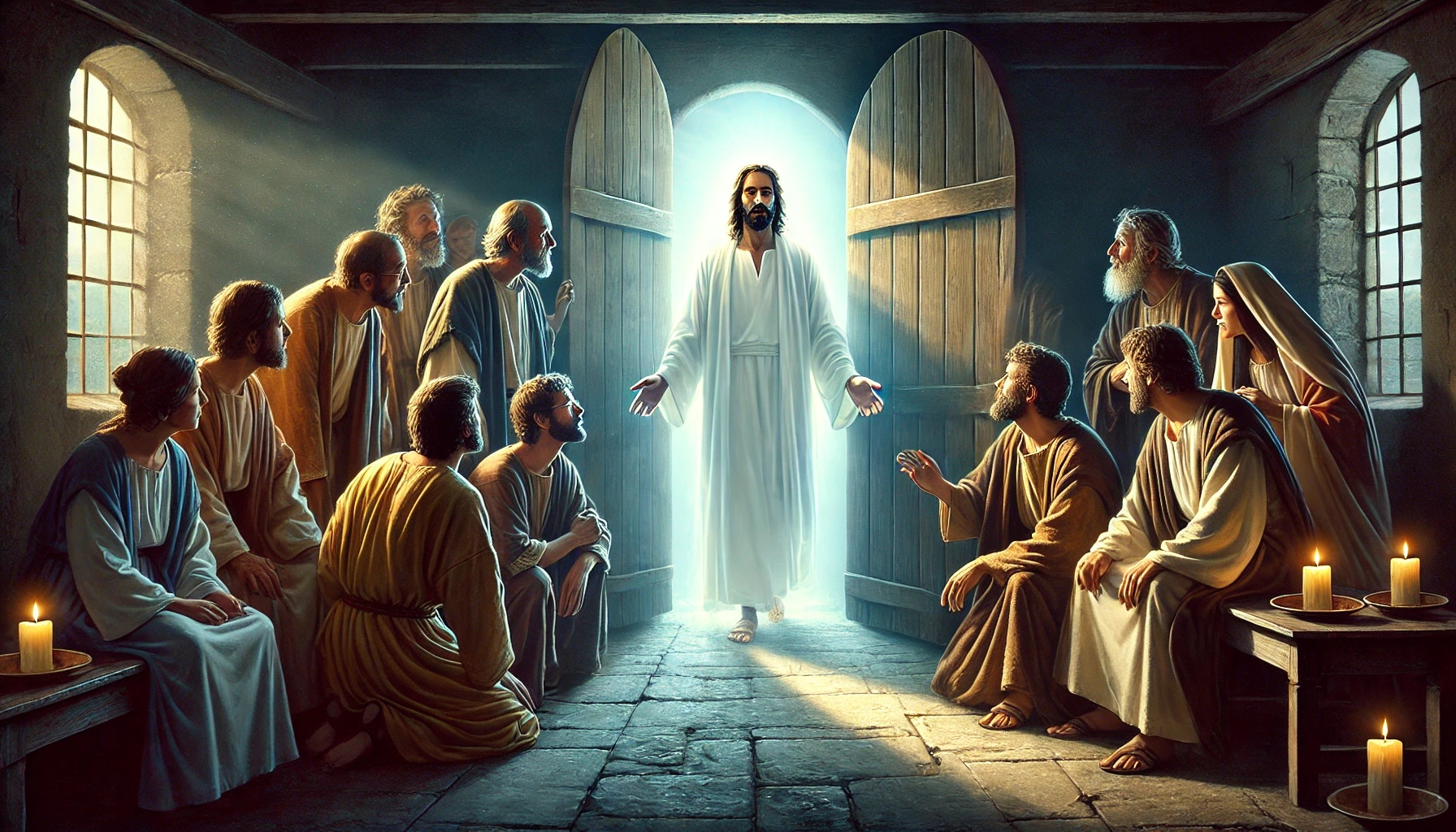
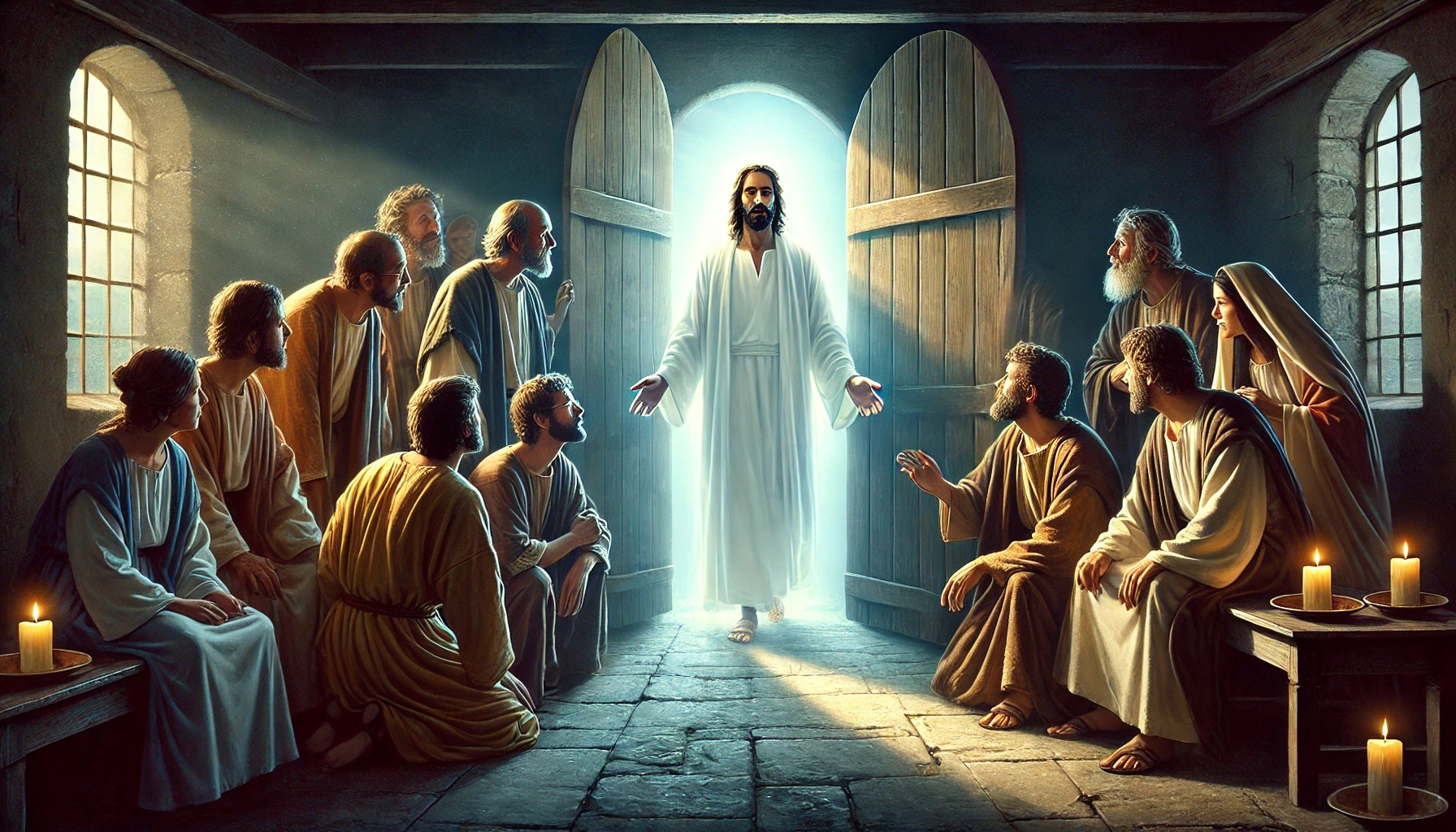
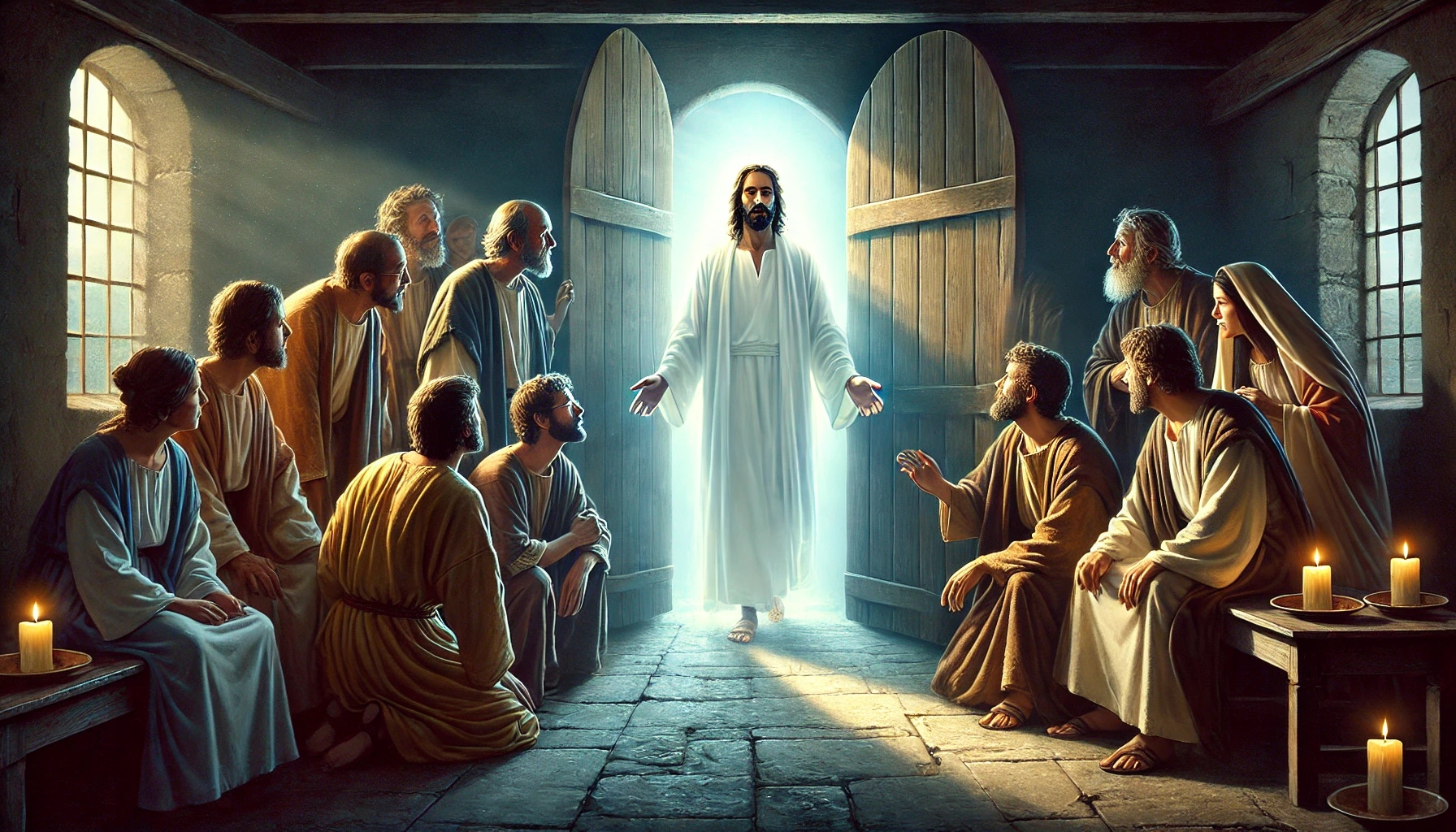
36 And as they thus spake, Jesus himself stood in the midst of them, and saith unto them, Peace be unto you.
37 But they were terrified and affrighted, and supposed that they had seen a spirit.
38 And he said unto them, Why are ye troubled? and why do thoughts arise in your hearts?
39 Behold my hands and my feet, that it is I myself: handle me, and see; for a spirit hath not flesh and bones, as ye see me have.
40 And when he had thus spoken, he shewed them his hands and his feet.
41 And while they yet believed not for joy, and wondered, he said unto them, Have ye here any meat?
42 And they gave him a piece of a broiled fish, and of an honeycomb.
43 And he took it, and did eat before them.
44 And he said unto them, These are the words which I spake unto you, while I was yet with you, that all things must be fulfilled, which were written in the law of Moses, and in the prophets, and in the psalms, concerning me.
45 Then opened he their understanding, that they might understand the scriptures,
46 And said unto them, Thus it is written, and thus it behooved Christ to suffer, and to rise from the dead the third day:
47 And that repentance and remission of sins should be preached in his name among all nations, beginning at Jerusalem.
48 And ye are witnesses of these things.
49 And, behold, I send the promise of my Father upon you: but tarry ye in the city of Jerusalem, until ye be endued with power from on high.
50 And he led them out as far as to Bethany, and he lifted up his hands, and blessed them.
51 And it came to pass, while he blessed them, he was parted from them, and carried up into heaven.
52 And they worshipped him, and returned to Jerusalem with great joy:
53 And were continually in the temple, praising and blessing God. Amen.
King James Version. Public Domain


Commentary
Introduction
Luke Chapter 24 describes the events following Jesus’ resurrection and includes some of the most significant moments in the Christian faith. This chapter highlights the revelation of Jesus’ resurrection first to the women at the tomb, then to the disciples on the road to Emmaus, and finally to the entire group of disciples. Through these appearances and conversations, Jesus opens the disciples’ understanding of the fulfillment of Scripture and confirms his resurrection as a central truth of faith.
Commentary
The chapter begins with the discovery of the empty tomb on the first day of the week. The women who came to anoint Jesus found the stone rolled away and encountered two angels who announced Jesus’ resurrection. This message was met with disbelief by the apostles, but Peter ran to the tomb to confirm the truth. In the story of the disciples on the road to Emmaus, Jesus initially reveals himself in disguise and explains the Scriptures to them. When breaking bread, they recognize him, and their hearts are filled with joy and understanding. Finally, Jesus appears to his gathered disciples, proving his identity through his wounds and explaining the necessity of his suffering and resurrection. The chapter culminates in Jesus’ ascension, which ends with a blessing and leaves the disciples with great joy and hope.
Summary
Luke 24 narrates the resurrection of Jesus, his encounters with the disciples, and his ascension. It begins with the discovery of the empty tomb, leads to Jesus’ appearance to the disciples on the road to Emmaus, and culminates in his final revelation to the gathered disciples. This chapter emphasizes the fulfillment of Old Testament prophecies through Jesus’ suffering and resurrection, and it concludes with the promise of the Holy Spirit and the ascension.


WEEKLY SPIRIT OF PROPHECY READING – Ellen White | The Desire of Ages
Chapter 68—In the Outer Court
This chapter is based on John 12:20-42.
Read online here


Commentary
Introduction
Chapter 68 is based on John 12:20-43 and deals with a pivotal event in Jesus’ life, when Greeks expressed the desire to see him. This chapter highlights the transition from Jesus’ earthly ministry to his impending sacrificial death on the cross, which would hold significance not only for the Jews but for all humanity. The desire of the Greeks to see Jesus symbolizes the universal appeal of his sacrifice and the expansion of the Gospel beyond the Jewish people.
Commentary
The chapter begins with the Greeks’ request to see Jesus, which Jesus interprets as a sign of his imminent glorification through his death on the cross. This encounter is reminiscent of the Magi who came at Jesus’ birth, signaling that Jesus’ mission is now extending beyond the borders of Israel. Jesus seizes the moment to compare his death to a grain of wheat that must die to bear fruit, emphasizing the necessity of his sacrifice for the salvation of the world.
The chapter underscores the importance of self-sacrifice, both in Jesus’ life and in the lives of his followers. Jesus speaks of his coming exaltation on the cross as the moment when he will draw all people to himself. Despite these revelations, many remain in disbelief, and even some of the leaders are afraid to publicly confess their faith.
Summary
Chapter 68 describes the final moments of Jesus before his crucifixion, interpreting the Greeks’ desire to see him as a sign of the expansion of his mission. Jesus explains that his death, like the death of a grain of wheat, is necessary to bring forth new life. The chapter emphasizes the universal significance of Jesus’ sacrifice and the spread of the Gospel beyond Israel. It calls for self-sacrifice, both for Christ and his followers, while reflecting the deep sorrow over the continued disbelief of many.


WEEKLY SPIRIT OF PROPHECY READING – Ellen White | The Desire of Ages
Chapter 69—On the Mount of Olives
This chapter is based on Matthew 24; Mark 13; Luke 21:5-38.
Read online here


Commentary
Introduction
Chapter 69 is based on the writings of Matthew 24, Mark 13, and Luke 21:5-38. It addresses Jesus’ prophetic announcements regarding the destruction of Jerusalem and His second coming. This discourse, delivered on the Mount of Olives, provides the disciples and future generations with guidance and warnings about upcoming trials and God’s ultimate triumph. Jesus instructs His disciples on the signs of the times and calls for vigilance and faithfulness in light of the forthcoming events.
Commentary
In this chapter, Jesus warns His disciples about the impending destruction of Jerusalem while simultaneously alluding to His second coming. He intertwines these two events in His prophetic announcements, emphasizing the necessity of vigilance. The signs that indicate the destruction of Jerusalem also serve as harbingers of the end times. Jesus speaks of false prophets, wars, famines, and persecutions that will precede the final judgment. He reminds His disciples not to be deceived and to maintain their faithfulness to God, even in the face of persecution. Finally, He points to the inevitable coming of the Son of Man in power and glory and encourages believers to remain steadfast in prayer and in anticipation of His return.
Summary
Chapter 69 describes Jesus’ significant sermon on the Mount of Olives, in which He prophesies the destruction of Jerusalem and His second coming. He provides the disciples with signs of the impending events and calls for constant vigilance. By linking the fall of Jerusalem with the end times, Jesus urges believers to examine their hearts, avoid deception, and faithfully await His return. The chapter underscores that both the destruction of Jerusalem and the second coming of Christ are part of the divine plan and that God will ultimately save His believers.

Source: https://fulfilleddesire.net/6-10-2024-luke-chapter-24-believe-his-prophets/

Share this:

  • Share on Facebook (Opens in new window) Facebook
  • Share on LinkedIn (Opens in new window) LinkedIn
  • Share on X (Opens in new window) X
  • Share on Pinterest (Opens in new window) Pinterest

Like this:

Like Loading…

Filed Under: Adventist Sermons & Video Clips, Fulfilled Desire

Themes in the Gospel of John – Lesson 2.Signs of Divinity | Sabbath School with Pastor Mark Finley

October 5, 2024 By admin

Series JESUS IN THE GOSPEL OF JOHN with Pastor Mark Finley  |
Lesson 2.Signs of Divinity  |
The Revelation of Jesus’ Divinity through His Miracles  
|
Lesson 2 explores the signs and miracles that reveal Jesus’ divinity. Through the Feeding of the Five Thousand, the Healing of the Blind Man, and the Raising of Lazarus, Jesus not only demonstrates His power over the physical world but also His role as Redeemer and Giver of Life. These miracles serve to point people towards a deeper spiritual truth: Jesus is the promised Messiah who has come to save humanity. His actions make it clear that He is not merely a prophet or teacher, but the divine Son of God. This realization invites believers to have faith in Him and receive eternal life.
Memory Text: John 11:25,26 – “Jesus said to her, ‘I am the resurrection and the life. He who believes in Me, though he may die, he shall live. And whoever lives and believes in Me shall never die. Do you believe this?’”
Content:
2.1 The Feeding of the Five Thousand
The Revelation of Jesus’ Divinity through the Feeding of the Five Thousand
In the story of the Feeding of the Five Thousand, John deliberately points to the temporal proximity to the Passover festival to highlight the parallel between Jesus and Moses. Just as Moses led the people of Israel in the wilderness and provided manna through God’s power, Jesus multiplied the loaves to feed the people. This act recalls the liberation from Egypt and symbolizes that Jesus is the new Moses who has come to finally free His people. The twelve baskets of leftovers refer to the twelve tribes of Israel, emphasizing the completeness and God’s care for His people. Through this act, Jesus not only shows His power but also His divinity by revealing Himself as the true Passover Lamb, sacrificed for the sins of humanity. This is particularly confirmed by Isaiah 53 and 1 Peter 2, which emphasize that Jesus took upon Himself our sins to redeem us—a truth that forms the foundation of our faith.
2.2 “Surely, He Is the Prophet”
Jesus’ Revelation as the True Bread of Life
In John 6:14–15, the people responded to Jesus’ miracles with the desire to make Him their earthly king, as they saw Him as the expected prophet who could politically liberate them. However, Jesus tried to shift their attention from the material miracles to the spiritual truth: He is the “Bread of Life” that came down from heaven to give eternal life to people. However, the people did not understand that Jesus came to free them from sin, not from political oppressors. Jesus’ “I am” statement (“I am the Bread of Life”) refers to His divinity, as revealed in Exodus 3:14. Yet the crowd was primarily seeking short-term benefits rather than recognizing the deeper spiritual significance of His mission.
2.3 The Healing of the Blind Man, Part 1
The Revelation of God through the Healing of the Blind Man
In John 9:1–16, the disciples thought that the man’s blindness was the result of sin, either his own or his parents’. Jesus corrected this assumption by explaining that the blindness was not due to sin, but that through this suffering, the works of God would be revealed. Jesus’ healing of the blind man by using mud to heal him recalls creation when God formed man from the dust of the earth. John’s account emphasizes less the healing itself and more the ensuing discussion, particularly the growing faith of the blind man and the increasing confusion of the Pharisees. Although the Pharisees saw Jesus’ healing on the Sabbath as a breach of the law, the miracle caused division among them as some could not believe that a sinner could perform such signs.
2.4 The Healing of the Blind Man, Part 2
The Spiritual Blindness of the Pharisees and the Growing Insight of the Healed Man
In John 9:17–34, the Pharisees repeatedly question the formerly blind man to challenge the authenticity of his healing and Jesus’ identity as a sinner. The man responds increasingly confidently, explaining that Jesus healed him and that no one who does not come from God could perform such a miracle. As the blind man gains more spiritual insight and believes in Jesus, the Pharisees become more obstinate and reject Jesus. This healing story shows a reversal of roles: the once blind man now sees clearly, while the religious leaders remain in their spiritual blindness. They refuse to recognize the obvious and expel the healed man from the synagogue. This story reminds us that true knowledge and wisdom are often given to those who are humble and open, as Paul emphasizes in 1 Corinthians 1:26–29, while worldly wisdom can be blinded.
2.5 The Resurrection of Lazarus
Jesus’ Power Over Death and the Revelation of His Divinity
The raising of Lazarus in John 11 is one of Jesus’ most powerful miracles and clearly demonstrates His divine power over death. Despite the mourning over Lazarus’ death and Jesus’ apparent hesitation, the delay served a higher purpose: the revelation of God’s glory and the confirmation that Jesus is the “Resurrection and the Life.” By raising Lazarus from the dead after four days in the tomb, Jesus proved that He has power over death and that through faith in Him, eternal life is possible. This miracle underscores the central message of the Gospel of John: Jesus is the divine Son of God, and through Him, we can receive true life. Yet, despite this incredible evidence, many of the leaders responded with disbelief and conspiracy, highlighting human blindness to divine wisdom.
2.6 Summary
The Revelation of Jesus’ Divinity through Miracles and Signs
In Lesson 2, Jesus’ divinity is clarified through various miracles and signs. In the Feeding of the Five Thousand, Jesus demonstrates His provision as the true “Bread of Life,” fulfilling people’s spiritual needs. The healing of the blind man reveals not only Jesus’ power over physical blindness but also the growing spiritual insight of the healed man in contrast to the Pharisees’ spiritual blindness. In the raising of Lazarus, Jesus demonstrates His power over death and reveals Himself as the “Resurrection and the Life.” These miracles confirm that Jesus is the divine Son of God who brings eternal life.

Source: https://fulfilleddesire.net/themes-in-the-gospel-of-john-lesson-2-signs-of-divinity-sabbath-school-with-pastor-mark-finley/

Share this:

  • Share on Facebook (Opens in new window) Facebook
  • Share on LinkedIn (Opens in new window) LinkedIn
  • Share on X (Opens in new window) X
  • Share on Pinterest (Opens in new window) Pinterest

Like this:

Like Loading…

Filed Under: Adventist Sermons & Video Clips, Fulfilled Desire, Sabbath School

Lesson 1.Signs That Point the Way | 1.7 Questions | THEMES IN THE GOSPEL OF JOHN | LIVING FAITH

October 4, 2024 By admin

1.Reflect on this week’s study guide. Faith was the key that made these healings possible. In contrast, the leaders demonstrated the dangers of doubt and unbelief. Why should we not confuse questions (which we all have) with doubts? Why are they not the same, and why is it important to know the difference between the two?
In this week’s study guide, it is clear that faith was the crucial key that made Jesus’ healings possible. People like the royal official whose son was healed or the paralyzed man at the Pool of Bethesda experienced miracles through their faith in Jesus’ words. In contrast, the religious leaders who rejected Jesus despite His clear signs demonstrated the dangers of doubt and unbelief.
Why Should We Not Confuse Questions with Doubts?
Questions are a natural part of the faith life. They arise when we do not immediately understand things or when we are confronted with difficult situations. Questions can lead us to search deeper, pray, and seek God’s guidance. In the Bible, we see many examples of believers who asked questions—from Abraham to Jesus’ disciples. These questions are part of a living and growing faith.
Doubts, on the other hand, are often a form of mistrust or rejection of God’s actions or His word. Doubts can paralyze faith because they undermine trust in God’s character and promises. Doubting means questioning God’s ability or willingness to work in our lives.
Why Is It Important to Know the Difference?
The difference between questions and doubts is crucial because questions can strengthen faith, while doubts can weaken it. Questions lead to growth because they prompt us to seek answers, trust God, and get to know Him better. Doubts, however, can weaken faith by distancing us from God and preventing us from fully trusting Him.
The religious leaders of Jesus’ time had studied the Scriptures and seen many signs, yet they rejected Jesus. Their unbelief prevented them from recognizing the truth and caused them to ignore even the most obvious signs. This serves as a warning for us: we must remain open to God’s answers and trust Him, even when we do not understand everything immediately.
Conclusion: Questions are part of a living faith, while doubts can stifle it. It is important to recognize the difference so that we can trust God’s promises and be willing to seek His answers. The religious leaders of Jesus’ time studied the Scriptures and saw signs but still rejected Him. Their unbelief hindered them from recognizing the truth and led them to dismiss even the most obvious signs. This is a warning for us: we must remain open to God’s answers and trust Him, even when we do not understand everything immediately.
2.Look at the last question in the Thursday section. Why must we, as Seventh-day Adventists, be especially cautious about this danger? As important as it is, for example, to know and keep the correct Sabbath day or to understand something about the state of the dead—why does this knowledge not save us? What saves us and how?
The question of how to guard against believing in God and upholding correct teachings without fully submitting to Christ is central to our faith life. Faith and scholarship are not the same, and mere knowledge of biblical truths is not sufficient for our salvation. As Seventh-day Adventists, we must be especially cautious because we place great emphasis on understanding biblical teachings. However, even though knowledge of the truth is important, it is not what ultimately saves us.
  1. Why Must We, as Seventh-day Adventists, Be Especially Cautious?
As Seventh-day Adventists, we place great importance on biblical teachings such as the Sabbath, the Second Coming of Christ, the state of the dead, and other prophetic insights. These truths are crucial and valuable, but they are not a substitute for a living relationship with Jesus. There is a danger that we may rely on our knowledge or adherence to certain rules and teachings and thereby forget that salvation comes solely through grace and faith in Jesus Christ.
The religious leaders of Jesus’ time upheld the correct teachings regarding the law and the Sabbath, but they missed the central truth—the relationship with God. They were proud of their knowledge, but this pride prevented them from recognizing Jesus as the Savior. Similarly, we could fall into the trap of emphasizing our knowledge of teachings without fully surrendering our hearts to Christ.
  1. Why Does Knowledge of the Truth Not Save Us?
Knowledge of biblical teachings, as important as it is, cannot save us because salvation is not obtained through knowledge or works. The Bible clearly states that we are saved by grace through faith—by believing in the completed work of Jesus Christ on the cross (Ephesians 2:8-9). Our understanding of truths like the Sabbath or the state of the dead is important because it helps us better comprehend God’s will, but it is not the knowledge itself that saves us.
What saves us is faith in Jesus Christ and accepting His sacrifice. This faith means more than just agreeing with certain teachings—it involves fully submitting our lives to Christ’s authority. We are called to surrender our hearts and wills to Him, live daily in His grace, and trust in His guidance.
  1. What Saves Us and How?
Salvation comes through grace, which we receive by faith in Jesus Christ. This means:
  • Recognizing that we are sinners and cannot save ourselves.
  • Believing in Jesus’ sacrifice, which paid the price for our sins.
  • Accepting Him not only as Savior but also as Lord of our lives and allowing Him to guide us in all areas.
Jesus’ saving work encompasses more than merely following rules or knowing certain teachings. It involves our entire lives being permeated by His grace and love. When we fully submit to Jesus, our knowledge of the truth becomes alive because it is rooted in our relationship with Him.
Conclusion: As Seventh-day Adventists, we must be particularly careful to ensure that our focus is not solely on knowing the correct teachings but on fully submitting our lives to Christ. It is essential to recognize that our knowledge of biblical truths does not save us—only God’s grace and Jesus’ sacrifice can do that. When we surrender our hearts and lives to Him, we can be confident that we not only know the truth but also live in that truth and are redeemed through it.
3.Examine John 5:47 closely. In what way do those who today, for example, deny the universality of the Flood or the literal six-day creation, do exactly what Jesus warned against?
In John 5:47, Jesus warns the religious leaders that their unbelief in the testimony of the Scriptures, especially the testimony of Moses, prevents them from believing in Him: “If you do not believe his testimony, how are you going to believe anyone else’s?” This warning is significant because it highlights that faith in the Old Testament Scriptures is closely tied to faith in Jesus and His teachings. Jesus refers to Moses because Moses’ writings prophesied the coming Messiah.
Relation to Today: Denying the Biblical Account of the Flood or the Literal Six-Day Creation
When people today deny the universality of the Flood or the literal six-day creation, they are doing exactly what Jesus warned against in John 5:47. They are doubting the fundamental accounts that God revealed through Moses and other prophets. This has far-reaching implications for their faith and ability to accept the entirety of Scripture and its claims, including the testimony of Jesus.
Why Is This Problematic?
  1. Doubt in the Reliability of Scripture: When people interpret parts of the Bible, such as the creation account or the Flood, as non-literal or symbolic, they question the credibility of the entire Scripture. The Bible teaches in Genesis that God created the world in six days and that the Flood was a universal event. These accounts are not merely symbolic but form the foundation for understanding God’s intervention in human history. Denying these fundamental narratives makes it difficult to fully trust other biblical teachings.
  2. The Bible as a Whole: The Bible forms a unified whole, spanning from creation to redemption through Jesus Christ. Denying the literal meaning of Genesis undermines the foundation on which many other biblical doctrines rest. If the creation and Flood accounts are viewed as mythological or symbolic, the belief in God’s sovereign action in human history and His power to guide the world is weakened.
  3. Contradiction to Jesus’ Teachings: Jesus Himself referred to the creation account and the Flood as historical events. In Matthew 19:4–6, He spoke of the creation of man as male and female, and in Matthew 24:37–39, He compared the time of His return to the days of Noah. Denying these accounts contradicts not only the Old Testament but also Jesus’ own words.
Connection to John 5:47:
In John 5:47, Jesus warns that those who do not believe in the Scriptures of the Old Testament cannot believe in His words either. The principle applies today: if we dismiss fundamental accounts like creation or the Flood as untrue or symbolic, we undermine the trustworthiness of the entire Bible—including Jesus’ words. This shows that faith in the Bible’s revelation from the first to the last page is crucial for maintaining faith in Jesus Christ and His redemption.
Conclusion: Denying the universality of the Flood or the literal six-day creation is an expression of doubt in the authority and credibility of the Bible. Jesus warned in John 5:47 against not taking the Scriptures seriously, as this leads to rejecting His words as well. As believers, we are called to accept the entire Bible as God’s inspired revelation, as it not only teaches us the truth about the past but also points the way to redemption through Christ.

Source: https://fulfilleddesire.net/lesson-1-signs-that-point-the-way-1-7-questions-themes-in-the-gospel-of-john-living-faith/

Share this:

  • Share on Facebook (Opens in new window) Facebook
  • Share on LinkedIn (Opens in new window) LinkedIn
  • Share on X (Opens in new window) X
  • Share on Pinterest (Opens in new window) Pinterest

Like this:

Like Loading…

Filed Under: Adventist Sermons & Video Clips, Fulfilled Desire

  • « Previous Page
  • 1
  • …
  • 172
  • 173
  • 174
  • 175
  • 176
  • …
  • 714
  • Next Page »

SkyScraper

Intercer Ministry – Since 1997!

We’re on Pinterest!

Partners


The Seven Thunders Ministry

Recent Posts

  • 👤 THE BIBLICAL PERSON OF THE DAY | 07.24.2026 | 🌪️ Absalom – The Handsome Son with a Rebellious Heart
  • 🌱LIVING FAITH | ⚠️ Lesson 4: Sin in the Church | 📌 4.6 Summary | ✉️ FIRST AND SECOND CORINTHIANS
  • 📜BELIEVE HIS PROPHETS | 📖 Bible Study | 07.24.2026 | 🙏 Job | 💎 Chapter 28 – True Wisdom
  • Bible Trivia: How Many Can You Answer Without Googling?
  • When Tragedy Strikes: Lessons from the Story of Lazarus

About Intercer

Intercer is a website with biblical materials in Romanian, English, Hungarian and other languages. We want to bring the light from God's Word to peoples homes. Intercer provides quality Christian resources...[Read More]

Lucian Web Service


Intercer is proudly sponsored by Lucian Web Service - Professional Web Services, Wordpress Websites, Marketing and Affiliate Info. Lucian worked as a subcontractor with Simpleupdates, being one of the programmers for the Adventist Church Connect software. He also presented ACC/ASC workshops... [read more]

Archives

Follow @intercer

Categories

[footer_backtotop]

Website provided by: Intercer Romania · Intercer Canada · Lucian Web Service · Privacy · Log in


%d