
Join It Is Written Sabbath School host Eric Flickinger and this quarter’s author, Dr Adenilton Tavares de Aguiar, as they provide additional insights into this week’s Sabbath School lesson.
Closer To Heaven
|
|
|
Join It Is Written Sabbath School host Eric Flickinger and this quarter’s author, Dr Adenilton Tavares de Aguiar, as they provide additional insights into this week’s Sabbath School lesson.
View an in-depth discussion of The Message of the Cross in the Hope Sabbath School class led by Pastor Derek Morris.
Click on the image below to view the video:
<
With thanks to Hope Channel – Television that will change your life.
Daily Lesson for Thursday 9th of July 2026
In 1 Corinthians 1:19-20,30, and 31, Paul talks about how God’s wisdom and human wisdom are incredibly different and, thus, mutually exclusive. Notice that Paul does not reject wisdom as such, but he rejects the kind of human wisdom that tries to compete with God. Human wisdom is incapable of freeing men from sin. Only Christ, the wisdom of God, can perform this work. See the table below.
| but to us who are being saved | [the message of the Cross] is the power of God | 1 Corinthians 1:18 |
| but to those who are called | Christ [is] the power of God | 1 Corinthians 1:24 |
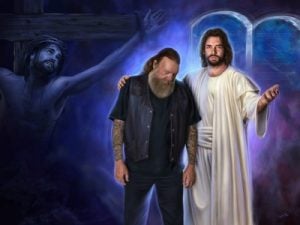
Image © Phil McKay Goodsalt.com
Both 1 Corinthians 1:18 and 1 Corinthians 1:24 show that Christ is the power of God, in the sense that He has the power to save people from their sins. Indeed, “it pleased God through the foolishness of the message preached to save those who believe” (1 Corinthians 1:21, NKJV). The phrases “us who are being saved” (1 Corinthians 1:18, NKJV), “those who believe” (1 Corinthians 1:21, NKJV), and “those who are called” (1 Corinthians 1:24, NKJV) refer to the same group, namely, people living the experience of salvation through faith. “The gospel of Christ . . . is the power of God to salvation for everyone who believes” (Romans 1:16, NKJV).
Christ is not only the power but also the wisdom of God. This means that through Him God faced and solved the problem of sin, a problem that human wisdom was powerless to solve. The wisdom of this world is unable to make people know God (1 Corinthians 1:21). Conversely, through Christ we become wise for salvation (2 Timothy 3:15).
In reading 1 Corinthians 1:24-29, one should also notice the terms foolish (or foolishness) and weak (or weakness). The point is that human wisdom may consider the message of the Cross to be foolishness and weakness. However, “the foolishness of God is wiser than men, and the weakness of God is stronger than men” (1 Corinthians 1:25, ESV). This doesn’t mean that God is weak or foolish; it’s merely an expression showing how God’s power and wisdom far exceed anything human.
|
Dwell on the words “that not many wise according to the flesh, not many mighty, not many noble, are called” (1 Corinthians 1:26, NKJV). What message is there for us? |
Daily Lesson for Wednesday 8th of July 2026
Paul wrote that the “Jews demand signs and Greeks seek wisdom” (1 Corinthians 1:22, ESV). The Cross—the idea of God, the Messiah, being crucified—was not a sign that the Jews had expected. Nor was it the kind of wisdom that the Greeks wanted. It went against everyone’s expectations.
In fact, all one has to do is read how the disciples reacted to the idea of Jesus being crucified (see Mark 8:31-32; Mark 9:30-32; and Mark 10:32-34) to begin to see how alien, and repulsive, the whole notion was, especially to the Jews. As said before, the Jews expected the Messiah to conquer the Romans; that is not what happened, at least not in the worldly military sense of “conquer.”
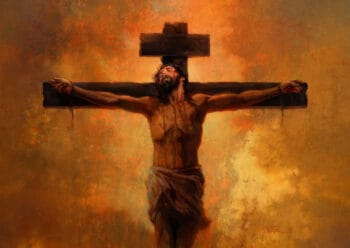
Image © Lars Justinen at Goodsalt.com
For centuries, the cross has been, for Christians, a symbol of faith. It is hard for twenty-first-century Christians to understand how crazy the idea of a crucified God was for the first-century mindset.
However, it is precisely because this was such a shocking message that makes it worthy of our most profound reflections. The portrait of a crucified Messiah makes it entirely clear to the whole universe how far God was willing to go to complete the plan of redemption. The idea of the cross itself, and of the Lord’s dying on the cross, is astonishing enough to us, sinners here on earth. (Imagine, though, what it must have meant to the sinless beings who knew, and worshiped, the Lord Jesus in heaven!)
Paul says Christ sent him to preach the gospel. And so Paul preaches the message of a crucified Messiah (1 Corinthians 1:23). He resumes these ideas in 1 Corinthians 2:1-5. The apostle was faithful to Christ’s commission. In proclaiming the gospel, he didn’t employ “lofty speech or wisdom” (1 Corinthians 2:1, ESV); instead, he focused only on “Jesus Christ and him crucified” (1 Corinthians 2:2, ESV). His speech and message “were not in plausible words of wisdom, but in demonstration of the Spirit and of power” (1 Corinthians 2:4, ESV) because, in fact, “the wisdom of men” stands in visible contrast with “the power of God” (2 Corinthians 2:5, ESV).
|
A crucified Messiah was something completely unexpected by the Jews and the Greeks. What does this tell us about the fact that God does not always act the way we expect? Why is this an important concept to grasp, especially when things don’t go as we have expected? |
Introduction: On the surface, our study this week seems incredibly odd. Last week we learned why Paul was entitled to call himself an “apostle.” But his background was nothing like the background of Jesus’ twelve disciples.  Paul had a premier theological education (Acts 22:3), he was Pharisee, and he wrote more New Testament books than any other writer. The Roman governor of Judea, Porcius Festus, in Acts 26:24, mentioned Paul’s “great learning.” Paul was a smart, highly educated man. Yet our study this week, written by Paul, openly attacks worldly wisdom and education. It favors the unwise, the foolish, and those with weak thinking. What is going on? Is the gospel for those with low intelligence? Is it for the uneducated? Let’s dive below the surface to try to understand what Paul is really teaching us!
I. Folly
A. Read 1 Corinthians 1:17-18. Paul tells us that the job he has been given by Jesus is to preach the gospel. What is and is not his approach to preaching? (He does not use “words of eloquent wisdom” to preach the gospel. Instead, Paul’s approach centers on the power of the cross.)
1. What does that mean? How would you preach the “power of the cross?” (Read 1 Corinthians 2:2. This reveals that Paul preached “Jesus Christ and Him crucified.”)
a. Is there power in that message? (I loved the gospel work of Billy Graham. But I always thought his preaching was rather simple. He caught the vision of Paul’s approach, “Stick to preaching Jesus and His sacrifice for us.”)
B. Look again at 1 Corinthians 1:18. Those who are perishing, meaning those who need the gospel, consider the “word of the cross” to be “folly.” The word translated “folly” is moria, from the same Greek root as the word from which “moron” is derived. But Paul is not saying the issue is low intelligence. He is saying that, to unbelieving human wisdom, the cross appears absurd. If the world thinks the message of the cross is absurd, how can that be the correct approach?
C. Read 1 Corinthians 1:19-20. What is Paul saying about worldly wisdom? (He says the worldly wise are the true morons (the foolish).)
1. The world thinks the gospel is moronic, and those who follow Jesus know the world is moronic. How do we resolve this very serious problem?
D. Read 1 Corinthians 1:21. What is God’s solution to this problem? (It is God’s plan that the world will not be converted through “wisdom.” Instead, God will convert pagans through “the folly of what we preach.”)
1. On whose shoulders does that place the burden of the gospel? (On God’s shoulders.)
2. The idea that wisdom prevents the knowledge of God seems very wrong to me. The more we understand about our world, the more the power of God is revealed. Even Paul admits this in Romans 1:18-20. How can this be explained? (The problem is not knowledge, education, or careful reasoning. Romans 1 teaches that creation reveals God. The problem is unaided human wisdom that refuses God’s revelation and tries to judge the cross by human pride, power, and status.)
E. Read 1 Corinthians 1:22-23. How are Jews and Greeks convinced that something is true? (The Jews demand signs and the Greeks are looking for smart, logical arguments.)
1. What is Paul offering instead? (“Christ crucified.”)
2. How logical is that approach? (Paul admits it is a “stumbling block to Jews and folly to Gentiles.”)
3. How many times do you hear that we must make the church “relevant?” How many times do you hear that we must accommodate the teachings of the church to the views or morality of the world? How many times do you hear that we must adapt to the advances of our modern age?
4. Is Paul telling us that he had a similar problem with his gospel mission? (Precisely. He is saying that the gospel does not fit the views and expectations of the Jews or Greeks.)
F. Read Acts 1:6. How deep was the problem of the Jews misunderstanding the gospel? (Even Jesus’ disciples, at the end of His time with them on earth, still harbored their original view of the Messiah coming in power.)
II. The Calling
A. The serious gospel mission problem seems pretty well laid out. Read 1 Corinthians 1:24. What overcomes this problem? (Calling.)
1. What do you understand “being called” to mean? Is it predestination? Is it the Holy Spirit? Is it a special qualification?
B. Read Matthew 22:14 and skim Matthew 22:1-13. Who does the choosing? (We choose to respond to the call.)
1. How central is this parable to the idea of being called? (The king called his friends, then he called everyone. The friends did not respond. Most of the ordinary people did respond, except the fellow who thought his clothing was just fine.)
III. The Antithesis
A. Read 1 Corinthians 1:25. Is preaching the gospel actual folly? Is it weak thinking? (No. It is the wisdom and power of God which exceeds any wisdom and power of humans.)
B. Read 1 Corinthians 1:26. Is there good news in this? Or is this just embarrassing? (The church is not a country club where the rich and smart get together. It is for everyone.)
C. Read 1 Corinthians 1:27. Why would God want to shame the wise or the strong? These are the people who get things done, right? They are the ones who build businesses and employ others, right?
D. Read 1 Corinthians 1:28-29. Is this the key to the mystery of why God shames the wise and the strong? (God is entitled to the glory of converting others. He is the power of the gospel.)
1. Let’s think about this a moment. Does God seem arbitrary in taking the glory to Himself?
2. Can you find in this a connection to a belief in righteousness by faith alone? (For me, this is the ultimate explanation of what seems odd on the surface. Jesus did it all: He gave Himself, came to earth, lived a perfect life, died a tortured death on the cross, and now offers eternal life to all who accept Him. It is God and God alone who deserves all the glory.)
E. In case this seems abstract, consider the continuing controversy over COVID-19. Government officials and scientific authorities repeatedly urged the public to trust “the science,” yet recently released government documents suggest that conflicts of interest, gain-of-function research, and institutional self-protection shaped what the public was told. The controversy reminds us that human wisdom, even when clothed in impressive credentials, can be distorted by pride, power, dishonestly, and self-interest.
F. Consider the church. In the struggle to preserve religious liberty against the demands of those promoting same-sex marriage, my church filed a brief with the U.S. Supreme Court supporting religious free speech. A group of members of the church, who consider themselves wiser than the church on this issue, filed a counter brief. These intellectuals would correct the church before the Supreme Court! The name of the case is 303 Creative v. Elenis. Religious free speech won in this landmark case.
G. Read 1 Corinthians 1:30-31. What does Paul say about righteousness by faith alone here? (He says that we now, when we are in Jesus, have “wisdom from God, righteousness and sanctification and redemption.”)
1. We are told that we should “boast in the Lord.” How would you do that?
2. At the root of the problem in the conflicting briefs before the Supreme Court is whether the plain teachings of the Bible about marriage will give way to modern-day wisdom on the subject. Do you have a view on some aspect of life that conflicts with the teachings of the Bible? Do you have friends who hold conflicting views?
a. What do you think is at the bottom of conflicts like this? (Pride. This is the problem of the cross. It was the most degrading way to die. How could you boast in a leader who died like that? Is it not more natural to want a Messiah who would be ruler over the Romans?)
H. Friend, we spent a lot of time in this study questioning why worldly wisdom and intellect were bad. The correct answer is that being smart and educated are in themselves good. The problem arises when we use these gifts to question and correct the teachings of God. The problem arises when we proclaim the gospel in a way that showcases human wisdom and education instead of the power of the cross. This reflects human pride. Will you determine today, by the power of the Holy Spirit, to defer to the wisdom of God? To boast in the Lord?
IV. Next week: Unity in Christ.
Copr. 2026, Bruce N. Cameron, J.D. Scripture quotations are from the ESV® Bible (The Holy Bible, English Standard Version®), copyright © 2001 by Crossway, a publishing ministry of Good News Publishers. Used by permission. All rights reserved. Suggested answers are found within parentheses. If you normally receive this lesson by e-mail, but it is lost one week, you can find it by clicking on this link: http://www.GoBible.org. Pray for the guidance of the Holy Spirit as you study.
 Intercer is a website with biblical materials in Romanian, English, Hungarian and other languages. We want to bring the light from God's Word to peoples homes. Intercer provides quality Christian resources...[Read More]
