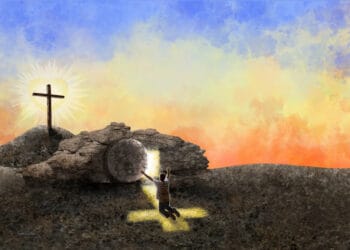
What does it mean to serve the Lord with sincerity and truth? Join the Hit the Mark panel as they discuss Sabbath School Lesson 13 – Choose This Day! It’s the fastest hour of the week!
Mission Spotlight for December 27
Our Sabbath School program has always been linked to the support of the Seventh-day Adventist Mission program. This video provides a little insight into this important work.
Inside Story: “How Do We Love God?”
Inside Story for Friday 26th of December 2025
Just as the 1996 Thirteenth Sabbath Offering is still being felt across the Southern Asia-Pacific Division and beyond through the work of the 1000 Missionary Movement, this quarter’s Thirteenth Sabbath Offering can, with God’s blessing, also have a long-lasting impact. Thank you for your generous offering this Sabbath.
__
Kim Sun, a missionary from South Korea, shared 15 stories of God’s love with the residents of a remote town in the Philippines for three months.
The townspeople were amazed to learn that God created everything in the world for them. They marveled at God’s love in the parables of the Good Samaritan and the Prodigal Son. Their hearts were touched to realize that Jesus died on the cross for them. After three months, many said, “We understand that God loves us. But how can we respond? How do we love God?”
“It’s so true,” Sun thought in amazement. “When we know someone loves us, we want to show the love in return.” It was time to dig deeper into the Bible.
For the next three months, he taught about the seventh-day Sabbath, clean and unclean food, tithe and offerings, and other Seventh-day Adventist fundamental beliefs. Many townspeople accepted what they learned. They wanted to know how to love God, and the doctrines showed the way.
Sun served as a missionary for 10 months: offering three months of labor, free of charge, three months of stories about God’s love, and three months of digging deeper into the Bible. That left one month to say goodbye. Sun spent the last month going door-to-door, inviting people to follow Jesus. “I’m leaving soon,” he said. “I would like you to join my church. I’ve been so blessed, and I’d like you to be blessed, too.” Many townspeople accepted his invitation.
Ellen White says, “Christ’s method alone will give true success in reaching the people. The Savior mingled with men as one who desired their good. He showed sympathy for them, ministered to their needs, and won their confidence. Then He bade them, ‘Follow Me’ ” (The Ministry of Healing, p. 143). For ten months, Sun practiced Christ’s method: mingling with people, desiring their good, showing sympathy, ministering to their needs, and winning their confidence; then he invited them to follow Jesus.
Today, Sun is a full-time missionary. He works as associate director of the 1000 Missionary Movement, an organization that is part of the Seventh-day Adventist Church’s Southern Asia-Pacific Division. He trains hundreds of missionaries every year at its headquarters, built with the help of a 1996 Thirteenth Sabbath Offering, in Silang, Philippines. “Being a missionary is the highest calling,” he said. “Missionaries don’t only give Bible studies. We especially need to show Jesus in our lives.”
Friday: Further Thought – Choose This Day!
Daily Lesson for Friday 26th of December 2025
Read Ellen G. White, “The Last Words of Joshua,” Pages 522–524, in Patriarchs and Prophets.
“Among the multitudes that came up out of Egypt were many who had been worshipers of idols; and such is the power of habit that the practice was secretly continued, to some extent, even after the settlement in Canaan. Joshua was sensible of this evil among the Israelites, and he clearly perceived the dangers that would result. He earnestly desired to see a thorough reformation among the Hebrew host. He knew that unless the people took a decided stand to serve the Lord with all their hearts, they would continue to separate themselves farther and farther from Him. . . . While a portion of the Hebrew host were spiritual worshipers, many were mere formalists; no zeal or earnestness characterized their service. Some were idolators at heart, who would be ashamed to acknowledge themselves as such.”—Ellen G. White, Signs of the Times, May 19, 1881.
“This solemn covenant was recorded in the book of the law, to be sacredly preserved. Joshua then set up a great stone under an oak that was by the sanctuary of the Lord. ‘And Joshua said unto all the people, Behold this stone shall be a witness unto us; for it hath heard all the words of the Lord which he spake unto us: it shall be therefore a witness unto you, lest ye deny your God.’ Here Joshua plainly declares that his instructions and warnings to the people were not his own words, but the words of God. This great stone would stand to testify to succeeding generations of the event which it was set up to commemorate, and would be a witness against the people, should they ever again degenerate into idolatry.”—Ellen G. White, Signs of the Times, May 26, 1881.
Discussion Questions
|
Thursday: Finishing Well
Daily Lesson for Thursday 25th of December 2025
Read the concluding words of the book of Joshua written by an inspired editor (Joshua 24:29-33). How are these words not only looking back to Joshua’s life but also looking forward to the future?
In the epilogue reporting on the deaths of Joshua and Eleazar, the high priest brings the book of Joshua to a sobering end. By recounting together the burial of Joshua, the burial of Eleazar, and the burial of Joseph’s bones, the author creates a contrast between the life outside the land and the beginning of life in the land. There is no need to wander anymore.
The earthly remains of the leaders don’t have to be carried along with them. The patriarchs buried their relatives in a cave (Genesis 23:13,19; Genesis 25:9-10), on a plot purchased at Shechem (Genesis 33:19). Now the nation buries its leaders in the territory of their own inheritance, thus having a sense of permanence. The promises given to the patriarchs have been fulfilled. Yahweh’s faithfulness constitutes the historical thread that links Israel’s posterity to its present and future.
As the concluding paragraphs of the book link the whole narrative to a larger story in the past, they also open the way for the future. Ex-archbishop of Canterbury Lord George Cary, in a keynote speech delivered at Holy Trinity Church in Shrewsbury, declared that the Anglican Church was “one generation away from extinction.”
In fact, the church is always one generation away from extinction, and so it was with the Old Testament people of God. A great chapter in the history of Israel comes to an end. Its future depends on what kind of answers it will give to the many questions that concern the future. Will Israel be loyal to the Lord? Will they be able to continue the unfinished task of possessing the whole land? Will they be able to cling to Yahweh and not get entangled in idol worship? A generation under Joshua has been faithful to the Lord, but will the next generation maintain the same spiritual direction that has been traced by its great leader? Each successive generation of God’s people, reading the book of Joshua, must face these same questions. Their success depends on the nature of the answers they provide in their everyday lives and how they relate to the truths they have inherited.
|
Joshua, like Paul, “fought the good fight” (2 Timothy 4:7, NKJV). What was the key to Joshua’s success? What decisions do you need to make today in order to finish with the same assurance of salvation? |
- « Previous Page
- 1
- …
- 25
- 26
- 27
- 28
- 29
- …
- 1056
- Next Page »