
Join It Is Written Sabbath School host Eric Flickinger and this quarter’s author, Nina Atchesonn, as they provide additional insights into this week’s Sabbath School lesson.
Closer To Heaven
|
|
|
Join It Is Written Sabbath School host Eric Flickinger and this quarter’s author, Nina Atchesonn, as they provide additional insights into this week’s Sabbath School lesson.
View an in-depth discussion of Into Eternity in the Hope Sabbath School class led by Pastor Derek Morris.
Click on the image below to view the video:
</p>
With thanks to Hope Channel – Television that will change your life.
Introduction: What is your favorite activity? When I was young I liked doing things that involved tension and a hint of danger. Things like riding a motorcycle through the woods, water skiing, or fast cars.  What I never liked was danger that I could not reasonably control, like roller-coasters or rides of that type. I barely cared about eating. Now that I’m old, I appreciate tension less and like eating more. Praising God brings joy. Some of the ideas of the saints in heaven are, frankly, discouraging. Is your favorite activity something that you will enjoy in heaven? For those who enjoy eating, the Bible contains references to eating and drinking in heaven. How much time do you spend thinking about you and eternity? Let’s explore the Bible to help shape our thoughts about eternity!
I. Rough Men Safe to Save?
A. Some have argued to me that we must be “safe to save.” What do you think that means? (I understand it to mean that if my character is not sufficiently attuned to the atmosphere of heaven, I will not be there because I’m not safe.)
1. What do you think of this religious claim?
2. What kind of mental picture do you have of men who are “safe to save?”
a. Is it consistent with spending hours sitting on a cloud playing a harp?
B. Read Hebrews 11:32. What do you think those guys liked to do in their spare time?
C. Read Hebrews 11:33-34. What kinds of activities are revealed here? (Mostly fighting! Many of these activities involved courage, danger, conflict, and great faith—conquering kingdoms, enforcing justice, obtaining promises, escaping death, and becoming mighty in war.)
1. Are these weak men? (They were “made strong out of weakness.”)
2. Are they going to be in heaven?
D. Read 1 Samuel 16:16-18. How does this describe David? (He was a harp (technically a lyre) player, which is what Saul wanted.)
1. What other attributes of David are listed that have nothing to do with his musical abilities? (He is brave and a “man of war.” He has a good presence, and “the Lord is with him.”)
E. Read Luke 23:39-43. What would you guess were the favorite activities of the man to whom Jesus promises salvation? (He confesses that his past activities justify his crucifixion.)
1. How is he safe to save?
F. During Jesus’ ministry, what type of men did He choose as disciples? Were these mild-mannered types? Did they have low testosterone?
1. What do you think they did in their spare time before they met Jesus?
2. Even the “certified” harp player, David, is not the kind of meek, mild, and weak man that is consistent with the common picture of the saved sitting on clouds spending their time playing harps.)
G. I’ve asked you a series of questions about men who we will meet in heaven. I asked about what you thought they would do in their spare time because what we do in our spare time likely reflects our favorite activities. The assumption underlying these questions is that in heaven we will have the freedom to do what we enjoy – and undoubtedly learn more enjoyable things to do. Do you agree with this assumption?
II. What We Know About Heaven
A. Read Revelation 21:2-3 and Revelation 21:15-17. Do these measurements seem symbolic to you? Or are these the actual size of the New Jerusalem? (These specific details suggest that they are the actual size. And the city is huge. Translating the measurements reveals that the city is a cube, which is 1,380 miles (2,220 km) on each side. Its walls are 216 feet (66 meters) thick. Turns out the New Jerusalem is a giant condominium!)
B. Read Revelation 21:18-21. Aside from the city being made of pure gold “like clear glass,” what other precious stones are part of its construction? (Jasper, Sapphire, Agate, Emerald, Onyx, Carnelian, Chrysolite, Beryl, Topaz, Chrysoprase, Jacinth, and Amethyst. Plus it has huge pearls for its gates.)
1. What point is God making when He reveals that the New Jerusalem is made of precious stones and metals? To what human instinct is God appealing?
2. What does this suggest about how you will live in heaven? (This is not self-denial. This is luxury.)
C. Read Luke 9:23. How do you reconcile this text with the astonishing luxury of heaven? (Jesus denied Himself in the extreme to come to earth to save us. It was temporary. Our life here is temporary, and following the example of Jesus we should engage in self-denial for the purpose of advancing the gospel.)
D. Read Revelation 22:1-2. Will we have fresh fruit in heaven? What is the purpose of this special fruit? (For health and healing. It gives us life.)
E. Read Genesis 2:16-17. If you think about Revelation 22:2 you might conclude that you had to eat the same fruit for an entire month. What does the Eden parallel teach us? (Like Eden, heaven will have all sorts of trees that provide food for us.)
F. Let’s look again at Revelation 22:1-2. We know that the New Jerusalem is this huge cube that is 1,380 miles (2,220 km) tall. The River of Life begins on the top at the throne of God. How do you think it progresses down for 1,380 miles? (The description is inconsistent with a waterfall. I think the city is an open atrium. The river flows from floor to floor with the Tree of Life and the main street on both sides. I imagine that our individual condominium apartments have a balcony overlooking the street and the river. We can reach out and pick fruit from the Tree of Life.)
III. Negative Assurance
A. From my days litigating how labor unions spend their money I learned the term, “negative assurance.” It is what accountants provide in a review (not an audit) that essentially says, “We’re not saying everything in these books is accurate, but we have not found any significant errors.” Read Isaiah 25:8 and Revelation 21:4. What will we not find in heaven? (Death, tears, mourning, crying, pain, shame, and fear about the future.)
B. Look again at Revelation 21:4. How important is this to living a great life?
IV. Worship and Work
A. Read Isaiah 25:9. What does this tell us will be our attitude in heaven? (Joy! Gladness!)
B. Read Revelation 22:3-4. What are two things that this tells us that we will do in heaven? (Worship God. And see Him face to face.)
C. Read Revelation 7:9-10 and Revelation 5:11-13. Have you experienced praising God while standing in a large group? (Thankfully, I am regularly able to do this when I attend the chapel at Regent University. Singing praises in a group lifts my heart to heaven. I love it!)
D. Read Matthew 8:11. What else will we be doing in heaven? (We will get to eat with the famous people of the Bible! Do you have any questions you would like to ask Abraham?)
E. Read Matthew 26:29. Who else do we get to eat with? (Jesus! We have a general picture that eating will be part of our enjoyable activities in heaven.)
F. Read Isaiah 65:21-22. Do you like to create things? This is part of the joy of heaven!
G. Read Revelation 22:3 and Genesis 3:17-19. What is Revelation 22:3 telling us about our work in heaven? (The curse is gone. It will not be painful or hard to work in heaven.)
H. Friend, if your desire to go to heaven is tempered by the idea that it will be filled with boring people doing boring stuff, I hope this study has changed your mind. Those the Bible tells us will be in heaven are not boring. Our surroundings in heaven are not boring! And I am confident that what we will be doing in heaven will be exciting and fulfilling. Why not, right now, ask Jesus to save you so that your future will be with God?
V. Next week we start a new series of lessons on First and Second Corinthians.
Copr. 2026, Bruce N. Cameron, J.D. Scripture quotations are from the ESV® Bible (The Holy Bible, English Standard Version®), copyright © 2001 by Crossway, a publishing ministry of Good News Publishers. Used by permission. All rights reserved. Suggested answers are found within parentheses. If you normally receive this lesson by e-mail, but it is lost one week, you can find it by clicking on this link: http://www.GoBible.org. Pray for the guidance of the Holy Spirit as you study.
Daily Lesson for Tuesday 23rd of June 2026
While exiled on the island of Patmos, the disciple John was given a vision of what it will be like when we are reunited with God for eternity.
The bride is beautiful, and on her wedding day, everyone wants to see her. A wedding day is a turning point of a new life together for the bride and groom, and this will also be true of our relationship with God upon His return.
Jesus has been preparing a place for us (John 14:1-3), a beautiful place that is too amazing to describe. In fact, “human language is inadequate to describe the reward of the righteous. It will be known only to those who behold it. No finite mind can comprehend the glory of the Paradise of God.”—Ellen G. White, The Great Controversy, p. 675.
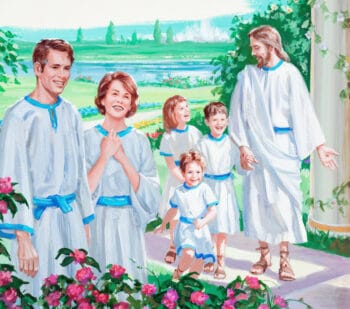
Image © Review & Herald Publishing at Goodsalt.com
Although we cannot really comprehend what the new heaven and new earth will be like, God shows John a vision of this place so that we look forward to the “wedding” that will soon happen. Indeed, we’re invited to “set your mind on things above, not on things on the earth” (Colossians 3:2, NKJV).
God is carefully preparing for this event, and He doesn’t want this “wedding” to catch us by surprise (see Matthew 22:1-14, Matthew 25:1-13).
The universe is the congregation that will see this event take place, and we are some of the central figures in this story. We will join with the “bride,” this city that Jesus will take us to at His second coming. Interestingly, God’s people (the saints) are also called the bride (see Revelation 19:7, NASB), perhaps because they are in “the holy city, New Jerusalem, coming down out of heaven from God, prepared as a bride adorned for her husband” (Revelation 21:2, NKJV).
This beautiful description of the Holy City shows that there is an intimate connection between God’s people and the city, because both are called “the bride.” The Bible reveals a detailed description of “the Holy City, the New Jerusalem, which is the capital and representative of the kingdom, [and] is called ‘the bride, the Lamb’s wife.’ ”—Ellen G. White, The Great Controversy, p. 426.
|
Read Revelation 21:9-27. Why is this so hard for us to imagine now? How do we even begin to wrap our minds around what is promised to us in these verses? |
Source: https://ssnet.org/blog/26b-13-the-bride/?utm_source=rss&utm_medium=rss&utm_campaign=26b-13-the-bride
Occasionally, I hear someone say that we can only have victory over sin in heaven, and until then, our righteousness is only by faith, which is why we need grace. Yet it seems to me that we will overcome only by faith and grace for all eternity. We will never ever overcome in our own strength. If we are able to resist sin by our own power in heaven, wouldn’t that become legalism? Revelation 12 tells us that a third of the angels fell with Lucifer. When we get to heaven, can you imagine the other two-thirds telling us that they kept from falling all by themselves? I doubt it! I imagine they will quickly attribute their own personal victory over Lucifer’s temptations to the grace of God. After all, for all eternity, we will be eating from the tree of life mentioned in Revelation 22:2, which will be for the healing of the nations. By eating this fruit every month, we will recognize that our spiritual health depends on our reliance on Jesus’ grace for all eternity.

Photo by William Earnhardt
In heaven, we will cast our crowns at the feet of Jesus, showing that we never have and never will live a victorious life on our own. We have always walked by faith and always will. Eternal life is onlyby faith, and it will be only by faith for all eternity. Hebrews 11:1 says faith is the evidence of things not seen. Since we will never see the end of eternity, our walk by faith will be for eternity. What I am saying is that, since eternity will never be fulfilled, we will forever have to trust God by faith that He is giving us eternal life. Also, for eternity that eternal life will be by grace. Ephesisans 2:8-9 tells us we are saved by grace through faith and not by works. Our works here on earth never award us heaven, but we also need to realize our works in heaven will never earn us eternal life either. There is not one single created being in the entire universe, fallen or unfallen, who can say that they deserve eternal life or have earned it.
We will be dependent upon grace and faith for all eternity, and that same grace and faith can give us victory in the here and now.
For the grace of God that brings salvation has appeared to all men, teaching us that, denying ungodliness and worldly lusts, we should live soberly, righteously, and godly in the present age, Titus 2:11-12 NKJV
Love has been perfected among us in this: that we may have boldness in the day of judgment; because as He is, so are we in this world. 1 John 4:17 NKJV
In 2 Corinthians 12, Paul had a weakness and a thorn in the flesh. He prayed for it to be removed, but Christ did not remove it. This weakness was not a sin. 1 Corinthians 10:13 tells us God will help us escape every temptation, but that does not mean He removes every temptation and weakness. However, he does give us the grace and strength to overcome.
And He said to me, “My grace is sufficient for you, for My strength is made perfect in weakness.” Therefore most gladly I will rather boast in my infirmities, that the power of Christ may rest upon me. 2 Corinthians 12:9 NKJV
The passage above tells us God’s grace continually strengthens and empowers us to overcome our continual weaknesses and temptations. While our flesh will be perfected in heaven according to 1 Corinthians 15:50-55, that does not mean we will no longer need faith and grace to live a life of eternal victory. After all, even with perfected bodies, Adam and Eve fell in the Garden of Eden. Even with perfect bodies, a third of the angels fell from heaven with Lucifer. This, again, is where the tree of life comes in for the healing and continual health of the nations. By continually eating from this tree, we will be symbolically declaring our eternal dependence upon the grace of Jesus to be eternally safe from sin.
When we get to heaven, we will not switch from grace to legalism. We will not switch from grace to the works of the flesh, even our perfect flesh. Both on this earth in this life and in the new earth, our eternal life will always be dependent upon Christ’s grace. And the same grace that will give us eternal victory will give us victory here on earth. “We need Thee every hour” is a lesson we learn here on earth and will practice for all eternity.
For whatever is born of God overcomes the world. And this is the victory that has overcome the world—our faith. 1 John 5:4
The death of Christ upon the cross made sure the destruction of him who has the power of death, who was the originator of sin. When Satan is destroyed, there will be none to tempt to evil; the atonement will never need to be repeated; and there will be no danger of another rebellion in the universe of God. That which alone can effectually restrain from sin in this world of darkness, will prevent sin in heaven. The significance of the death of Christ will be seen by saints and angels. Fallen men could not have a home in the paradise of God without the Lamb slain from the foundation of the world. Shall we not then exalt the cross of Christ? The angels ascribe honor and glory to Christ, for even they are not secure except by looking to the sufferings of the Son of God. It is through the efficacy of the cross that the angels of heaven are guarded from apostasy. Without the cross they would be no more secure against evil than were the angels before the fall of Satan. Angelic perfection failed in heaven. Human perfection failed in Eden, the paradise of bliss. All who wish for security in earth or heaven must look to the Lamb of God. {5BC 1132.8} –Ellen White, Signs of the Times, December 30, 1889.
 Intercer is a website with biblical materials in Romanian, English, Hungarian and other languages. We want to bring the light from God's Word to peoples homes. Intercer provides quality Christian resources...[Read More]
