What are you most looking forward to saying “finally” about? Join the Hit the Mark panel as they discuss Sabbath School Lesson 15 – Into Eternity. It’s the fastest hour of the week! Get your copy of this week’s Keyword Workbook HERE.

Closer To Heaven
|
|
|
What are you most looking forward to saying “finally” about? Join the Hit the Mark panel as they discuss Sabbath School Lesson 15 – Into Eternity. It’s the fastest hour of the week! Get your copy of this week’s Keyword Workbook HERE.
Daily Lesson for Wednesday 24th of June 2026
Have you ever been asked what you’re most looking forward to in eternity? A child might say, “Riding a tiger,” “Sliding down a giraffe’s neck,” or “Flying to different planets.” If you were to ask a teenager, they might say, “Not having to do any more schoolwork,” or “Exploring heaven with my friends without getting hurt.” And if you were to ask a group of adults, they might say, “Being in a place where there’s no more pain, suffering, or death,” or “Being reunited with loved ones.” All of these responses are good and true, and there is so much to look forward to in the new heaven and the new earth. Eternity burns within our hearts, and, intrinsically, we know there must be something more to life than the here and now.
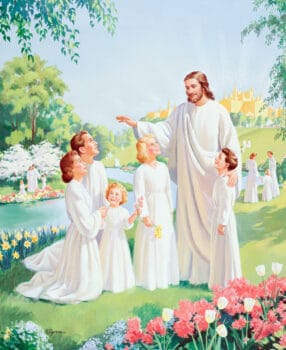
Image © Review & Herald Publishing at Goodsalt.com
Surely the greatest blessing of heaven will be to finally see Jesus and to thank Him, in person, for what He has done for us on this fallen earth. We will want to lavish our adoration and worship to Him for saving us, by His own suffering on the cross, from eternal death.
“ ‘Worthy is the Lamb who was slain to receive power and riches and wisdom, and strength and honor and glory and blessing!’ ” (Revelation 5:12, NKJV).
John the Baptist introduced Jesus as “the Lamb of God” (John 1:36). Two of John’s disciples heard this statement and followed Jesus (John 1:37), and Revelation 14:4 tells us we should do the same. “These are the ones who follow the Lamb wherever He goes” (Revelation 14:4, NKJV). However, if we want to follow Him in heaven, we must first follow Him here on earth.
Jesus, the Lamb, is also our Shepherd, guiding our paths as no other can. This is so reassuring for us as we struggle through the hard times that we find ourselves in, but Jesus will never stop leading us, even in heaven. Revelation 7:17 says, “ ‘For the Lamb who is in the midst of the throne will shepherd them and lead them to living fountains of waters’ ” (NKJV). As His people, His sheep, we will follow Jesus in heaven, forever wanting to be in His presence. One defining characteristic of God’s people is that “His name shall be on their foreheads” (Revelation 22:4, NKJV). That is, we always will be thinking of Him.
|
Listen to the Adventist gospel song “Follow the Lamb” at https://vimeo.com/1067821589 and make the words your personal prayer today. |

Join It Is Written Sabbath School host Eric Flickinger and this quarter’s author, Nina Atchesonn, as they provide additional insights into this week’s Sabbath School lesson.
View an in-depth discussion of Into Eternity in the Hope Sabbath School class led by Pastor Derek Morris.
Click on the image below to view the video:
</p>
With thanks to Hope Channel – Television that will change your life.
Introduction: What is your favorite activity? When I was young I liked doing things that involved tension and a hint of danger. Things like riding a motorcycle through the woods, water skiing, or fast cars.  What I never liked was danger that I could not reasonably control, like roller-coasters or rides of that type. I barely cared about eating. Now that I’m old, I appreciate tension less and like eating more. Praising God brings joy. Some of the ideas of the saints in heaven are, frankly, discouraging. Is your favorite activity something that you will enjoy in heaven? For those who enjoy eating, the Bible contains references to eating and drinking in heaven. How much time do you spend thinking about you and eternity? Let’s explore the Bible to help shape our thoughts about eternity!
I. Rough Men Safe to Save?
A. Some have argued to me that we must be “safe to save.” What do you think that means? (I understand it to mean that if my character is not sufficiently attuned to the atmosphere of heaven, I will not be there because I’m not safe.)
1. What do you think of this religious claim?
2. What kind of mental picture do you have of men who are “safe to save?”
a. Is it consistent with spending hours sitting on a cloud playing a harp?
B. Read Hebrews 11:32. What do you think those guys liked to do in their spare time?
C. Read Hebrews 11:33-34. What kinds of activities are revealed here? (Mostly fighting! Many of these activities involved courage, danger, conflict, and great faith—conquering kingdoms, enforcing justice, obtaining promises, escaping death, and becoming mighty in war.)
1. Are these weak men? (They were “made strong out of weakness.”)
2. Are they going to be in heaven?
D. Read 1 Samuel 16:16-18. How does this describe David? (He was a harp (technically a lyre) player, which is what Saul wanted.)
1. What other attributes of David are listed that have nothing to do with his musical abilities? (He is brave and a “man of war.” He has a good presence, and “the Lord is with him.”)
E. Read Luke 23:39-43. What would you guess were the favorite activities of the man to whom Jesus promises salvation? (He confesses that his past activities justify his crucifixion.)
1. How is he safe to save?
F. During Jesus’ ministry, what type of men did He choose as disciples? Were these mild-mannered types? Did they have low testosterone?
1. What do you think they did in their spare time before they met Jesus?
2. Even the “certified” harp player, David, is not the kind of meek, mild, and weak man that is consistent with the common picture of the saved sitting on clouds spending their time playing harps.)
G. I’ve asked you a series of questions about men who we will meet in heaven. I asked about what you thought they would do in their spare time because what we do in our spare time likely reflects our favorite activities. The assumption underlying these questions is that in heaven we will have the freedom to do what we enjoy – and undoubtedly learn more enjoyable things to do. Do you agree with this assumption?
II. What We Know About Heaven
A. Read Revelation 21:2-3 and Revelation 21:15-17. Do these measurements seem symbolic to you? Or are these the actual size of the New Jerusalem? (These specific details suggest that they are the actual size. And the city is huge. Translating the measurements reveals that the city is a cube, which is 1,380 miles (2,220 km) on each side. Its walls are 216 feet (66 meters) thick. Turns out the New Jerusalem is a giant condominium!)
B. Read Revelation 21:18-21. Aside from the city being made of pure gold “like clear glass,” what other precious stones are part of its construction? (Jasper, Sapphire, Agate, Emerald, Onyx, Carnelian, Chrysolite, Beryl, Topaz, Chrysoprase, Jacinth, and Amethyst. Plus it has huge pearls for its gates.)
1. What point is God making when He reveals that the New Jerusalem is made of precious stones and metals? To what human instinct is God appealing?
2. What does this suggest about how you will live in heaven? (This is not self-denial. This is luxury.)
C. Read Luke 9:23. How do you reconcile this text with the astonishing luxury of heaven? (Jesus denied Himself in the extreme to come to earth to save us. It was temporary. Our life here is temporary, and following the example of Jesus we should engage in self-denial for the purpose of advancing the gospel.)
D. Read Revelation 22:1-2. Will we have fresh fruit in heaven? What is the purpose of this special fruit? (For health and healing. It gives us life.)
E. Read Genesis 2:16-17. If you think about Revelation 22:2 you might conclude that you had to eat the same fruit for an entire month. What does the Eden parallel teach us? (Like Eden, heaven will have all sorts of trees that provide food for us.)
F. Let’s look again at Revelation 22:1-2. We know that the New Jerusalem is this huge cube that is 1,380 miles (2,220 km) tall. The River of Life begins on the top at the throne of God. How do you think it progresses down for 1,380 miles? (The description is inconsistent with a waterfall. I think the city is an open atrium. The river flows from floor to floor with the Tree of Life and the main street on both sides. I imagine that our individual condominium apartments have a balcony overlooking the street and the river. We can reach out and pick fruit from the Tree of Life.)
III. Negative Assurance
A. From my days litigating how labor unions spend their money I learned the term, “negative assurance.” It is what accountants provide in a review (not an audit) that essentially says, “We’re not saying everything in these books is accurate, but we have not found any significant errors.” Read Isaiah 25:8 and Revelation 21:4. What will we not find in heaven? (Death, tears, mourning, crying, pain, shame, and fear about the future.)
B. Look again at Revelation 21:4. How important is this to living a great life?
IV. Worship and Work
A. Read Isaiah 25:9. What does this tell us will be our attitude in heaven? (Joy! Gladness!)
B. Read Revelation 22:3-4. What are two things that this tells us that we will do in heaven? (Worship God. And see Him face to face.)
C. Read Revelation 7:9-10 and Revelation 5:11-13. Have you experienced praising God while standing in a large group? (Thankfully, I am regularly able to do this when I attend the chapel at Regent University. Singing praises in a group lifts my heart to heaven. I love it!)
D. Read Matthew 8:11. What else will we be doing in heaven? (We will get to eat with the famous people of the Bible! Do you have any questions you would like to ask Abraham?)
E. Read Matthew 26:29. Who else do we get to eat with? (Jesus! We have a general picture that eating will be part of our enjoyable activities in heaven.)
F. Read Isaiah 65:21-22. Do you like to create things? This is part of the joy of heaven!
G. Read Revelation 22:3 and Genesis 3:17-19. What is Revelation 22:3 telling us about our work in heaven? (The curse is gone. It will not be painful or hard to work in heaven.)
H. Friend, if your desire to go to heaven is tempered by the idea that it will be filled with boring people doing boring stuff, I hope this study has changed your mind. Those the Bible tells us will be in heaven are not boring. Our surroundings in heaven are not boring! And I am confident that what we will be doing in heaven will be exciting and fulfilling. Why not, right now, ask Jesus to save you so that your future will be with God?
V. Next week we start a new series of lessons on First and Second Corinthians.
Copr. 2026, Bruce N. Cameron, J.D. Scripture quotations are from the ESV® Bible (The Holy Bible, English Standard Version®), copyright © 2001 by Crossway, a publishing ministry of Good News Publishers. Used by permission. All rights reserved. Suggested answers are found within parentheses. If you normally receive this lesson by e-mail, but it is lost one week, you can find it by clicking on this link: http://www.GoBible.org. Pray for the guidance of the Holy Spirit as you study.
 Intercer is a website with biblical materials in Romanian, English, Hungarian and other languages. We want to bring the light from God's Word to peoples homes. Intercer provides quality Christian resources...[Read More]
