Our Sabbath School program has always been linked to the support of the Seventh-day Adventist Mission program. This video provides a little insight into this important work.
(0)Closer To Heaven
|
|
|
By admin
Our Sabbath School program has always been linked to the support of the Seventh-day Adventist Mission program. This video provides a little insight into this important work.
(0)By admin
Is this True, Somewhat True, or False? In the spiritual realm, if it’s yours, you don’t have to work for it; you just have to accept it. Join the Hit the Mark panel as they discuss Sabbath School Lesson 9 – Heirs of Promises, Prisoners of Hope. It’s the fastest hour of the week!
(0)By admin
Introduction: One of the most controversial political issues of our day, and one that has existed for a long time, is the land dispute between Israel and the Palestinians. Should the Palestinians have a state of their own next to Israel,
or have they forfeited their right to live in the area because of their repeated attacks on Jewish civilians? Instead of entering into that heated debate, let’s do what I always like to do and see what God has said about the Jews and the land of Israel. Let’s dive into our study of the Bible!
I. The Promise Fulfilled?
A. Read Joshua 13:1-2 and Joshua 13:7-8. Joshua is very old, and the task of occupying the promised land is not complete. We will skip the reading of the specific land assignments that remain. Has God fulfilled His promise of giving to Abram’s descendants the land?
B. Read Joshua 13:6. Who does this say will complete the task? (God says that He will drive out the rest of the pagans. God does not fault Joshua; He tells Joshua that his remaining task is to “allot” the remaining land among the tribes.)
C. Read Joshua 11:15 and Joshua 21:43-45. What does this say about the job Joshua did in leading the conquest of the promised land? (It praises Joshua for a great job and it says that God completely fulfilled His promise.)
II. The Unconditional Covenant
A. Read Genesis 12:1-2 and Genesis 13:14-17. As you consider these promises to Abram, does God say that they are conditional?
B. In Genesis chapter 15, God repeats His promise to Abram. Read Genesis 15:8. What practical question is Abram asking God?
C. Read Genesis 3:22-24. Is Abram thinking about how God drove Adam and Eve out of the Garden of Eden, and even placed an armed guard so they could not re-enter it? (There is no record of a land promise to Adam and Eve. Genesis 2:8 says that God planted the garden and put humans in it. Abram had a promise from God.)
D. Read Genesis 15:18-21. This is part of God’s response to Abram’s question in Genesis 15:8, “How am I to know you mean to give me the land?” Would you say that God’s promise is conditional?
E. Read Genesis 15:9-12 and Genesis 15:17. Why are we told about cutting up animals and a torch passing between the animal parts while Abram is sleeping? (Passing between animal parts was an act of entering into a formal contract with another person.)
F. Read Genesis 17:7. What is God promising, and for how long is He promising it? (God says that He will be the God of Abram’s offspring forever. The agreement is “everlasting.”)
G. Read Genesis 17:8. How long will Abram’s descendants possess the land promised to them? (Forever. The land is “an everlasting possession.”)
III. The Conditional Covenant
A. Read Leviticus 20:22. What does this say might happen to Abram’s offspring? (They might get “vomited out” of the land just like the Canaanites.)
B. Read Deuteronomy 4:25-27. What does this promise say will happen to God’s people if they act “corruptly”? (They will perish from the land promised to them through Abram.)
C. Read Deuteronomy 28:63-65. What does this say will be the “resting place” of God’s people if they disobey?
D. Read Deuteronomy 30:15-18. Does God warn that living in the promised land, indeed living at all, is conditional on obedience to God?
IV. The Jubilee Pattern
A. Read Leviticus 25:10, Leviticus 25:13-15 and Leviticus 25:23-24. What does this say happens to land during the 50th year Jubilee celebration? (The land is returned, under equitable circumstances, to the original owners.)
B. Read Leviticus 26:40-42 and Leviticus 26:44-46. The prior chapter of Leviticus describes the Jubilee pattern for land ownership. Do these statements in Leviticus 26 sound like they reflect the same attitude-that the land is never permanently alienated?
C. Let’s think about what we have studied so far. Is the Jubilee pattern of land ownership the ultimate answer to whether God’s land promise to Abram was conditional? (It resolves the apparent conflict for me. God fulfilled His promise. The land remains in the ownership of His people. But living on the land depends on obedience to God. Turning to God restores the land to God’s people.)
V. The Future
A. Read Romans 11:25-29. What does this tell us about the future of the Hebrews and God’s promises to them? (This affirms that God’s gifts are “irrevocable.” There will be a time when the “partial hardening” of Abram’s descendants will no longer exist, a time when “the Gentiles” have come to faith. Romans says, “all Israel will be saved.”)
B. Read Luke 21:24-27. How does Jesus connect the “times of the Gentiles are fulfilled” with His Second Coming? (Assuming that we are correct that the Jubilee pattern of land return is God’s plan for Israel, then just before Jesus returns we will see Abram’s descendants return to faith and return to their land.)
C. Friend, God is faithful! Will you be faithful to Him? The consequences for unfaithfulness are dire. Why not decide right now, that through the power of the Holy Spirit, you will be faithful?
VI. Next week: The True Joshua.
Copr. 2025, Bruce N. Cameron, J.D. Scripture quotations are from the ESV® Bible (The Holy Bible, English Standard Version®), copyright © 2001 by Crossway, a publishing ministry of Good News Publishers. Used by permission. All rights reserved. Suggested answers are found within parentheses. If you normally receive this lesson by e-mail, but it is lost one week, you can find it by clicking on this link: http://www.GoBible.org. Pray for the guidance of the Holy Spirit as you study.
(0)By admin
Inside Story for Friday 28th of November 2025
Kim Sun is associate director of the 1000 Missionary Movement, whose headquarters in Silang, Philippines, were constructed with the help of a 1996 Thirteenth Sabbath Offering. Read more next week.
__
Kim Sun, a South Korean teen studying at the Adventist University of the Philippines, wondered if he could make a career out of going door-to-door after a man whom he had invited to evangelistic meetings got baptized. He wasn’t Adventist, and it had been his first time going door-to-door.
“What’s this that we were doing?” he asked a pastor who had accompanied the students going door-to-door. “Is it called community service?”
The pastor smiled. “No,” he said. “It’s called mission.”
“Is there a full-time job like this?” Sun said.
“Yes,” the pastor said. “It’s called being a missionary.”
“Can I have this job, too?”
“Yes. The income isn’t so much, but you can do it.”
“How can I do it?”
“You’ll have to change your studies from nursing to theology.”
“Oh. I’ll need to ask my mom.”
Sun was studying in the Philippines because his parents had wanted him to make something of his life. Before, he had been living for himself.
When Sun spoke to his mother, he asked if he could change his major.
Mother was confused. “What is theology?” she said.
“Theology is serving the church,” he said, adding that the pay may be low.
Mother said he could take theology if he also finished his nursing studies.
“But nursing isn’t meaningful to me,” Sun said.
Then Mother had an idea. Her goal wasn’t for him to be rich but to be a good person. “If you take theology, can you drink or smoke?” she said.
When he said no, she exclaimed, “Then please change your studies!”
Sun loved theology. He learned the biblical basis for the seventh-day Sabbath. He read the prophecies of Daniel and Revelation. He got baptized.
When he returned home for vacations, he tried to persuade his parents to accept his new beliefs. “Mom and Dad, sit down and let me talk to you,” he said. “Sunday is not the Sabbath day. Saturday is the Sabbath. Do you know Daniel’s interpretation of Nebuchadnezzar’s dream?”
He couldn’t understand why his parents weren’t open-minded. He was dismayed when Mother finally asked him to stop, saying, “You take your God, and I’ll take my God,” she said.
“But they’re the same God!” he said. “We have to follow God’s Word.”
(1)By admin
Daily Lesson for Friday 28th of November 2025
Further Thought:
Read Ellen G. White, “The Controversy Ended,” Pages 672–678, in The Great Controversy.
“We shall be saved eternally when we enter in through the gates into the city. Then we may rejoice that we are saved, eternally saved. But until then we need to heed the injunction of the apostle, and to ‘fear, lest, a promise being left us of entering into his rest, any of us should seem to come short of it’ [Hebrews 4:1]. Having a knowledge of Canaan, singing the songs of Canaan, rejoicing in the prospect of entering into Canaan, did not bring the children of Israel into the vineyards and olive-groves of the promised land. They could make it theirs in truth only by occupation, by complying with the conditions, by exercising living faith in God, by appropriating his promises to themselves.”—Ellen G. White, Youth’s Instructor, February 17, 1898.
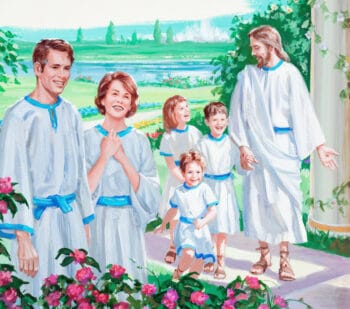
“In the Bible the inheritance of the saved is called ‘a country.’ Hebrews 11:14-16. There the heavenly Shepherd leads His flock to fountains of living waters. The tree of life yields its fruit every month, and the leaves of the tree are for the service of the nations. There are ever-flowing streams, clear as crystal, and beside them waving trees cast their shadows upon the paths prepared for the ransomed of the Lord. There the wide-spreading plains swell into hills of beauty, and the mountains of God rear their lofty summits. On those peaceful plains, beside those living streams, God’s people, so long pilgrims and wanderers, shall find a home.”—Ellen G. White, The Great Controversy, p. 675.
Discussion Questions
|
(3)