View an in-depth discussion of Setbacks in the Hope Sabbath School class led by Pastor Derek Morris.
Click on the image below to view the video:
With thanks to Hope Channel – Television that will change your life.
Closer To Heaven
|
|
|
View an in-depth discussion of Setbacks in the Hope Sabbath School class led by Pastor Derek Morris.
Click on the image below to view the video:
With thanks to Hope Channel – Television that will change your life.
Growing in a Relationship With God has many wonderful steps in it. There are several beautiful hymns from which to choose as a theme due to all the changes that come along when we grow in our relationship with God. On page 31 we see that “the most powerful weapon is prayer” to help us through our growing times. Therefore, we will wish to sing
Turn Your Eyes Upon Jesus – Hymn 290 to keep learning every minute of the day in our journey. To help with this journey, Lord,
Give Me The Bible – Hymn 272 to instruct even more with the Holy Spirit encouraging along the way: 
Hover O’er Me, Holy Spirit – Hymn 260.
To learn unknown hymns, you will find the accompaniment music for each one at: https://sdahymnals.com/Hymnal/
Another great resource is for when there is a hymn you wish to sing but can’t find it in your hymnal. Go to https://www.sdahymnal.org/
2 Timothy 2:15 KJV – “Study to shew thyself approved unto God, a workman that needeth not to be ashamed, rightly dividing the word of truth.”
Daily Lesson for Sunday 7th of June 2026
Jesus had spent the day speaking to large crowds of people on the shores of Galilee. Jesus’ words would echo in the people’s minds for a long time and down throughout eternity.
As evening fell, Jesus spoke to His disciples, inviting them on a journey with Him. “ ‘Let us cross over to the other side’ ” (Mark 4:35, NKJV). Jesus knew a storm would come but suggested they go anyway. He had an important life lesson to teach His closest followers.
You likely know what happened next.
Consider these points:
Jesus falls asleep on what was likely the only pillow in the boat. The fishing boats usually had one pillow, which the driver of the boat, at the stern, sat on. The person at the stern guided the boat to the destination. So here, Jesus is in the position of the boat’s “driver,” but He falls asleep at the wheel.
Not all the disciples were new to sailing. Peter, James, and John were experienced fishermen. They knew the Sea of Galilee, and they would have known how to navigate a storm.
This is the only recorded Gospel account of Jesus sleeping. During one of the worst storms in their lives, when the disciples are terrified and think they’re going to die, Jesus is asleep at the stern.
The disciples’ response in their time of crisis is “Do You not care?” They questioned Jesus’ character and His love for them. Too often, this is also our response when we face hard times.
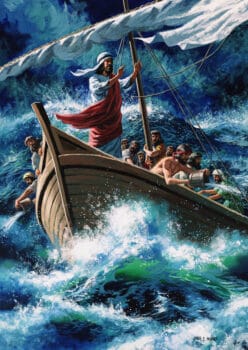
Image © Pacific Press at Goodsalt.com
It’s in the midst of hopelessness that we might try to save ourselves (like the disciples), or sometimes it’s when we feel pain or loss that we start to question or doubt God’s love and care for us. We presume that He should act in a certain way based on what we think and see from our human perspective. But, as with the disciples, it’s in life’s storms that God can work the greatest miracles. God is always faithful, even when His apparent lack of involvement doesn’t make sense to us. He’s in our storms with us and can calm the storm when we cannot.
|
What is your usual response when you face a storm in your life? How do such moments impact your relationship with God? When have you lived out 2 Corinthians 5:7? |
This lesson teaching plan is prepared for Sabbath School Class on June 13, 2026.
Photograph by William Earnhardt
Key Text: “And not only that, but we also glory in tribulations, knowing that tribulation produces perseverance; and perseverance, character; and character, hope. Now hope does not disappoint, because the love of God has been poured out in our hearts by the Holy Spirit who was given to us” (Romans 5:3-5, NKJV).
Read in Class: Mark 4:35-41.
Study: What lessons on faith can you take from here?
Apply: What is your usual response when you face a storm in your life? How do such moments impact your relationship with God? When have you lived out 2 Corinthians 5:7?
Share: Sailboats can’t move without wind. Can you share a time when the “stormwinds” actually got you to a better place? See Do You Have Enough Faith Not to Ask Jesus to Calm the Storm?
Read in Class: Mark 5:21-34.
Study: What happened, and what can we learn?
Apply: How did this woman in such great need demonstrate the ideas in Romans 5:3-5? What might this look like in your life?
Share: Share why you think Jesus thought it was important to identify the woman in the crowd, even though she was already healed?
Read in Class: Job 19:23-27 and Job 23:8-12.
Study: What was Job’s attitude towards his setbacks?
Apply: What has been your attitude when life served you a setback? How did God’s grace carry you though, maybe even when your faith was not there?
Share: Share how you maintain your integrity when you are trying to do everything right, but everything keeps going wrong.
Read in Class: Luke 24:13-27.
Study: What were the differences between Jesus’ perspective and the other two men’s perspectives concerning the event they were discussing?
Apply: What is your attitude when God allows setbacks when you do not undersand why He allowed them?
Share: What are your go-to passages when you are experiencing a setback?
Mission: Can you think of someone who is experiencing a setback? Can you reach out to them this week and offer a prayer and word of encouragement?
Daily Lesson for Sabbath 6th of June 2026

Image © Pacific Press
Mark 4:35-41; Mark 5:21-34; Romans 5:3-5; Job 19:23-27; Job 23:8-12; Luke 24:13-27; Romans 8:18,28.
Memory Text:
“And not only that, but we also glory in tribulations, knowing that tribulation produces perseverance; and perseverance, character; and character, hope. Now hope does not disappoint, because the love of God has been poured out in our hearts by the Holy Spirit who was given to us” (Romans 5:3-5, NKJV).
One evening, as the sun dipped over the horizon, a girl was walking home when a dark storm blew in. She quickened her pace, knowing there was still a way to go. A lone raindrop fell on her cheek, then another, and, before she knew it, she was drenched. She started to run toward the front door of her home, where her father rushed to meet her. He had been watching her from the front window. As he wrapped a blanket around her shoulders, he asked her, “I saw you just now, in the rain. Why, with every bolt of lightning, did you stop running to look up and smile?”
“Oh, I stopped to look up,” she said, “because God was taking my picture!”
What is our response when the storms of life come or when we have certain setbacks in our relationship with God? Do we put our head down as the rain pelts upon our backs or do we look up, knowing and trusting that God is there as we turn our face toward Him?
This week, we’ll explore some responses we often have when life is challenging. We’ll consider how we might use life’s setbacks to strengthen, not weaken, our most important relationship.
Source: https://ssnet.org/blog/26b-11-setbacks/?utm_source=rss&utm_medium=rss&utm_campaign=26b-11-setbacks
 Intercer is a website with biblical materials in Romanian, English, Hungarian and other languages. We want to bring the light from God's Word to peoples homes. Intercer provides quality Christian resources...[Read More]
