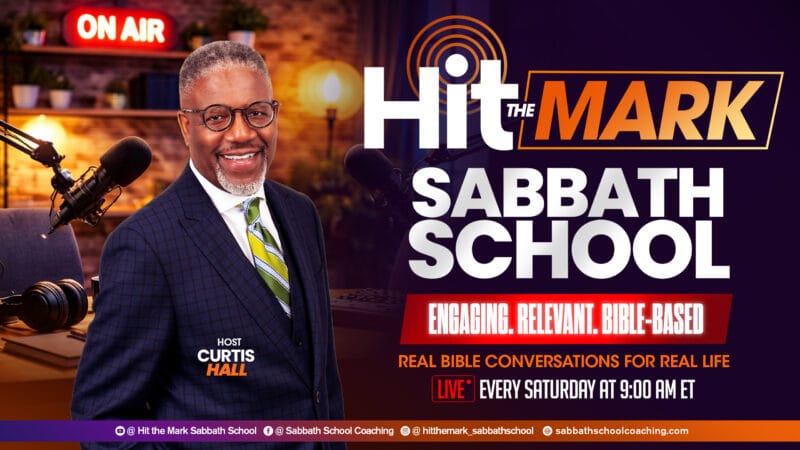
Is this True, Somewhat True, or False: Our major role in making disciples is in influencing people to attend our church services. Join the Hit the Mark panel as they discuss Sabbath School Lesson 12 – Share Him. It’s the fastest hour of the week! Get your copy of this week’s keyword handout HERE
Inside Story: Stranger in the Parking Lot
Inside Story for Friday 19th of June 2026
Thank you for your Thirteenth Sabbath Offering, also known as the Quarterly Mission Project Offering, that is helping people like Zeth prepare for gospel ministry. Klabat University, located near Manado, Indonesia, is a previous offering recipient. This quarter’s offering will help similar schools in the East-Central Africa Division. Watch a YouTube video of Zeth at bit.ly/Zeth-IS.
People ask Zeth Louis Lekatompessy how he supports his wife and three children without a salaried job in Indonesia. He says it is God’s providence.
Zeth decided to volunteer as a Bible worker after feeling convicted that he needed to trust more in God and less on himself during the COVID-19 pandemic. He had a heart for souls, and he put into motion a plan that he had used to lead many of his siblings to Christ.
He and his wife put together a list of every person whom they knew on Ambon Island, where they lived. Then they prayed for the names daily. They also got on their motorcycle every morning and visited the people on the list. The visits prompted Bible studies, and the Bible studies led to baptisms.
Zeth and his wife visited about three families a day, and the discussions sometimes lasted until late at night.
Many people couldn’t understand how the family was making ends meet.
“How do you survive with no job or savings or property that you can sell to help with your financial needs?” someone asked.
“It’s impossible to live without a paying job,” said another. “I can’t believe it. Please prove it.”
Zeth acknowledges that his family has faced challenges. One Friday, the money ran out, and he and his wife prayed for God to intervene. Their prayers stretched into Sabbath. “We don’t have anything but You,” they prayed. “We can only trust in You.” That Sabbath, a stranger approached Zeth in the church parking lot and handed him an envelope. “This is for you so you can cheerfully continue your ministry,” he said.
At home, Zeth and his wife thanked God and opened the envelope. Inside they found enough money to cover their needs for several months.
To those who seek evidence, Zeth recounts the experience, saying, “Out of hundreds of experiences of God’s providence, this is just one of them.”
Today, Zeth is studying theology at Klabat University in hope of learning how to give better Bible studies. He said God is still covering his family’s expenses. When he graduates, he is ready to serve as a pastor, a Bible worker, or in another position from God.
“Pray for me and my family,” he said. “Pray that when I finish my studies, I can bring more souls to God’s kingdom.”
Friday: Further Thought – Share Him
Daily Lesson for Friday 19th of June 2026
Further Thoughts:
“Whatever the profession, no man has pure love to God unless he has unselfish love for his brother.
But we can never come into possession of this spirit by trying to love others. What is needed is the love of Christ in the heart. When self is merged in Christ, love springs forth spontaneously.”—Ellen G. White, Christ’s Object Lessons, p. 384.
“Those who are most actively employed in doing with interested fidelity their work to win souls to Jesus Christ, are the best developed in spirituality and devotion.”—Ellen G. White, Evangelism, p. 356.
“Strength to resist evil is best gained by aggressive service.”—Ellen G. White, The Acts of the Apostles, p. 105.
“In order to enter into His joy—the joy of seeing souls redeemed by His sacrifice—we must participate in His labors for their redemption.”—Ellen G. White, The Desire of Ages, p. 142.
“Those who reject the privilege of fellowship with Christ in service, reject the only training that imparts a fitness for participation with Him in His glory.”—Ellen G. White, Education, p. 264.
Discussion Questions
|
Summary: When God’s love and His living, powerful Word fill our daily lives, we will be compelled to love and share Him with those around us. We should be prayerful, thoughtful, and intentional about witnessing, believing that His Word, which goes forth from His mouth, shall not return to Him void, but it shall accomplish what He pleases, and it shall prosper in the things for which He sent it (see Isaiah 55:11).
12: Share Him (Matthew 10 and 28, Revelation 14) – Sabbath School Lesson Teaching Outline
Introduction: Have you seen some bad examples of sharing Jesus with others? At church, one fellow who acknowledged his own struggle with weight reported that he shared Jesus by correcting the eating habits of a nonmember.
Even he realized the problem by admitting, “I could lose a few pounds.” Have you seen good examples of sharing? In the past, church members shared by going door to door. Nothing in the Bible records that John the Baptist or Jesus went house to house sharing the gospel. People came to them. How should we share the gospel? What are good examples of sharing? Should we wait for people to come to us? How should we get them to come? Let’s plunge into our study of the Bible and see what we can learn!
I. The Commission
A. Read Matthew 28:18-20. What did Jesus ask His disciples to do? And by extension, what does He ask us to do? (1. Go. 2. Make disciples. 3. Baptize the new disciples. 4. Teach the new disciples.)
1. Which one of those four assignments seems to be the most difficult? (Making disciples. The first, third and fourth assignments seem less complicated. “Go” seems to require us to move forward. If individuals are considering baptism or need teaching, they seem to have already consented to being engaged by the gospel.)
B. Look again at Matthew 28:19 and the command to “make disciples.” What do you think about the practice of going door to door uninvited to witness? (I never felt comfortable doing that. Part of the problem was that I was invading the homeowner’s space. The homeowner had not invited me to interrupt his day. He had expressed no interest in learning more about God.)
1. I used to fly a lot. Often I would ask myself if I should witness to the the person in the seat next to me. Is this better or very much like going door to door to witness? (Perhaps it is worse because they were stuck sitting by me. I would look for the person to say something that would naturally allow me to discuss spiritual matters.)
2. On one flight I was with my wife. We were seated in the same row, but another person was seated between us. He immediately asked if my wife would change seats with him because he did not want to be bothered by others talking. She agreed, and my wife and I (now seated next to each other) began discussing a religious liberty case I was litigating. It turns out the fellow was listening to us and he suddenly asked my wife if she would change seats with him again because he had such an interest in the case I was litigating. Is this the work of the Holy Spirit?
3. Does Jesus explain how to make disciples? (Not here. We look at that next.)
C. Read Matthew 10:5-6. That does not seem to be an instruction for today, but is there a lesson in this for us? (We need to direct our evangelism to those the Holy Spirit suggests to us. Going door to door is being guided mostly by geography, not the Holy Spirit.)
D. Read Matthew 10:7. We discussed what this meant two weeks ago. What did we decide? (I suggested that the Jewish audience would think this meant the Messiah had come and would take over the world. Today we know Jesus’ mission on earth.)
1. With that in mind, what should be the topic of our evangelism? (Jesus came to earth as our Messiah. Jesus is coming again.)
a. Would another approach be better considering the passage of time and the widespread knowledge of Jesus?
E. Read Revelation 14:6-7. Is this an “update” to Matthew 10:7? (It is an update, and it is about the gospel.)
1. What makes it time sensitive? (The reference to judgment!)
F. Read Revelation 14:8-10. What does this explain about the judgment? (That we need to be careful about who we worship. We do not want to receive the mark.)
G. Read Matthew 10:8. How should we understand this for today? (Jesus tells His disciples to do Holy Spirit-powered things that would cause people to come to them. If you are doing things like this, you do not need to go door to door.)
1. Does this stop us dead in our tracks? Should we expect to do these miracles, or should we look for alternatives?
2. Think again about Revelation 14. Is talking about the end of the world and how to avoid the mark something that will attract listeners?
3. Does the instruction, “Give without pay,” provide another approach? If our life has been benefited by the gospel, should we share that benefit as the “hook” to bringing listeners to our presentations?
H. Read Matthew 10:9-10. How should we understand this? (Jesus explains that the hearers of the gospel should assume the expense of the evangelism.)
1. Does that mean that we should charge people to attend our meetings? (I have found that if a person has to pay for something, they take better care of it. They value it more.)
I. Read Matthew 10:11-13. Has the idea of staying in a stranger’s home been eclipsed by time?
1. Read Luke 10:34-35. This reveals that “inns” existed at the time of Jesus’ instruction to His disciples. Does that make it more likely that this applies to us today? We should stay in homes?
2. Or is the entire idea of walking around to towns, staying in homes, and sharing the gospel person to person made obsolete by the Internet? What about the aspect of face-to-face witnessing?
3. Decades ago, I daydreamed about retiring from my regular job, converting a bus to a motorhome, and traveling from church to church teaching and preaching. Let’s say that I had a packed schedule and visited 50 churches a year. Let’s be generous and say that 200 people showed up at each church to listen. My total audience for the year would be 10,000. This lesson is sent to more than 24,000 subscribers each week. This does not count those who come to the GoBible website or read the lesson in one of its many translations. Not everyone who subscribes to the email opens or reads it, but not everyone in a church is paying attention. Would it be sensible for me to go door to door or church to church?
J. Read Matthew 10:14. What does this teach us about pestering people to accept the gospel?
II. The Holy Spirit
A. Read John 20:20-22. What is the first requirement for sharing the gospel? (Having the Holy Spirit in us.)
B. Read John 20:23. Is Jesus giving us the power to forgive sins? Isn’t that power reserved to God alone?
1. What about the power to refuse the forgiveness of sins? Will our witness include the authority to keep others out of Heaven?
C. Read Matthew 16:18-19. If any of the disciples could forgive or refuse to forgive, that would be Peter. How many might come to a meeting if you promised that if they came they would be forgiven of their sins and could be sure of getting into heaven?
D. Read Acts 2:38. How did Peter understand the power that Jesus had given to him? (Peter’s power was to share the gospel. Otherwise, verse 38 would say, “I forgive your sins.” Peter’s understanding of what Jesus told him should be conclusive. In fact, we do not see any of the disciples claiming the right to forgive or withhold forgiveness of sins.)
1. So, how should we understand Jesus’ statements about granting or withholding forgiveness? (I think Jesus is saying that sharing the gospel is important for the salvation of our listeners.)
a. Does that mean our laziness or timidity can hinder someone else’s opportunity to hear the gospel?
E. What about the promise of forgiveness as the ‘hook’ for bringing people to a meeting to hear the gospel? Is this one excellent way to make disciples?
F. Friend, will you decide today to be intentional about making disciples? If your answer is, “Yes,” then the first thing to do is to invite the Holy Spirit into your mind and seek His direction on how best to make disciples.
III. Next week: Into Eternity.
Copr. 2026, Bruce N. Cameron, J.D. Scripture quotations are from the ESV® Bible (The Holy Bible, English Standard Version®), copyright © 2001 by Crossway, a publishing ministry of Good News Publishers. Used by permission. All rights reserved. Suggested answers are found within parentheses. If you normally receive this lesson by e-mail, but it is lost one week, you can find it by clicking on this link: http://www.GoBible.org. Pray for the guidance of the Holy Spirit as you study.
Thursday: Bring Them Back
Daily Lesson for Thursday 18th of June 2026
We’ve all had weak or wavering moments in our walk with God—the valleys where our heart has been unfaithful or where we’ve merely been lukewarm for too long. What was it that brought you back into an abiding relationship with Him?
Zechariah 10:1-12 shares some beautiful messages about God bringing His people back to Him. Read this chapter now slowly and take note of the main messages.
In a practical sense, knowing how to relate to, and interact with, a loved one who has walked away from a relationship with the Lord can be challenging. You might wonder how things could have evolved for a different outcome; you might wonder how to interact with them now that they have a different worldview; and you might feel frustrated and helpless about the poor decisions they may still be making. These thoughts will always impact how you treat your loved one, and it’s therefore so important to live and speak from the overflow of your personal time with your Savior.
The testimony of your life, your actions, your words, and your prayers for your spouse or child who has walked away from God can radically change their lives and future. (Read in Luke 22:31-32 and John 21:15-17 how Jesus’ prayers for Peter changed his future.) Surrender any sadness, judgment, or condemnation you might feel toward them, and instead ask God to replace these feelings with love that only He can give. Ask God to cover you with His character so that you can model a loving, unselfish attitude. Remember that “no other influence that can surround the human soul has such power as the influence of an unselfish life. The strongest argument in favor of the gospel is a loving and lovable Christian.”—Ellen G. White, The Ministry of Healing, p. 470.
Through our example of a consistent life that points others to Christ, those who have rejected Christ will see in us something that can come only from God. They will see a peace that passes understanding, love that will never let go, and hope that believes against all odds. God’s love for us and our loved ones never wavers. We can give this love, which we receive every day, to those around us.
|
What does Ephesians 3:17-19 encourage us to do? |
- « Previous Page
- 1
- 2
- 3
- 4
- 5
- 6
- …
- 1112
- Next Page »